


News & Exhibitions
Latest Factory Updates, Industry Trends & Global Exhibition Information
Which shipping documents prevent customs delays for woodworking machines?
Which Shipping Documents Prevent Customs Delays for Woodworking Machines?
For procurement teams importing production equipment, customs clearance is rarely delayed because a machine is difficult to identify. More often, it is delayed because the documents describe it inconsistently. A hot press may be called “woodworking equipment” on one form, “lamination machine” on another, and “industrial machinery parts” on a packing list. That gap can trigger questions about classification, value, origin, safety requirements, or the actual contents of a container.
Accurate woodworking machine shipping documents give customs authorities a consistent account of what has been sold, packed, shipped, and declared. They also give the buyer’s customs broker enough information to prepare clearance before the vessel or aircraft arrives. For a machinery purchase tied to a factory expansion, a furniture line upgrade, or a replacement of ageing equipment, this preparation matters as much as the production schedule at the supplier’s plant.
The right document set depends on the importing country, Incoterms, shipment method, machine configuration, and whether the purchase includes installation materials, spare parts, or auxiliary automation. Still, several documents form the practical core of nearly every international shipment of woodworking machinery.
The documents customs officers and brokers compare first
The commercial invoice is usually the starting point. It should identify the seller and buyer, invoice number and date, currency, agreed trade term, goods description, quantity, unit price, total value, country of origin, and the appropriate tariff classification where required. A broad description such as “woodworking machine” may not be enough for a complex shipment. Customs and brokers normally need wording that identifies the machine’s function: for example, a CNC nesting machine, edge banding machine, sanding line, veneer press, or melamine-paper lamination hot press.
Descriptions should be technically correct without becoming overloaded with sales language. “Automatic hydraulic hot press for laminating melamine impregnated paper onto MDF, particle board and plywood” is clearer than “high-quality furniture panel machine.” If the equipment includes a loading system, feeder, control cabinet, spare parts crate, or separate hydraulic unit, those items should be visible in the invoice structure rather than disappearing under one vague line.
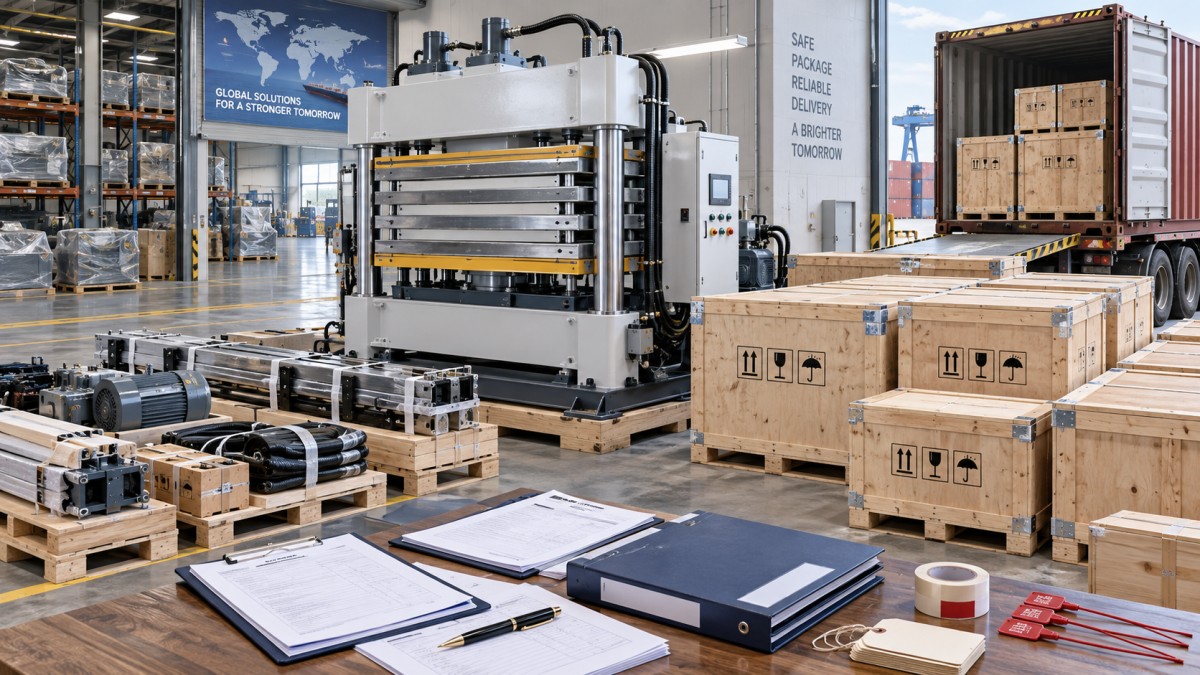
The packing list must support the invoice, not merely repeat it. It tells the carrier, warehouse, customs officer, and receiving team how the shipment is physically arranged. For crated machinery, it should show package numbers, package type, gross and net weight, dimensions, and contents. This becomes especially important when a press machine is shipped in multiple pieces: press frame, heating platens, electrical cabinet, hydraulic station, rollers, conveying equipment, and accessory boxes may all travel as separate packages.
A bill of lading for ocean freight, or an air waybill for air freight, links the cargo to the transport contract. Buyers should check that the consignee, notify party, port names, package count, and cargo description do not conflict with the invoice and packing list. A misspelled consignee name or an incorrect destination can be more disruptive than a minor formatting problem. Where original bills of lading are used, the document release process should also be agreed early; a shipment can arrive while the buyer is still waiting for endorsed originals.
Origin, tariff classification, and value need to tell the same story
A certificate of origin may be required by the buyer, bank, customs authority, or a preferential trade arrangement. Requirements vary by destination, so it should not be treated as an automatic document for every shipment. When it is needed, its product description, exporter information, consignee details, and country of origin should align with the commercial invoice.
Tariff classification deserves similar attention. Woodworking machines may fall within machinery tariff headings, but the correct classification depends on the function and configuration of the machine. A supplier can provide a suggested HS code based on its export experience, yet the importer or appointed customs broker normally remains responsible for confirming the code used at import. This distinction is important: the same equipment may face different national tariff subdivisions, duty treatment, or documentary requirements after arrival.
Declared customs value must also be defensible. It should reflect the commercial arrangement and be consistent with the invoice, purchase order, payment terms, and applicable Incoterm. Attempts to simplify a shipment by combining machine value, freight, installation, tooling, or spare parts without clear line-item logic can create questions later. A clear invoice does not eliminate customs review, but it makes review easier to resolve.
Machine-specific records are not just technical attachments
Many delays occur after a shipment has passed the basic document check and customs asks for supporting information. For woodworking equipment, useful records may include a signed sales contract or purchase order, technical specification sheet, machine layout, operating manual, electrical information, serial-number list, and spare-parts list. The exact package should be agreed with the destination broker before dispatch, particularly when local market-access or electrical compliance rules apply.
Serial numbers deserve careful handling. If a machine has a nameplate and the export documents list a serial number, the number should match the machine and any accompanying technical record. For multi-unit projects, a serial-number schedule can prevent confusion between the main machine, optional modules, and separately packed control systems.
Machinery containing hydraulic oil, lubricants, batteries, or chemical products may require extra attention. Safety data sheets are not a standard substitute for customs documents, but they can be relevant when a carrier, forwarder, or authority asks about materials in the shipment. Wooden packaging presents another common issue. Crates, skids, and pallets may need to meet the importing country’s phytosanitary requirements. The supplier should confirm packaging treatment and marking requirements with the forwarder and buyer rather than assuming all timber packaging is accepted in every market.
Complex presses need a component-level shipping plan
A large hot press illustrates why generic paperwork is risky. Consider a system designed for double-sided veneer production with upper and lower hot pressing plates measuring 1400 × 2600 mm, adjustable infeed and outfeed speed, PLC and touch-screen control, and heating platens operating at up to 250°C. It may be ordered with board feeding, vacuum loading, alignment, and stacking equipment. Customs does not need every engineering detail on the invoice, but the description must make clear whether these are integrated machine elements, separately invoiced automation modules, or spare parts.
For a configuration such as the Short Cycle Melamine Paper Lamination Hot Press Machine for MDF, Particle Board & Plywood, the shipping file should identify the principal press unit and list the major separate packages in a way that corresponds to the packing list. A 2000-ton press frame, hydraulic system, heating plates, electrical cabinet, and automated material-handling equipment cannot be treated as anonymous crates if the buyer must coordinate unloading, installation, or inland transport.
This is also where accurate weights and dimensions affect more than customs. The buyer’s freight forwarder needs them for container planning, port handling, route assessment, and delivery to site. If the final location has limited unloading capacity, the package schedule becomes an operational document for the project team.
Where document sets commonly break down
The most familiar problem is inconsistency. The invoice says ten packages, the bill of lading says nine, and the packing list contains eleven. Another frequent issue is a machine description that is too general for the declared HS code. A third is mixing free-of-charge commissioning spares with production spare parts without stating their value treatment clearly. None of these necessarily means the shipment is non-compliant, but each one invites additional questions at the least convenient time.
Procurement teams can reduce these risks by requesting draft documents before cargo is loaded. The buyer, supplier, and customs broker should review the same working set rather than reviewing separate versions in parallel. It is wise to confirm:
- the exact legal names and addresses of shipper, consignee, and notify party;
- the machine description, model, quantity, and serial numbers where available;
- whether optional equipment, tools, and spares appear as separate line items;
- gross weight, net weight, dimensions, and number of packages;
- the agreed Incoterm, named place or port, and freight-document release method;
- whether origin evidence, compliance materials, import permits, or packaging declarations are required locally.
Build documentation into supplier coordination, not the final dispatch step
Reliable woodworking machine shipping documents begin during order confirmation. At that stage, the buyer should provide destination requirements, preferred consignee wording, broker contacts, requested document originals or electronic copies, and any known market-access requirements. Waiting until the machine is already packed leaves little room to correct an invoice, revise a bill of lading instruction, or obtain a document that requires third-party issuance.
This approach is particularly useful when a purchase includes technical support after arrival. Qingdao Zhongding Machinery Co., Ltd., a manufacturer and exporter with more than 20 years in woodworking machinery, works with customers across furniture production, workshops, and industrial lines where the delivery file must support installation as well as import clearance. Manuals, electrical information, packing details, and spare-parts identification are more useful when prepared as part of one coordinated handover package.
The practical objective is not to create the largest possible stack of paperwork. It is to create a document set that answers predictable questions without contradiction: what the machine is, what was shipped, where it was made, what it is worth, how it is packed, and who is authorized to receive it. Before shipment, ask the customs broker to validate the draft set against the destination’s current requirements. That small review often prevents the expensive uncertainty of solving documentation issues after the cargo reaches the port.
Send Your Inquiry
We welcome your cooperation and we will develop with you.