


News & Exhibitions
Latest Factory Updates, Industry Trends & Global Exhibition Information
How export logistics protect woodworking machines in overseas transit
A woodworking machine can leave the factory in correct operating condition and still arrive overseas with corrosion, misalignment, damaged electrical components, or missing accessories. The failure often begins long before the vessel departs: a cabinet is not fully immobilized, a machined surface is left exposed to humid air, or a container is loaded without enough restraint for braking, rolling, and ship motion.
Effective woodworking machinery export logistics protects equipment by treating transit as a controlled preservation process rather than a shipping task. The essential direction is straightforward: document the machine’s condition before packing, protect vulnerable surfaces against moisture and impact, design the package around the machine’s real weight distribution, secure it to prevent movement, and preserve evidence through each handoff. For high-value CNC equipment, these controls are as important as the final factory inspection.
Damage in transit is rarely caused by one visible mistake
When a machine is unloaded and a panel is dented or a spindle cannot be started, the visible defect may be only the last part of a longer chain. Condensation inside a container can develop during temperature changes between inland transport, port storage, and sea transit. Repeated vibration can loosen fasteners that were not protected or supported. A machine may remain upright but still experience enough lateral movement to strain cable routes, guards, precision assemblies, or cabinet doors.
This is why export preparation should begin with a transit-risk review. The review should consider the equipment’s dimensions, center of gravity, exposed machined parts, electrical enclosure layout, removable components, lifting points, and destination route. It should also distinguish between risks that packaging can absorb and risks that must be prevented by loading practice. A crate cannot compensate for an unstable machine base, and desiccant cannot solve water entering through poorly sealed wrapping.
For safety and inspection personnel, the key question is not simply whether the machine has been packed. It is whether the packing method prevents foreseeable damage during handling, stacking pressure, vibration, humidity exposure, and container movement.
Start with a pre-shipment condition baseline
A reliable logistics process creates a condition record before any protective material covers the machine. This gives receiving teams a practical reference and prevents later disputes about whether an issue existed before loading. The record should be completed after final assembly and functional checks, but before the machine is moved to the packing area.
Useful records include overall photographs from several angles, close photographs of control panels, electrical cabinets, spindles, worktables, guides, external motors, and any areas with finished or machined surfaces. Photograph the machine identification plate, accessory boxes, loose parts, and the condition of doors, guards, and covers. Where the equipment has moving assemblies, record their locked or transport positions.
- Confirm that power is isolated and no loose cable, hose, tool, or fixture remains inside the work area.
- Check that lubricants, hydraulic fluids, and other service fluids are at the intended shipment level and that fill points are properly sealed.
- Verify that removable guards, handles, extension tables, and accessories are either fixed securely or packed separately with clear identification.
- Inspect painted surfaces and exposed metal for scratches, chips, moisture, or rust before wrapping.
- Record the gross machine weight, package dimensions, lifting locations, and orientation requirements on the packing plan.
Condition documentation should be linked to the packing list and shipping marks. A receiving inspection becomes much faster when the machine serial information, package number, accessory list, and photographic record can be matched without guesswork.
Moisture control must protect both the machine and its enclosure
Sea freight presents a particular risk because equipment can encounter large temperature swings while enclosed for long periods. Warm humid air trapped in a package or container can condense when the surrounding temperature falls. Moisture may collect on steel surfaces, inside electrical cabinets, around connectors, and beneath protective covers. The risk is higher when a machine is packed soon after cleaning, when timber packaging is wet, or when wrapping has gaps that allow humid air to circulate.
The first control is to ensure that the machine is dry before preservation begins. Cleaning residues, water from testing, and moisture in recessed areas should be removed. Exposed unpainted metal surfaces such as guideways, shafts, precision adjustment areas, or tooling interfaces may need a suitable temporary corrosion-prevention treatment compatible with commissioning requirements. The treatment should not be selected only for appearance; it must remain effective for the expected transport and storage period and be removable without harming the machine.
A sealed barrier layer is then used to isolate the machine from surrounding air. Desiccant placed inside the barrier helps reduce residual moisture, but it only works properly when the barrier is sealed and the desiccant amount is appropriate for package volume, material permeability, expected transit duration, and climate exposure. Moisture indicator cards can provide a simple visual check at unpacking, especially for electrically controlled machines.
Wood packaging needs attention as well. Timber that has absorbed moisture can release it after the crate is closed. Pallets, blocking members, and crate panels should therefore be dry and structurally sound. Any destination-specific requirements for wood packaging should be confirmed before shipment, rather than discovered after the cargo reaches an inspection point.
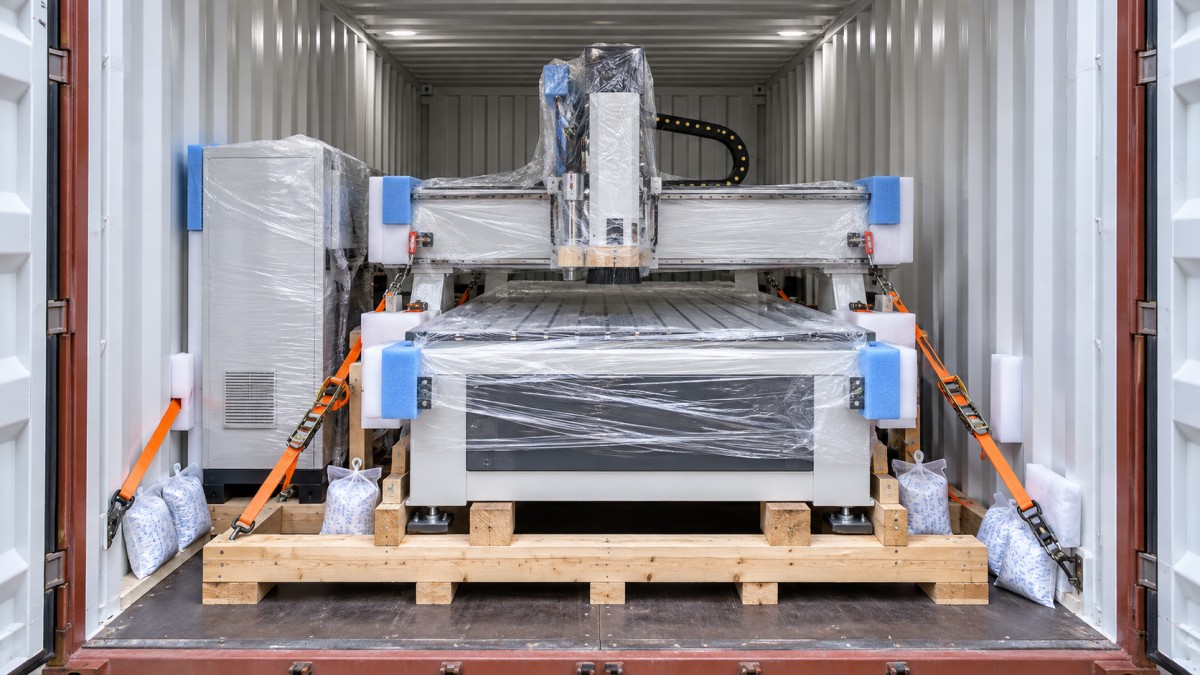
Immobilize moving assemblies before they become impact points
Woodworking machines contain components designed to move accurately under controlled power, not to withstand uncontrolled shocks during road and sea transport. Gantries, drilling heads, sliding tables, movable fences, pneumatic cylinders, and cabinet doors can all become damage points when left free to shift.
Transport locking should be designed around the machine’s structure. A restraint must support the component without applying damaging force to bearings, guide rails, drive systems, or precision faces. Temporary blocks, brackets, bolts, straps, and cushioning materials should be visibly identifiable so that the receiving team knows what must be removed before commissioning. Where a moving part is held by a transport bolt, a warning label near the relevant control or assembly can prevent accidental operation before the restraint is removed.
Consider a door-processing machine with multiple motors, drilling functions, and CNC-controlled axes. The CNC Door Lock and hinge milling machine model ZD1226 has a 3700 × 1700 × 1600 mm overall size and a machine weight of 1000 kg. Its maximum working length reaches 2800 mm, while the machine combines side-slot, drilling, and upper-slot functions. Such equipment should not be treated as a single rigid block merely because the main frame is substantial. The packing plan must account for the mounted working units, the control system, cable routing, and any parts that can move along their intended machining paths.
Locking arrangements should be checked after the machine is placed on its shipping base, not only before. A restraint that fits in the assembly area may be affected by pallet geometry, crate clearance, or changes in the machine’s support points.
The shipping base carries more responsibility than the outer crate
The base is where machine weight, lifting forces, and cargo restraint loads are transferred. A visually strong wooden case can still fail if the equipment is not supported at approved points or if the pallet is too flexible. The base should hold the machine level enough to avoid concentrated stress on the frame and should allow forklifts or lifting equipment to engage safely without contacting sensitive components.
Before final closure, inspect whether the machine is anchored to the base using the specified mounting points or an approved alternative. Fasteners should be sized for the machine’s mass and anticipated transport loads, with measures to resist loosening. The machine must not be secured by attaching straps around delicate covers, electrical cabinets, motor housings, handwheels, or exposed shafts.
Weight distribution matters during container loading. A heavy machine placed off-center can make handling less stable and complicate load restraint. It can also create avoidable stress on the package floor. Where several packages share a container, the loading sequence should be planned so that the heaviest and least compressible cargo is positioned appropriately, while accessory cartons are protected from crushing and cannot shift into the machine.
Outer protection should match the route
Crating is not identical for every shipment. A fully enclosed crate can offer impact protection and controlled access, but it must have enough structural strength for lifting and the expected handling method. A shrink-wrapped machine on a reinforced base may be suitable in controlled circumstances, yet it provides less protection against puncture, compression, and weather exposure. Open-frame packaging can make inspection easier, but it requires stronger protection around exposed controls and is less forgiving of rough terminal handling.
The appropriate choice depends on the route, cargo type, handling points, consolidation arrangements, expected storage time, and whether the machine will move as a full-container load or through multiple transfers. The decision should be recorded rather than made informally because package design affects insurance evidence, loading instructions, and destination unloading procedures.
Container loading is a separate quality gate
A machine can be packaged correctly and still be put at risk inside the container. The container should be inspected before loading for holes, damaged flooring, roof leakage, standing water, sharp projections, strong odors, or residues that could affect the cargo. Door seals and locking hardware should function correctly. The floor must be capable of supporting the actual cargo configuration, not merely the individual package weight.
During loading, maintain required clearances, avoid contact between packages, and use blocking and bracing that prevents forward, rearward, and sideways movement. Cargo lashings should be rated and arranged according to the package weight and restraint points. They should not pass over areas likely to deform under tension. Corner protectors may be needed where straps contact crate edges, while timber blocking must be fixed so it cannot migrate under vibration.
Photographs taken after final lashing are valuable because they show the condition of the cargo immediately before doors are closed. The record should capture package labels, restraint layout, desiccant or container moisture-control materials where used, door-side protection, and the container number. If a shock or tilt indicator is applied, its initial state should be visible in the record.
Documentation protects the machine after the physical journey begins
Shipping documents do not prevent mechanical damage, but they prevent avoidable delays and make condition control traceable. The commercial invoice, packing list, package dimensions, gross and net weights, machine identification, and shipment marks should agree with one another. Inconsistent descriptions can cause clearance questions, storage delays, or difficulty locating specific accessory packages.
Instructions for lifting, orientation, center of gravity, and unpacking should be legible on the relevant package rather than stored only in a separate document. For complex equipment, an unpacking note can explain the order for removing outer protection, moisture barriers, transport locks, and accessory cartons. It should also state that the machine should be inspected for shipping damage before installation and energization.
At destination, inspection should occur before signing off on delivery where practical. Examine the container or package exterior for impact marks, water staining, broken crate members, shifted blocking, and activated indicators. Photograph anything unusual before unpacking. Once the barrier is opened, inspect exposed metal, electrical enclosures, cable connectors, moving units, and loose accessories against the pre-shipment record.
Where logistics controls often break down
One frequent error is assuming that the supplier’s final machine test is enough. Functional testing verifies manufacturing condition at that moment; it does not prove that the machine was preserved for a humid voyage or restrained for multimodal handling. Another error is relying on foam or wrapping to compensate for an unsecured machine. Soft materials may reduce surface abrasion, but they cannot safely control the inertia of a heavy CNC assembly.
Weak handoffs also create gaps. The packing team may know which axis is locked, while the loading crew may not know which points can accept lashing. The receiving crew may see a crate but not know that moisture indicators or transport bolts are inside. A short, package-specific handover record is more useful than a generic statement that the cargo was “securely packed.”
The strongest export logistics process connects factory inspection, preservation, packaging, container loading, shipping documents, and destination receiving into one traceable chain. When each stage has clear acceptance points, overseas transit becomes less dependent on assumptions and less likely to turn a sound woodworking machine into a commissioning problem.
Send Your Inquiry
We welcome your cooperation and we will develop with you.