


News & Exhibitions
Latest Factory Updates, Industry Trends & Global Exhibition Information
When does container loading service reduce damage to woodworking machines?
A container loading service reduces damage to woodworking machines when it changes the forces and conditions that the machine will experience during handling and ocean transit. Its value is highest when the equipment is heavy, long, precision-aligned, moisture-sensitive, or shipped with detached assemblies that can move independently. Simply placing a crated machine in a container is not enough. Damage is reduced only when the loading method matches the machine's weight distribution, lifting points, packaging strength, route conditions, and unloading arrangement at destination.
Woodworking equipment often contains a difficult combination of rigid frames and vulnerable precision parts. A welded base may tolerate substantial load, while a guide rail, spindle, pneumatic fitting, electrical enclosure, glue system, roller, or sensor bracket may not. Transit damage is therefore frequently caused by relative movement: the machine shifts against the container floor, an unsecured accessory strikes the main frame, or a heavy component transfers force through packaging that was intended only for dust protection.
When loading control makes the greatest difference
The strongest case for a professional woodworking machine container loading service is a shipment that cannot remain stable through normal container movement by its own mass and footprint. Container vessels, trucks, rail transfers, terminal lifts, and uneven roads create repeated acceleration in several directions. A machine that appears secure while the container is stationary can still creep, rack, or rebound after many hours of vibration.
Long machines deserve particular attention because their support points are far apart. If the middle section is inadequately supported, floor deflection or uneven blocking can impose twist on the bed. This matters for equipment with linear guides, synchronized feed sections, or aligned rollers. A machine does not need to visibly fall over to lose accuracy; a small displacement at a mounting point can create installation work that is wrongly attributed to factory adjustment.
Loading control is also more valuable when the shipment contains machines of different heights or densities. A dense, low machine may be safe near the container front, while a lighter cabinet or accessory crate becomes vulnerable if loaded above it or beside an unrestrained void. Empty space is not harmless. It gives cargo room to build momentum before contacting another item.
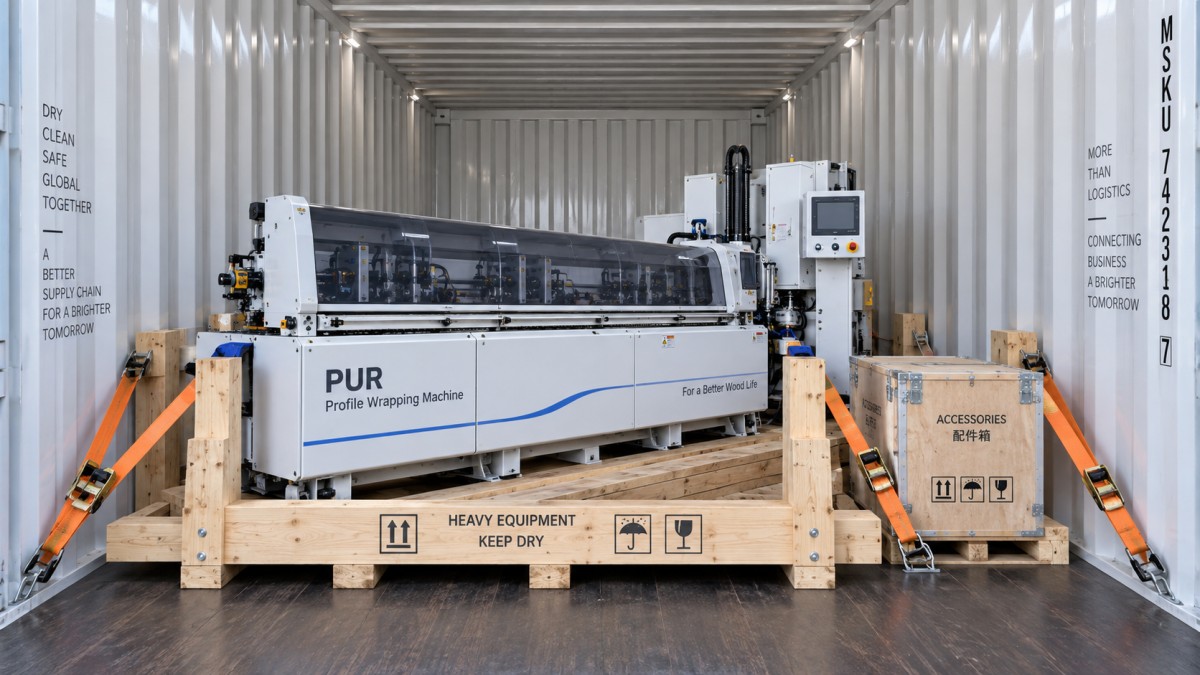
For a 2,500 kg wrapping machine with an overall dimension of 6000 x 850 x 2000 mm, such as the PUR WRAPING Machine 300, the length and narrow width make longitudinal restraint and evenly distributed support especially important. The machine should be treated as a long industrial assembly, not as a single compact crate. The maximum lamination width or production speed does not determine its shipping risk; its center of gravity, base geometry, and protected component locations do.
Movement patterns that packaging alone cannot solve
Protective wrapping, corner boards, and a plywood case can prevent scratches and minor impact, but they do not automatically restrain cargo. A common error is to assume that a strong-looking crate provides complete transport protection. If the crate is not blocked and tied down to the container structure or floor, it can still slide. Once it moves, the crate may concentrate force at one corner, damage its own base, or strike container corrugations.
Longitudinal movement is often the primary concern because braking, acceleration, and vessel motion act along the container length. Blocking at the front and rear should contact structural areas of the skid or base, rather than press against sheet-metal covers, cable trays, or machine feet that are not designed for lateral loads. Timber blocks must be strong enough for the expected force and fixed so they cannot rotate or split under compression.
Side-to-side movement is different. It is commonly controlled with lashing, bracing, or tightly planned cargo arrangement, but the restraint must not pull the machine into distortion. Lashing over a machine cover, control cabinet, or roller assembly can create damage before the container leaves the loading site. Attachment points should be structural lifting eyes, designated securing points, or a properly designed transport base. If those points are absent, the restraint strategy should act on the skid or crate rather than improvised points on the machine.
Vertical shock is less obvious. Containers experience jolts during terminal handling and road transport, and a machine can bounce slightly if it is perched on uneven blocks or loosely restrained. Loose bolts, cracked castings, displaced leveling feet, and damaged instrument mounts can result. Firm bearing across the intended support locations is more effective than a large number of small wedges placed wherever space is available.
Weight distribution must be established before the container is selected
Container loading reduces damage only when the selected container and load plan suit the actual cargo. Gross machine weight is an incomplete input. The loading team also needs the packed dimensions, skid dimensions, center-of-gravity location, lifting instructions, base contact points, and the weights of separate crates. A machine with a control cabinet at one end or a motorized feeding section may have a noticeably offset center of gravity even when its overall dimensions look symmetrical.
Floor loading capacity should be considered in relation to concentrated contact area. A heavy machine carried on narrow steel feet creates a different condition from the same weight spread across a full timber skid. When a base is narrow, a load-spreading timber arrangement may be needed to avoid indentation, instability, or local failure of packaging. The support arrangement must remain compatible with forklift access and destination unloading; removing transport supports too early can leave the equipment unstable at the receiving site.
The container's internal height is also a practical constraint. Clearance above a tall crate must allow safe placement without scraping the roof structure or forcing the machine to be tilted beyond its approved handling position. Loading a tall item under minimal clearance can damage top-mounted electrical boxes, exhaust ducts, pneumatic regulators, or protective covers. A loading plan should distinguish between an item that fits geometrically and one that can be safely maneuvered into position.
Dense cargo and mixed loads
Mixed loads require more discipline than a full container of identical crated machines. Heavy equipment should generally occupy positions that limit its ability to transfer force into lighter cargo. Small accessory cartons, spare rollers, glue units, and toolboxes need their own retention method; placing them in an open gap beside the main machine invites impact damage. Their packaging may survive, while the machine's painted surface, connectors, or guards do not.
Stacking should be avoided unless both the lower package and the upper package were designed for it. A crate lid is not evidence that it can accept a concentrated load. When stacking is permitted, load-bearing positions, allowable weight, fork entry direction, and stack height need to be confirmed from the packaging design rather than inferred from available container volume.
Moisture protection works only with a closed transport system
Woodworking machines contain bare metal surfaces, electrical terminals, bearings, pneumatic components, and sometimes adhesive-related equipment that can be affected by humidity or condensation. Moisture protection is effective when the barrier, desiccant arrangement, and container condition work together. A sealed bag with desiccant is undermined by torn film, unsealed openings around cables, or sharp edges that puncture the barrier during loading.
Container sweat is often mistaken for rain exposure because water appears on upper surfaces or packaging after arrival. The source can instead be condensation caused by temperature changes during transit. This distinction matters because replacing outer wrap alone may not address the cause. A moisture-control plan should include dry packing materials, intact vapor barriers where required, desiccant sized for the enclosed volume and expected transit duration, and an inspection of the container interior for visible dampness, odor, holes, or damaged door seals.
Moisture protection must not trap parts in a way that creates another problem. For example, a wrapped machine with loose components inside may experience abrasion when vibration causes the components to rub against finished surfaces. Internal accessories should be immobilized before the outer barrier is closed. Desiccant should not rest directly against painted panels, electrical items, or surfaces where concentrated contact may leave marks.
Where loading plans fail despite good intentions
Many failures begin with incomplete handover information. The packing crew may know the dimensions but not the machine's prohibited lifting areas. The freight team may know the container type but not whether the destination has a forklift long enough for a six-meter skid. The result is a plan that works for loading but creates unsafe unloading, repacking, or unplanned lifting at arrival.
Another frequent weakness is treating lashing as a substitute for blocking. Lashings control movement by tension, while blocking resists movement through direct contact. A heavy machine on a smooth floor can settle and reduce lashing tension over time. Conversely, blocking without adequate restraint may not prevent lateral movement. The appropriate combination depends on cargo mass, base design, container space, and the route's handling exposure.
Over-tightened lashings can also be harmful. Excessive force can crush crate edges, deform a skid, pull a machine against a block, or load sensitive assemblies through the packaging. Tension should be sufficient to retain the load within the designed restraint system, not applied as a general attempt to eliminate every visible gap. Gaps should normally be addressed by correctly placed blocking, bracing, or dunnage rather than by increasing strap force indefinitely.
Dunnage itself needs scrutiny. Soft timber, broken boards, oily surfaces, wet wood, or loose wedges can lose effectiveness during transit. Materials used for separation should resist compression and remain positioned under vibration. Contact surfaces should be clean enough that the machine or crate cannot slide over contamination. Any material placed near a finished machine surface needs to avoid abrasion and moisture transfer.
Loading sequence affects machine condition at destination
The safest load arrangement is not always the easiest sequence for the loading dock. A machine placed first may block access to the points needed to restrain it. A rear item may be impossible to inspect once adjacent cargo has been packed. The sequence should allow the crew to verify each machine's final support, blocking, and lashing before access disappears.
Before the doors are closed, the load should be visually examined as a complete system. The machine base should have full support at intended points; blocks should meet the skid or structural frame without pressing on guards; straps should have no sharp-edge exposure; detached items should be restrained independently; and no package should be able to contact door hardware. Photographs taken at this stage establish the cargo condition and show whether all restraints were installed as planned.
Door-end clearance deserves particular care. Cargo that shifts toward the doors can create a hazard during opening and may damage door panels or locking gear. A load plan should account for door-end restraint, not merely leave a narrow visual gap. The goal is controlled separation, supported by suitable blocking and restraint, rather than unused space that allows cargo to move.
Transit protection continues after the container is opened
A properly loaded container can still suffer avoidable damage during unloading if the receiving sequence is unknown. The first action should be an exterior and interior condition review before cargo is moved. Broken blocks, slack lashings, collapsed packaging, moisture marks, or shifted accessories should be documented before restraints are released. Releasing a door-end restraint without understanding the load condition can expose nearby personnel to cargo movement.
After unloading, precision-related checks should focus on shipping-sensitive areas: loose fasteners, damaged covers, bent brackets, disturbed cable connectors, cracked pneumatic fittings, corrosion signs, and visible changes around guide systems or roller assemblies. Installation alignment should not begin until shipping braces and transport locks have been removed according to the machine instructions. Leaving a transport lock in place can be mistaken for a mechanical fault, while removing one before the machine is adequately supported can cause genuine damage.
Container loading service reduces damage when it is planned as part of machine preservation rather than treated as a final warehouse activity. The practical test is simple: every item must remain supported, restrained, protected from its neighbors, and recoverable at destination without improvising a new handling method. When those conditions are designed into the load, the container becomes a controlled transport environment instead of an oversized box.
Send Your Inquiry
We welcome your cooperation and we will develop with you.