


News & Exhibitions
Latest Factory Updates, Industry Trends & Global Exhibition Information
CNC Drilling Machines for Furniture: How Spindle Layout Affects Cycle Time
CNC Drilling Machines for Furniture: How Spindle Layout Affects Cycle Time
For technical evaluators, spindle layout is one of the most consequential details in a cnc drilling machine for furniture production. It affects far more than the number of holes completed per minute. The arrangement, orientation, pitch, and controllability of the spindles determine whether a panel can be machined in one clamping, how often the workpiece must be repositioned, how much travel the machine axis requires, and how reliably the drilling pattern matches the downstream assembly process.
This matters especially in cabinet, wardrobe, kitchen, office furniture, and ready-to-assemble panel production, where a single board may require shelf-pin holes, cam-lock bores, dowel holes, hinge cups, connector holes, and edge drilling. A machine can have a high spindle count and still produce disappointing real-world throughput if its spindle pattern does not match the factory’s dominant hole patterns. Conversely, a more flexible configuration can justify a longer nominal drilling time when it eliminates handling steps, manual setup, or secondary machining.
The practical question is not simply, “How many spindles are installed?” It is: “How much panel processing can this spindle layout complete accurately before the panel leaves the machine?”
Cycle Time Is a Process Measure, Not Just a Drilling-Speed Figure
In furniture drilling, the visible cutting time is only one part of the cycle. A realistic assessment should include panel loading, referencing, clamping, machine-axis movement, drill descent and retract, tool or head changes where applicable, unloading, and any additional handling required to machine another face or edge. On an automated line, transfer and queue time may also matter. On a stand-alone machine, the operator’s ability to orient panels consistently can have a larger effect than a modest difference in spindle motor speed.
Spindle layout influences several of these elements at once. A fixed multi-spindle boring head can drill a repeated row in a single plunge. An individually controlled drilling head may use fewer simultaneous spindles but avoid manual indexing when hole locations vary. Horizontal units can complete edge operations without sending the part to a second machine. Therefore, a layout that looks slower in a brochure may produce a shorter end-to-end cycle for a mixed furniture program.
For evaluation purposes, it helps to separate machine time per panel from production time per completed panel. The latter is usually the more useful figure when comparing equipment options.
What Spindle Orientation Changes on a Furniture Panel
Most furniture drilling configurations combine vertical and horizontal drilling functions. Vertical spindles work on the face of the panel and are commonly used for construction holes, shelf supports, connector systems, and hinge-related operations. Horizontal spindles drill into panel edges, supporting dowels, cam fittings, minifix-style connectors, and other joining requirements. Whether those functions are available in the same clamping sequence is often the dividing line between a straightforward process and a handling-heavy one.
A vertical-only machine can be productive for panels dominated by face drilling, particularly when edge holes are completed elsewhere or are not required. But in carcass furniture production, edge drilling is rarely an afterthought. If every side panel must be removed, turned, re-referenced, and processed on a separate station, the apparent savings from a simple spindle arrangement can disappear in labor, floor movement, and avoidable positioning risk.
A combined vertical-and-horizontal layout can reduce these interruptions, provided the workpiece support and clamping system hold the panel securely during all required operations. The gain is not merely fewer touches. It is also better positional consistency between face holes and mating edge holes, because they are referenced within the same machine coordinate system.
Fixed Boring Blocks: Fast When the Pattern Repeats
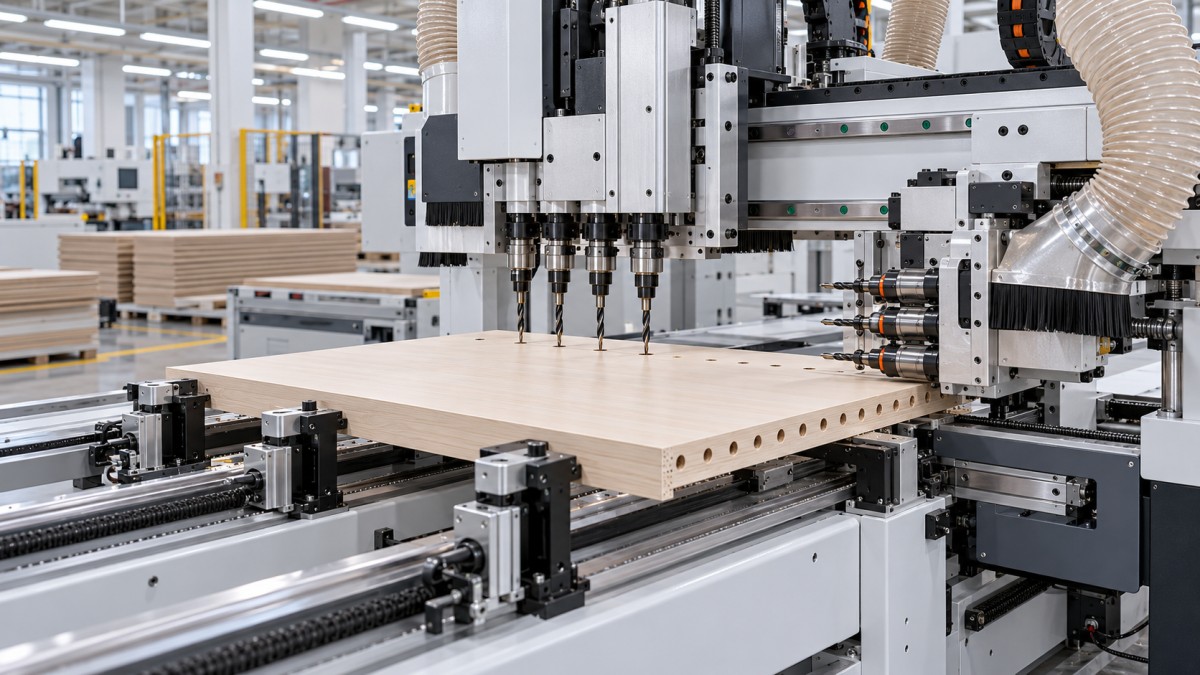
Fixed-spindle boring blocks remain highly relevant in furniture manufacturing because many designs are built around repeating hole intervals. Shelf support rows, system-hole patterns, and standard cabinet connections can be drilled efficiently when spindle spacing corresponds to the product design. Multiple drills descend together, so the head can complete a line of holes in one motion rather than positioning for each individual hole.
This layout is particularly effective when panel dimensions and construction methods are stable. It reduces axis travel, simplifies programming, and can make cycle time more predictable across a large production batch. In conventional cabinet production, that predictability is often as valuable as peak speed because it supports balanced downstream cutting, edging, assembly, and packaging operations.
The limitation is geometric. A fixed pitch does not automatically fit every hole pattern. When hole positions fall between the available spindles, the controller may need to move the panel or drilling unit to create the required pattern. If the product mix includes non-standard connector positions, asymmetric hardware, or frequent engineering changes, the machine can spend more time repositioning than expected. Operators may also face more setup work if drills must be changed or selectively activated for different panel programs.
The issue is not that fixed blocks lack precision. Properly maintained, they can provide dependable repetitive drilling. The issue is whether the fixed geometry mirrors the furniture factory’s recurring geometry.
Independently Controlled Spindles and Flexible Drilling Heads
More flexible CNC drilling heads are designed for plants where hole patterns vary by order, material, market, or hardware specification. Depending on the design, drilling units may be independently selectable or arranged so that the machine can combine drilling directions without relying on one fixed row pattern. This is useful for custom cabinetry, contract furniture, small-batch production, and factories processing frequent design revisions.
The main cycle-time advantage is not necessarily simultaneous drilling at every location. It is reduced non-cutting time: fewer fixture changes, fewer manual decisions, fewer panel returns, and less need to prepare a dedicated setup for each furniture family. A flexible head can be a better fit when the production schedule has many short runs and the cost of changeover exceeds the saving offered by a faster fixed pattern.
There is a trade-off. Greater flexibility places more importance on control software, program verification, axis dynamics, and operator discipline. It also requires clear confirmation of drill diameter ranges, available tool positions, minimum spacing between operations, and whether all specified vertical and horizontal holes can be processed without interference. A flexible layout should not be treated as universally faster; it is faster when variation is the source of lost time.
How Common Layouts Compare in Practice
Spacing, Interference, and the Hidden Cost of Repositioning
Spindle spacing deserves the same attention as spindle count. Closely spaced drilling positions may be essential for certain fittings, but a head layout must also provide physical clearance for drill bodies, collets, adjacent tools, clamps, and panel supports. The machine supplier should review the actual hole map rather than only a list of required drill diameters. Two programs with the same number of holes can behave very differently if one contains tightly grouped operations near an edge or close to a clamp zone.
Repositioning is often underestimated during machine selection. A few extra axis moves may appear insignificant in an isolated program, but their effect accumulates over a shift. More importantly, each movement can introduce a dependency on accurate panel reference and stable holding. Thin components, narrow rails, warped boards, and panels with delicate laminated surfaces all deserve attention during trials. The fastest programmed sequence is of limited value if the operator must slow the machine to avoid marking, vibration, or misalignment.
For through-holes and holes near a panel edge, support design and backer material management also influence quality and uptime. Chip breakout, drill wear, and poor extraction can force cleaning or rework that does not appear in a theoretical cycle calculation.
Use Representative Panels for Acceptance Testing
A sound technical comparison should be based on representative production files, not a generic drilling demonstration. Select several panel types: a high-volume standard side panel, a door or drawer component, a panel with dense hardware drilling, and one difficult low-volume or customized part. Include the actual board materials, thickness range, edge-banded condition where relevant, and the hardware drilling patterns used in production.
During evaluation, record the full sequence from loading to completed unloading. Check hole position, depth consistency, edge breakout, repeatability after several cycles, and the need for manual intervention. Also ask how the machine handles rejected or incorrectly oriented panels, drill replacement, program revision, and routine cleaning. These operational details are where cycle-time estimates become realistic.
Safety requirements should be reviewed as part of the same exercise. Woodworking machinery safety obligations vary by destination market and installation context. Relevant machine safety standards, electrical requirements, guarding, emergency-stop arrangements, dust extraction interfaces, documentation, and local conformity requirements should be confirmed against the specific project rather than assumed from a general machine category.
Selecting for the Production Mix, Not the Largest Specification
A high spindle count is valuable only when those spindles are working on the hole patterns that recur most often. For standardized flat-pack furniture, a fixed multi-spindle configuration with suitable vertical and horizontal capability may provide a disciplined, efficient process. For customized kitchens, project furniture, or short-run workshop production, flexibility and reduced setup may be more important than maximum simultaneous drilling.
Qingdao Zhongding Machinery Co., Ltd. has spent more than two decades working in woodworking machinery, from its early workshop origins to supplying machines and broader woodworking solutions for furniture factories, workshops, and industrial production lines. That experience points to a practical principle: the machine should be reviewed alongside panel flow, software data, hardware standards, maintenance access, spare-parts planning, and the capabilities of the people who will run it. A spindle layout is not an isolated specification; it is part of a production system.
Before finalizing a cnc drilling machine for furniture, provide the supplier with representative part files and ask for a proposed sequence for each panel. Confirm which holes are drilled simultaneously, which require axis repositioning, which edges are accessible in one clamping, and what assumptions are built into the stated cycle. That discussion is usually more revealing than comparing spindle numbers alone, and it creates a clearer basis for machine configuration, technical support, spare-parts preparation, and long-term operating decisions.
Send Your Inquiry
We welcome your cooperation and we will develop with you.