


News & Exhibitions
Latest Factory Updates, Industry Trends & Global Exhibition Information
Wood Machining Machines: Key Technologies Reshaping Small-Batch Production
Small-batch woodworking is no longer defined simply by lower output. It is defined by frequent product changes, mixed material specifications, short delivery windows, and limited tolerance for rework. A workshop producing fifty cabinet components, ten custom doors, and a small run of retail fixtures in the same week faces a production-control problem that a conventional high-volume line was not designed to solve.
The technologies reshaping this segment are not necessarily the largest or most automated systems. Their value lies in reducing the cost of variation: less programming time between orders, fewer manual measurement errors, faster material handling, and more reliable repeatability across changing designs. For companies assessing machines usinage bois, the central question is therefore shifting from “How much can this machine produce?” to “How efficiently can it move from one job to the next without sacrificing accuracy or margin?”
Flexibility has become a production capability, not a convenience
Traditional woodworking equipment remains effective when work is repetitive and component geometry is stable. A dedicated panel saw, edge bander, boring machine, or spindle moulder can offer strong throughput within a narrow task. The limitation appears when order composition changes frequently. Every new panel size, drilling pattern, edge treatment, hinge location, or surface material can introduce setup work, operator interpretation, and the risk of producing the wrong version.
Small-batch production converts these interruptions into a major cost category. Machine idle time is only one part of the issue. The wider cost includes engineering preparation, material waste from first-piece errors, work-in-progress accumulation, delayed assembly, and the management time required to resolve exceptions. A machine with a lower purchase price can be more expensive in practice if every order requires extensive adjustment and checking.
This is why flexible CNC machining, digital job preparation, and linked material-flow systems are receiving closer attention. They do not eliminate the need for skilled operators or sound production planning. They reduce the number of decisions that must be recreated manually at the machine for every order.
Nesting CNC is changing the economics of panel-based production
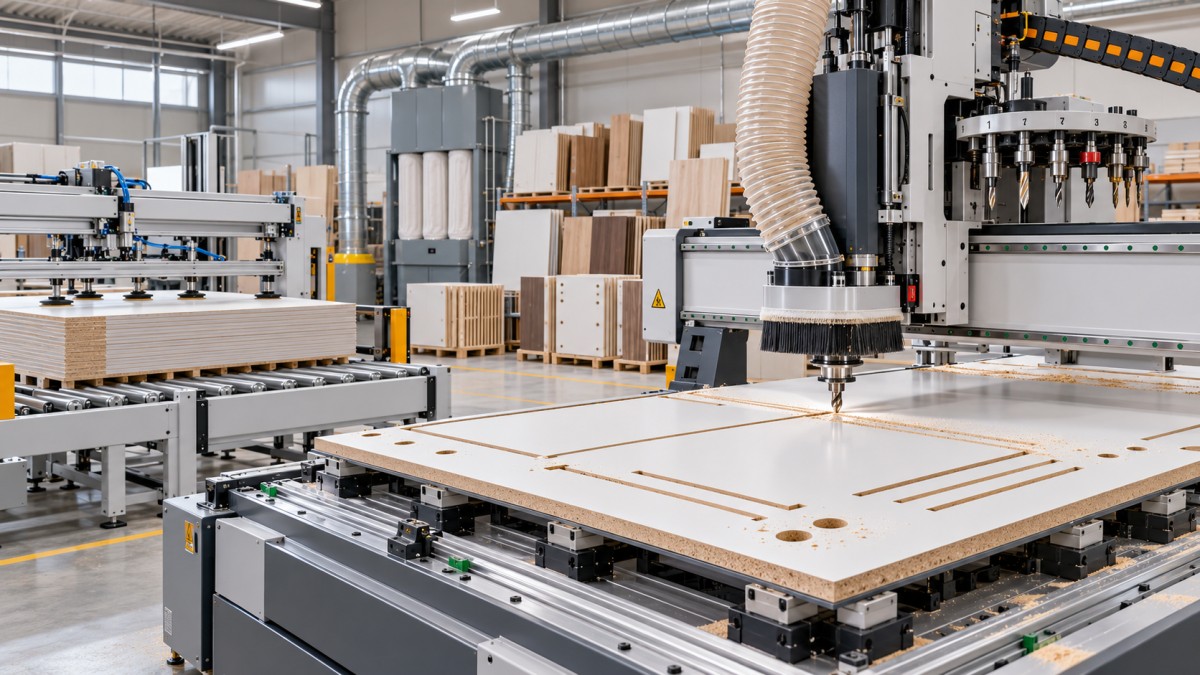
For cabinet, furniture, shopfitting, and interior-fit-out manufacturers, nesting CNC routers have become a significant alternative to processing panels through separate cutting and drilling stages. In a nesting workflow, software arranges multiple parts on a sheet, while the CNC machine cuts contours, drills holes, mills pockets, and can add identification marks in one programmed cycle.
The economic case is strongest where panel designs vary regularly and component quantities are modest. Instead of setting up multiple machines for each batch, a producer can consolidate several operations around a digital cutting file. This can reduce handling between stations and lower the chance that a panel reaches drilling or assembly in the wrong orientation.
However, nesting is not automatically the right answer for every panel operation. Its performance depends heavily on board quality, vacuum hold-down capacity, tool selection, dust extraction, and nesting software logic. Small parts, narrow rails, warped boards, and materials with inconsistent surfaces can challenge vacuum retention. When hold-down is insufficient, part movement affects edge quality and positional accuracy. This is an operational limitation, not merely a machine specification issue.
Cycle time also requires careful interpretation. A nesting router may reduce total process steps while taking longer to complete a particular sheet than a dedicated high-speed cutting and drilling line. The relevant comparison is total order lead time, including setup, transfer, sorting, rework, and assembly readiness—not spindle time alone.
Automatic tool changing matters more when product variation increases
Tool-changing capability is often described as a productivity feature, but its strategic value in small-batch work is broader. A single component may require cutting, pocket milling, hinge boring, groove machining, edge profiling, and engraving. Completing these operations with manual tool changes is feasible for simple jobs, yet it introduces delays and creates opportunities for incorrect tooling, incorrect offsets, or missed operations.
An automatic tool changer supports more stable machining sequences, particularly when jobs are generated from design software rather than programmed independently on the shop floor. The advantage is not that every machine needs a large tool magazine. In many small-batch applications, an appropriately selected set of cutters and drills is more valuable than excessive magazine capacity. The important issue is whether the tooling configuration matches the actual component mix.
Tool management is becoming an increasingly important part of this technology transition. Cutter diameter, wear condition, length compensation, rotational speed, feed rate, and material type all influence machining results. Without disciplined tool data, even a capable CNC system can produce inconsistent dimensions or poor finished edges. Digital tool libraries make repeatability easier to manage, but they do not replace routine inspection and replacement practices.
From machine control to connected production data
The most consequential change is often not visible in the machine itself. It occurs in the connection between design, order management, programming, cutting, machining, and assembly. When dimensions and machining instructions are re-entered at several stages, small changes in a customer order can create multiple opportunities for inconsistency. A revision that is correctly reflected in a drawing but not in a drilling program can lead to expensive downstream failure.
Digital production workflows address this by creating a more continuous information path. Design data can generate cut lists, machining programs, labels, and assembly references. Barcode or QR-code identification can then link physical parts to their job information as they move through the workshop. The technology is not limited to large factories; its relevance is often greater in mixed-order environments where visual recognition and paper-based tracking become unreliable.
The practical benefit is traceability. When a component is damaged, missing, or found to have an incorrect machining feature, the business needs to know whether the source was design data, program generation, material selection, machine setup, or operator handling. A connected workflow does not prevent every error, but it makes the error path more visible and reduces the time spent searching for the cause.
Integration should not be judged by software claims alone. Compatibility between CAD/CAM systems, machine controllers, labeling equipment, and enterprise resource planning tools can vary substantially. Some systems exchange data smoothly only within a single vendor ecosystem; others depend on file exports, post-processors, or custom interfaces. Before investing, companies should test the full route from approved design to finished, labeled component, including engineering changes and remakes.
Precision is increasingly tied to process control, not only machine construction
High rigidity, accurate guides, stable spindles, and reliable positioning systems remain fundamental to machining quality. Yet small-batch production exposes another dimension of precision: process consistency across different jobs, materials, and operators. A machine can hold excellent positional accuracy while the finished part still fails because the board has moved, the wrong reference face was selected, the drill block was not configured correctly, or the program does not account for material thickness variation.
This is particularly relevant in coated boards, plywood, MDF, solid wood, compact laminates, and composite furniture materials. These materials behave differently under cutting and drilling. Chip-out, heat buildup, tool wear, tear-out, and edge quality must be controlled through the combined choice of cutter geometry, feed speed, spindle speed, clamping method, and machining direction.
Solid wood creates an additional challenge because grain direction, moisture condition, and natural movement affect outcomes. Automation can improve repeatability in machining, but it cannot make unstable material behave like a uniform engineered panel. Production planning must still distinguish between operations suitable for automated repeat processing and those requiring more material-sensitive handling.
The trend, therefore, is toward machines equipped with better reference systems, automatic calibration functions, vacuum zoning, sensor-supported setup, and programmable working units. These features can reduce dependence on repeated manual adjustment, but their commercial value depends on whether the workshop has standardized its component and material data.
Edge processing is becoming part of the small-batch bottleneck
Cutting and drilling are often the focus of automation discussions, while edge processing receives less attention until it becomes the limiting operation. In panel furniture, visible-edge quality strongly influences perceived product quality. Short runs can be particularly difficult because they may involve frequent changes in board thickness, edge-band material, adhesive settings, corner treatment, and panel geometry.
Modern edge banders with programmable units, automatic adjustment, and rapid changeover can reduce these interruptions. Return conveyors and coordinated handling systems can also allow one operator to process panels more efficiently. Yet edge banding remains sensitive to material preparation and machine maintenance. Glue temperature, pressure settings, trimming-tool condition, scraping, and cleaning all affect the final result.
For some product categories, a fully configured edge bander may be justified. For others, the better choice may be a more modest machine supported by disciplined job grouping. The determining factor is not whether automation is available, but whether the order mix generates enough repeated edge-processing complexity to make automatic changeover economically meaningful.
Robotics and automated handling are entering selectively
Robotic loading, unloading, stacking, and sorting are often presented as the next stage of woodworking automation. Their role in small-batch production is real but selective. Handling automation can improve safety and stabilize throughput where sheet materials are heavy, production is extended, and machine utilization is high enough to justify a continuous feed system.
Its limitations should be acknowledged. Mixed panel sizes, irregular shapes, changing surface finishes, and highly variable batch sequences make automated handling more difficult than repeat production. The integration of a robot or loading system also changes the layout requirements of the factory: space, safety fencing, material staging, access for maintenance, and recovery procedures after faults all need consideration.
In many smaller operations, the more immediate opportunity lies in semi-automated handling—lift tables, roller systems, return conveyors, vacuum lifters, and guided sorting methods. These interventions can reduce manual strain and lost time without imposing the full complexity of a robotic cell.
Investment decisions are moving from machine price to system economics
Comparing woodworking machines only by purchase price, spindle power, or published feed rates misses the core economics of small-batch production. The relevant cost structure includes engineering time per order, setup duration, labor needed to move and identify parts, scrap exposure, maintenance responsiveness, software licensing, tooling consumption, training, and the availability of spare parts.
A more useful investment review starts with the orders that currently create friction. These may be jobs with high component variation, repeated drilling mistakes, delayed assembly caused by missing parts, excessive offcut waste, or frequent edge-processing changes. The proposed technology should be assessed against those specific loss points rather than against a generic productivity claim.
Capacity should also be evaluated conservatively. A machine that is technically capable of processing many formats may still be constrained by programming, material preparation, unloading, sorting, or assembly. If a new CNC router produces parts faster than the next process can absorb them, the business has shifted the bottleneck rather than removed it.
Supplier capability has a direct bearing on lifecycle risk. Machine documentation, remote diagnostics, controller familiarity, operator training, installation support, electrical compatibility, and spare-parts access can matter as much as the initial specification. For internationally sourced equipment, clear agreement on technical scope, acceptance criteria, safety configuration, software language, and service responsibilities reduces ambiguity after delivery.
The competitive advantage is shorter decision-to-part time
The most important direction in wood machining is not simply greater automation. It is the compression of time between an approved design decision and a correctly machined component ready for assembly. CNC nesting, automatic tool changing, digital job data, programmable edge processing, and selective material handling all contribute to that outcome when they are implemented as parts of a coherent production system.
For small-batch manufacturers, the winning configuration will rarely be the most complex machine cell available. It will be the configuration that fits the actual order profile, material range, workforce capability, and service environment. The continuing evolution of machines usinage bois is making flexible production more technically accessible, but the return still depends on disciplined data, realistic workflow design, and a clear understanding of where variation is currently consuming time and margin.
Send Your Inquiry
We welcome your cooperation and we will develop with you.