


News & Exhibitions
Latest Factory Updates, Industry Trends & Global Exhibition Information
What Safety Standards Should Industrial Woodworking Machinery Meet?
What Safety Standards Should Industrial Woodworking Machinery Meet?
What safety standards should industrial woodworking machinery meet? For furniture factories, workshops, and high-volume production lines, this question reaches far beyond fitting a guard around a blade. Woodworking machines combine high-speed rotating tools, heavy workpieces, pneumatic or hydraulic movement, electrical systems, and combustible dust. A machine may produce excellent panels, doors, or mouldings, yet still create unacceptable risk if its safeguarding, control logic, installation, and operating procedures do not work together.
The practical answer depends on the machine type, destination market, level of automation, and local legal requirements. A sliding table saw, four-side moulder, edge bander, CNC nesting router, wide-belt sander, and automated feeding line do not present the same hazards. Still, well-designed industrial woodworking equipment should be built around a consistent safety framework: risk assessment, effective guarding, reliable stopping functions, safe electrical design, dust-extraction compatibility, clear documentation, and maintainable safety components.
For buyers, the objective is not simply to ask whether a machine is “safe.” The more useful question is whether the supplier can show how foreseeable hazards have been identified, reduced by design, protected by safeguards, and explained to the operator and maintenance team.
Start with risk assessment, not with a checklist
The foundation of modern machinery safety is risk assessment. ISO 12100 is widely used as a framework for identifying hazards, estimating risk, and selecting protective measures. It encourages manufacturers to consider the entire machine life cycle: transport, installation, set-up, normal operation, cleaning, tool changes, fault finding, maintenance, and decommissioning.
This matters because many serious woodworking incidents occur outside ordinary cutting. An operator may reach into a machine to remove an offcut, a technician may adjust a pressure beam while energy remains available, or a cleaner may open a cover before a spindle has stopped. Safety design must anticipate these actions, including reasonably foreseeable misuse, rather than assuming perfect behavior at every shift.
A sound risk assessment normally considers mechanical contact, ejected workpieces or broken tooling, crushing and trapping points, unexpected start-up, electrical shock, noise, dust, fire and explosion risk, ergonomic strain, and failures in the control system. It should also consider the material being processed. Solid timber, MDF, plywood, laminated board, and reclaimed wood can behave differently during machining and generate different dust loads.
The preferred order of control is important. Designers should first reduce hazards inherently—for example, by enclosing a cutting zone or limiting access. Guards, interlocks, sensing devices, warnings, training, and personal protective equipment then support that design. PPE is necessary in many workshops, but it should never be treated as a substitute for proper machine safeguarding.
Machine-specific standards matter in woodworking
Generic machinery-safety principles are only the beginning. Woodworking equipment has hazards that are specific to rotating cutters, feed systems, sanding belts, workpiece kickback, and tool run-down time. The ISO 19085 series addresses safety for woodworking machines and includes machine-specific parts for several categories of equipment. Depending on the machine, related European EN standards may also be relevant, including standards associated with particular saw types or machining processes.
A purchaser does not need to become a standards specialist, but should ask a supplier which machine-specific requirements were considered. A useful answer names the applicable standards or technical basis, explains major hazards, and identifies the protection method used. A vague statement that the machine is “built to international safety standards” is not enough for a serious procurement decision.
For machinery supplied into the European Economic Area, the applicable machinery legislation and conformity-assessment route must be confirmed for the date of placing the machine on the market. CE marking is not a generic quality badge; it is tied to specific legal obligations, technical documentation, declarations, and applicable requirements. Importers and end users should verify the current rules with their compliance advisers, particularly where a machine is integrated into a larger production line.
In the United States, OSHA requirements commonly relevant to woodworking include general machine guarding requirements under 29 CFR 1910.212 and woodworking machinery requirements under 29 CFR 1910.213. Electrical and industrial-control expectations may also involve local codes and standards such as NFPA 79, depending on the installation. These references do not replace a site-specific review, but they help frame the questions that should be asked before commissioning.
Guards must protect the real operating condition
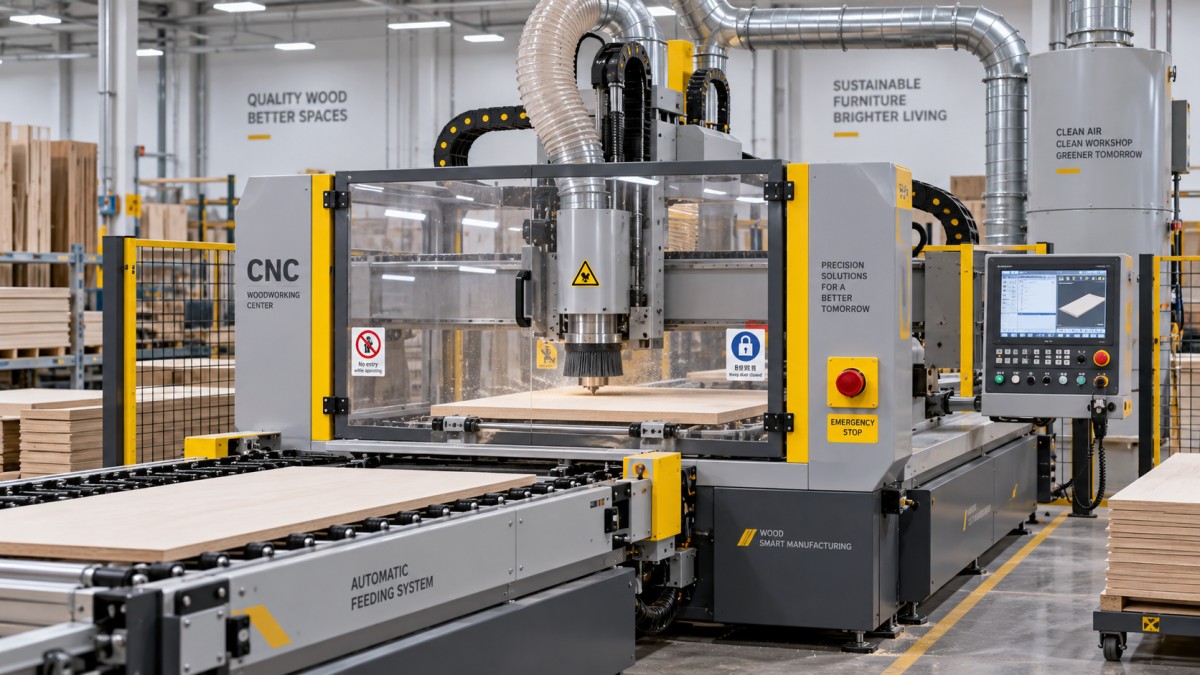
Guards are the most visible part of machinery safety, but a guard only works if operators can use the machine productively without defeating it. On a panel saw, this may involve upper blade protection, riving knives where applicable, anti-kickback measures, and access control around moving carriage areas. On a moulder or planer, it may involve cutter-head enclosures, chip breakers, hold-down systems, and guarded feed mechanisms. On CNC routers, the concern often shifts to perimeter access, tool-change zones, vacuum hold-down, and unexpected motion during automatic cycles.
Fixed guards should require tools for removal where access is not routinely needed. Movable guards often need interlocking, so opening the guard stops hazardous movement or prevents it from starting. Where stopping time is significant
Send Your Inquiry
We welcome your cooperation and we will develop with you.