


News & Exhibitions
Latest Factory Updates, Industry Trends & Global Exhibition Information
How to Match Woodworking Machine Voltage and Frequency to Your Country
How to Match Woodworking Machine Voltage and Frequency to Your Country
Choosing a woodworking machine is not only about cutting capacity, feed speed, spindle configuration, or automation level. Electrical compatibility deserves the same attention, especially when a machine will be exported, installed in an existing workshop, or added to a larger production line.
A machine that appears suitable on a quotation can become difficult or expensive to commission if its voltage, frequency, phase arrangement, or control components do not match the local electrical supply. The question, “How do I match woodworking machinery voltage and frequency to my country?” is therefore not a minor technical detail. It is part of selecting the correct machine configuration from the beginning.
The practical objective is simple: the machine should operate safely at its rated performance without unnecessary transformers, frequency converters, rewiring, motor replacement, or local troubleshooting after arrival. That requires more than knowing the country’s nominal voltage. Buyers also need to examine phase type, available power capacity, grounding arrangement, motor design, and the electrical requirements of each machine component.
Start With the Actual Power Available at the Installation Site
Country-level power standards are a useful starting point, but they are not enough to confirm a machine specification. A furniture factory may have a different supply arrangement from a small joinery shop in the same city. Industrial parks, older buildings, rented workshops, and rural sites can also differ substantially.
Before discussing machinery with a supplier, obtain the details of the electrical service at the machine location. This information is usually available from the facility electrician, electrical drawings, main distribution board labels, or the local utility connection documents.
- Nominal supply voltage at the distribution board
- Frequency: normally 50 Hz or 60 Hz
- Single-phase or three-phase availability
- Three-phase voltage measured line-to-line
- Available circuit breaker capacity and cable size
- Grounding or protective earth arrangement
- Whether the machine will share a circuit with dust extraction, compressors, or other high-load equipment
For example, 230 V single-phase power may be common for smaller workshop equipment in many markets, while industrial facilities often use 380 V, 400 V, 415 V, 440 V, or 480 V three-phase supplies depending on the region and local installation. North American facilities commonly work with 208 V, 230/240 V, 460/480 V, or other service configurations, generally at 60 Hz. Much of Europe and many other export markets use 50 Hz systems, often around 400 V three-phase in industrial settings. These are common patterns, not a substitute for checking the actual site.
A supplier should receive the site specification in a clear format, such as “400 V, 50 Hz, 3 phase, with protective earth” or “480 V, 60 Hz, 3 phase.” If the workshop has only single-phase service, this should be stated early. It affects which machines are practical, particularly for high-power planers, wide belt sanders, CNC routers, panel saws, and production-line equipment.
Voltage, Frequency, and Phase Are Related—but They Are Not the Same
Electrical specifications are often simplified into one number: “Is it a 380 V machine?” That shortcut creates avoidable mistakes. Voltage, frequency, and phase must all be considered separately.
Voltage is the electrical potential supplied to the machine. A substantial voltage mismatch can overheat motors, damage coils, cause protection devices to trip, or prevent equipment from starting. Some motors and control transformers can accommodate a defined voltage tolerance, but this must be verified from the nameplate and electrical documentation rather than assumed.
Frequency is measured in hertz. It directly affects the speed of many AC induction motors. A motor designed for 50 Hz does not behave exactly the same when connected to 60 Hz, even if the voltage seems close. Likewise, using a 60 Hz motor on 50 Hz supply without proper evaluation can create overheating or torque problems.
Phase describes how the supply is delivered. Single-phase power is common in smaller premises and can support light-duty machinery. Three-phase power provides smoother motor operation and is generally better suited to industrial woodworking equipment with larger motors, multiple drives, pneumatic systems, and dust collection loads.
A machine label reading “380 V / 50 Hz / 3 Ph” is not automatically equivalent to a site supply of “480 V / 60 Hz / 3 Ph.” Both are three-phase, but both voltage and frequency differ. A transformer may address voltage in some situations; it does not change frequency. That distinction matters.
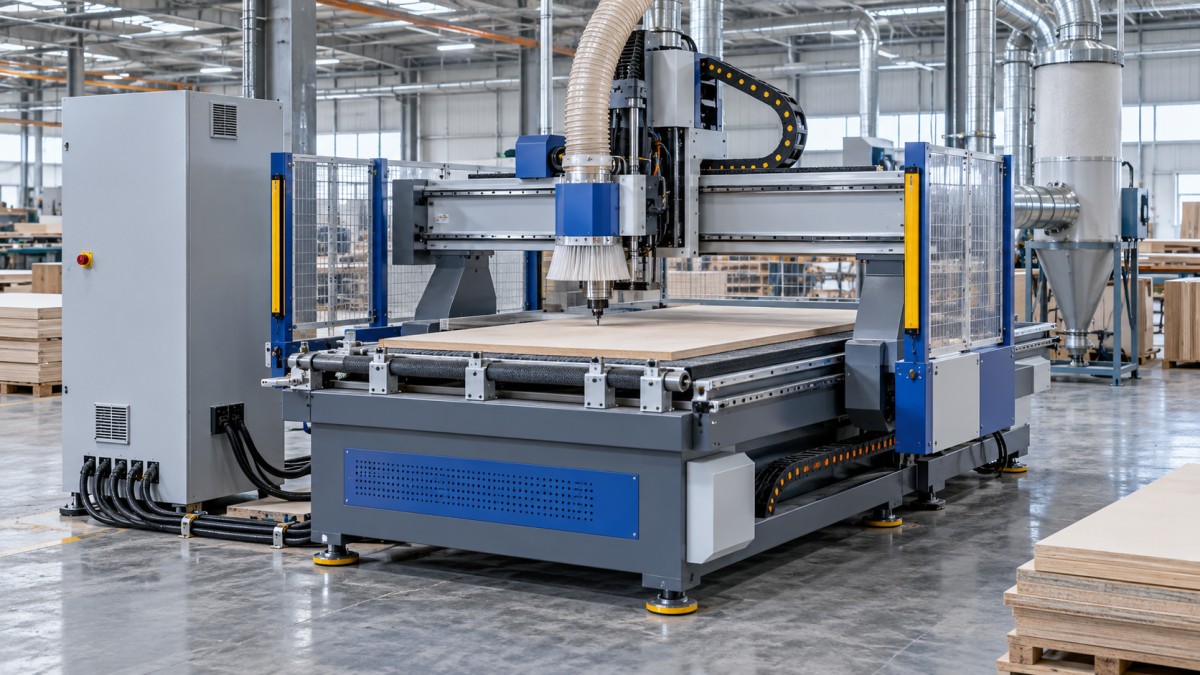
Why Frequency Requires More Attention Than Many Buyers Expect
Frequency affects rotating machinery. In a basic induction motor, running speed is linked to supply frequency and motor pole count. Moving from 50 Hz to 60 Hz changes the theoretical synchronous speed by roughly 20 percent. Actual motor speed is slightly lower because of slip, but the operating change is still meaningful.
On a woodworking machine, this can influence spindle speed, saw blade peripheral speed, cutterhead performance, feed rate where mechanically linked, fan output, pump behavior, and braking characteristics. A higher motor speed is not automatically better. A saw blade, cutterhead, sanding belt, or bearing assembly must remain within its intended operating limits.
The more serious risk often occurs when equipment designed for 60 Hz is run at 50 Hz without a suitable design review. Motor speed falls, and a motor may draw excessive current if the voltage-to-frequency relationship is not managed correctly. Load torque, cooling performance, and starting conditions all need consideration. In some applications, the machine manufacturer can provide motors and electrical components specifically configured for the destination frequency. That is usually more straightforward than attempting to adapt the machine after delivery.
Not every component responds to frequency in the same way. Modern machines may include variable-frequency drives, servo systems, PLCs, switching power supplies, digital displays, contactors, solenoid valves, and safety circuits. Some of these components have broad input ranges, while others do not. The complete electrical system—not only the main motor—must be reviewed.
Single-Phase or Three-Phase: Match the Machine to the Real Workload
For a compact workshop, a single-phase machine can be sensible when its power demand is modest and the facility has no three-phase service. Small edge banders, drill presses, light-duty saws, and selected portable or semi-stationary machines may be available in this format. However, the available current becomes a practical constraint as motor size increases.
Three-phase machinery is normally the more suitable route for continuous industrial work. Motors start more smoothly, current is distributed more effectively, and larger machines can be integrated into a coordinated production environment. A CNC nesting cell, multi-spindle drilling machine, wide belt sander, or automated panel-processing line also often requires three-phase supply because it combines several motors, motion controls, vacuum pumps, and auxiliary devices.
It is tempting to solve a lack of three-phase power with a phase converter. That may be feasible for a limited and carefully assessed application, but it is not a universal answer. Rotary converters, static converters, and variable-frequency drives have different capabilities. A converter sized only for the rated motor power may still be unsuitable for high starting loads, multiple motors, electronically controlled equipment, or machines requiring stable power quality. Discuss this with both the machine supplier and a qualified local electrical professional before purchasing.
Read the Nameplate, Then Read Beyond It
The nameplate is the first document to inspect, but it should not be the last. It typically identifies rated voltage, frequency, phase, current, motor power, wiring arrangement, and sometimes insulation or duty information. This is valuable, especially when evaluating an existing machine or planning a replacement.
For a new woodworking machine, request the full electrical specification before the production order is finalized. The main questions include:
- Is the quoted voltage and frequency the machine’s factory configuration or only a general option?
- Are all motors supplied for the destination power system?
- Are control transformers, power supplies, contactors, overload protection, and drives compatible with that supply?
- What is the total connected load and recommended upstream protection?
- Does the machine require a neutral conductor, or only three phases and protective earth?
- What cable size, breaker arrangement, and grounding provisions are recommended in the installation manual?
The total connected load should not be confused with normal operating consumption. Motors may not all run at full load simultaneously, but start-up conditions and peak loads still matter. Dust extraction is commonly overlooked. A production machine may fit the available supply, while the combined demand of the machine, extraction fan, air compressor, vacuum pump, and material handling equipment exceeds the capacity of the workshop circuit.
Common Mismatches and Their Consequences
The most expensive electrical problems usually begin with a well-intentioned shortcut. One common mistake is treating a voltage transformer as a complete solution. A transformer can step voltage up or down, but it cannot convert 50 Hz to 60 Hz or turn single-phase input into a robust three-phase industrial supply by itself.
Another mistake is assuming that a dual-voltage motor makes the entire machine dual-voltage. The motor may be reconnectable between specified voltages, but the control circuit, transformer, VFD, braking unit, safety relay, and ancillary equipment may still be designed for only one supply arrangement.
Grounding should not be treated as an installation detail to resolve later. Woodworking environments involve conductive machine frames, dust, moving cutters, and sometimes static electricity. Correct protective earthing, suitable circuit protection, emergency-stop wiring, and local electrical practices are fundamental to safe commissioning. Local requirements may also affect disconnect switches, cable routing, enclosure selection, and the way machinery is connected to the building supply.
Voltage quality is another real-world issue. Long cable runs, undersized conductors, weak local supply, or heavily loaded systems can cause voltage drop. Motors may then struggle during acceleration, contactors may chatter, and electronic controls may report faults. If the site is known to have unstable supply, that information should be shared before machine configuration and installation planning are completed.
Build Electrical Confirmation Into the Purchase Process
The best time to resolve electrical compatibility is before manufacturing begins. At Qingdao Zhongding Machinery Co., Ltd., electrical configuration is part of the broader discussion around machine application, workshop conditions, and long-term serviceability. With more than 20 years in woodworking machinery, the company has seen that installation questions are easier to address when the buyer, supplier, and local electrician exchange accurate information early rather than after the machine is already in transit.
For an individual machine, this may mean confirming a 50 Hz or 60 Hz motor set and the correct control-voltage arrangement. For a complete furniture-production project, it may involve reviewing the combined electrical demand of cutting, edging, drilling, sanding, dust extraction, and compressed-air systems. The right approach depends on the actual scope of the workshop, not simply on a country name printed on a shipping document.
A useful pre-shipment record should include the confirmed supply specification, electrical drawings where applicable, motor and major component information, installation requirements, and spare-parts references. This makes future maintenance easier as well. When a replacement contactor, inverter, motor, or control component is needed, a clear original specification helps prevent ordering the wrong version.
A Practical Final Check Before You Approve the Machine
Before final approval, compare one line from the facility power record with one line from the machine’s confirmed electrical specification. They should match in voltage, frequency, phase, and grounding expectations. Then check whether the site has enough capacity for the machine and its supporting equipment. If there is any uncertainty, have a qualified electrician review the proposed connection and protection arrangement.
Matching woodworking machinery voltage and frequency to your country is not about memorizing global power standards. It is about connecting the machine design to the electrical reality of the workshop where it will work every day. A few accurate details gathered before ordering can prevent altered production schedules, damaged components, and avoidable commissioning costs later.
Send Your Inquiry
We welcome your cooperation and we will develop with you.