


News & Exhibitions
Latest Factory Updates, Industry Trends & Global Exhibition Information
ATC Router Tool-Changer Capacity: When More Tool Positions Improve Throughput
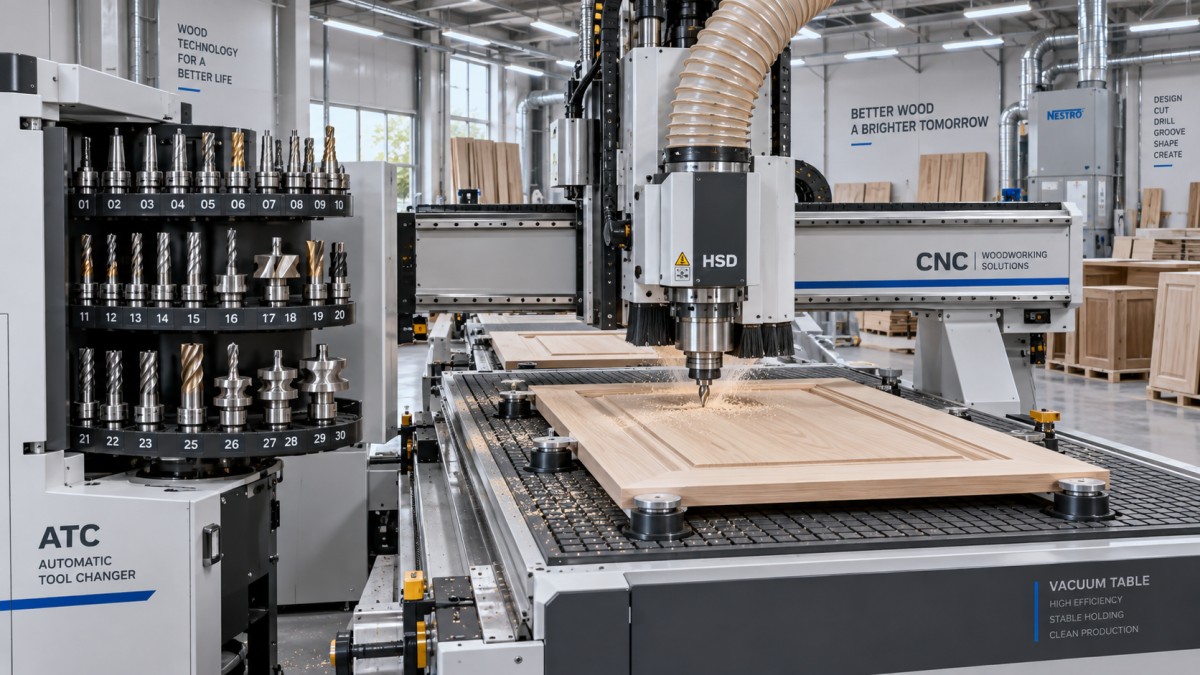
For technical evaluators comparing CNC solutions, ATC router tool-changer capacity is a practical factor in the balance between throughput, machining flexibility, machine footprint, and capital cost. A larger magazine can eliminate manual intervention and keep complex nested jobs moving, but “more positions” is not automatically the same as “more productivity.”
The key question is not how many tools a CNC router can hold. It is how many tools a real production schedule needs at the machine, including the tools required for routine cutting, profiling, drilling, finishing operations, and the inevitable exceptions that appear during a shift. In woodworking production, where a cabinet door may need drilling patterns, hinge cups, grooves, edge profiling, and panel cutout work, tool availability can shape the entire rhythm of the cell.
This article examines when higher ATC capacity creates measurable gains, when it adds little value, and what technical details should be reviewed before specifying an automatic tool changer for a woodworking CNC router.
Tool-Changer Capacity Is a Production Decision, Not a Catalog Number
An automatic tool changer stores and exchanges tools without requiring the operator to stop the machine, open the spindle, install a cutter, reset tool data, and restart the program. That basic function is familiar. The more important evaluation point is whether the magazine capacity matches the machining strategy.
A compact ATC router may carry only a limited set of essential tools: for example, a roughing cutter, a finishing cutter, a drill, a slotting tool, and a profiling bit. This arrangement can work well for stable, repetitive jobs. If every sheet follows a similar program and the operation uses the same five or six tools, a larger tool magazine may sit half empty for much of the week.
Capacity becomes more meaningful when production contains variation. Consider a workshop producing custom furniture, mixed cabinet components, interior doors, decorative panels, and hardware-preparation work. In that environment, operators may need different cutter diameters, drill groups, compression bits, straight bits, ball-nose tools, chamfer tools, and specialized profile cutters. Without enough available positions, the theoretical automation of the CNC router is interrupted by planned or unplanned manual tool loading.
Those interruptions affect more than spindle idle time. They may require an operator’s attention at the least convenient moment, increase the chance of loading the wrong tool, and introduce inconsistency when tool length or diameter information is not managed carefully.
Where Additional ATC Positions Produce Real Throughput Gains
Expanded capacity tends to pay back when it removes a recurring constraint rather than simply adding spare storage. The following operating conditions are strong indicators that a larger tool changer deserves serious consideration.
1. Parts Require More Unique Tools Than the Current Magazine Can Support
This is the clearest case. If the average production job routinely uses more unique tools than the machine can carry, manual tool swaps are built into the process. A job requiring ten tools on a six-position machine may be technically possible, but it is not fully automated.
It is important to count unique tools, not merely operation types. A drilling operation may involve several diameters. Routing may require separate tools for roughing and finishing. A cutout program may use one compression tool for panel edges and another tool for smaller internal geometry. Tool duplication may also be necessary when one cutter is reserved for laminated board and another is used for solid wood or veneered material.
For a facility that changes jobs regularly, keeping the complete standard tool set loaded can be more valuable than adding a few seconds of speed to an individual cutting path.
2. The Machine Runs High-Mix, Low-to-Medium Volume Work
High-volume manufacturing often justifies dedicated machines, fixed tooling plans, or tightly controlled product families. High-mix production is different. The CNC router must shift from one part type to another with minimal preparation, sometimes several times a day.
In this setting, extra ATC positions function as a buffer against setup variation. A programmer can build robust tool libraries around material groups and common product features instead of continually deciding which tools must be removed to make room for the next job. The result is not necessarily a dramatic reduction in cycle time for one panel; it is a smoother production day with fewer pauses between orders.
This is particularly relevant to made-to-order cabinetry, contract furniture, shopfitting, and interior component production. Evaluators should examine weekly job diversity rather than relying only on the tool count of one sample program.
3. Tool Wear Creates Unplanned Stops
A tool changer with open positions can support a more deliberate wear-management strategy. Depending on the machine configuration and control capabilities, a shop may keep replacement tools prepared in the magazine or maintain alternative tools for demanding materials. This does not remove the need for inspection and tool-life monitoring, but it can reduce the disruption caused by a worn cutter discovered mid-shift.
The benefit is strongest where edge quality is critical. Melamine-faced board, veneered panels, compact laminates, and engineered wood products can reveal cutter wear quickly through chipping, heat marks, or poor edge finish. If a worn finishing tool forces a stop, the cost is not limited to the tool change; the downstream process may also wait for acceptable parts.
4. Programs Combine Routing, Drilling, and Detail Work
A nested-based production router frequently handles more than perimeter cutting. It may drill shelf-pin holes, machine connector locations, cut dados, create pockets, route curves, form recesses, and finish exposed edges in the same setup. The more process stages consolidated onto one machine, the more tool positions become relevant.
There is a practical threshold here. Once a router becomes a multifunction machining center rather than a simple sheet-cutting platform, a small magazine can become the limiting element. Adding capacity allows the programmer to select tools for process quality instead of forcing multiple operations onto one “general-purpose” cutter.
A Simple Way to Quantify the Opportunity
Technical evaluations benefit from separating tool-change time from total available production time. A larger ATC magazine does not make every automatic exchange faster; magazine design, travel distance, spindle orientation, and control sequence all matter. Its primary value is often the elimination of manual exchanges and offline setup interruptions.
A useful review starts with production records from representative jobs:
- Number of unique tools required per job;
- Frequency of jobs exceeding current magazine capacity;
- Average manual intervention time, including tool installation and verification;
- Number of job changes per shift;
- Scrap or rework linked to incorrect tool loading, offset errors, or worn tools;
- Whether operators delay jobs because the required tooling is not prepared.
For example, a manual exchange may appear to take only a few minutes. In practice, the interruption can include finding the correct cutter, cleaning the holder, loading the tool, confirming the tool number, measuring or checking offsets, restarting the program, and inspecting the first completed part. Multiplied across mixed production, this time becomes visible in machine utilization.
However, a capacity increase should be judged against the actual bottleneck. If the router spends significant time waiting for loading, unloading, labeling, sanding, assembly, or material handling, an enlarged tool changer alone will not transform output. It should be evaluated as part of the complete production flow.
Magazine Size, Layout, and Tooling Envelope Must Be Evaluated Together
Comparing positions alone can lead to poor specifications. A twelve-position carousel and a twelve-position linear tool rack may offer the same nominal capacity while affecting access, change sequence, machine footprint, and maintenance in different ways. The preferred design depends on the machine architecture and the workshop’s production priorities.
A larger magazine may also require a more disciplined tooling layout. Tools should not be assigned randomly to open stations. Heavy tools, large-diameter cutters, and long drill tools need clear placement rules. Frequently used tools should be arranged in a way that supports the machine’s preferred exchange pattern where applicable, while cutter collision envelopes must be checked in both parked and exchange positions.
The Hidden Requirement: Tool Data Discipline
More capacity increases flexibility, but it also increases the amount of tool information that must be controlled. Each tool requires a correct identification, diameter value, length offset, maximum speed, feed-rate guidance, and, ideally, a defined material/application range. Without this discipline, a large ATC router can create more opportunities for mistakes than a smaller machine.
Technical evaluators should ask how the shop will manage the tool library. Will operators measure tools manually? Is there a tool-setting device on the machine? Are offsets confirmed after tool replacement? Is the same tool number consistently associated with the same holder and cutter type? Can the CNC control warn the operator about tool-life limits or missing tools?
These questions are especially important in factories operating multiple shifts. A well-organized tool system supports repeatability across operators. A loosely managed system turns every job change into a small troubleshooting event.
When More Tool Positions Do Not Improve Throughput
There are valid reasons to choose a smaller magazine. A shop focused on a narrow product range may use only a few tools throughout most production. If the router performs basic nesting and cutout work, a compact ATC configuration can be easier to manage and may offer a better cost-to-output ratio.
Likewise, adding capacity does not solve problems caused by poor nesting, underpowered vacuum holding, slow material loading, inadequate dust extraction, unstable workholding, or inefficient programming. When a router is waiting for labor or materials, unused tool positions do not create production value.
Another common mistake is specifying a large magazine because a future product range is vaguely anticipated. Future-proofing is sensible when there is a credible plan for additional machining operations, new materials, or increased job variety. It is less sensible when no tooling strategy accompanies the specification. A magazine should support an expected production model, not merely make a quotation look more complete.
A Practical Capacity Selection Framework
Rather than selecting from standard capacity tiers by instinct, build a tool map from representative work. Review a normal week of production, not only ideal jobs. List every cutter, drill, and specialty tool required, then identify which ones must remain loaded simultaneously to avoid manual intervention.
Next, add a reasonable operating margin. This margin may cover replacement cutters, material-specific alternatives, temporary special tools, or the next job in a mixed schedule. The appropriate margin varies by production style: a stable cabinet line needs less flexibility than a custom workshop serving many design formats.
Finally, confirm that nominal positions are genuinely usable. If two large tools cannot occupy adjacent stations, or if a required aggregate head restricts neighboring positions, the effective capacity may be lower than the catalog figure. Ask the supplier to review the planned tooling list, including holder dimensions and cutter diameters, before finalizing the machine configuration.
What Technical Evaluators Should Request from the Supplier
When comparing an ATC router, request documentation that makes the tool-changing system measurable rather than descriptive. This should include the magazine type, position count, permitted tool diameters, maximum tool dimensions, holder specification, automatic tool measurement options, and tool-change sequence details. If the machine will process varied furniture components, share representative CNC programs or operation lists with the supplier.
For woodworking manufacturers, this conversation should extend beyond the machine itself. Qingdao Zhongding Machinery Co., Ltd., with long experience supporting woodworking operations, approaches router selection as part of a broader production requirement: machine configuration, tooling compatibility, technical support, spare-parts availability, and the practical realities of keeping equipment running over time all matter. The most suitable ATC capacity is the one that fits the customer’s process without introducing unnecessary complexity.
In the end, an expanded tool changer is valuable when it protects spindle time, reduces setup dependency, and lets the machine complete a broader set of operations in one uninterrupted cycle. For repetitive, limited-tool work, a smaller configuration may be entirely sufficient. For mixed production and multifunction machining, the right additional positions can turn an ATC router from a capable cutting machine into a more dependable production resource.
Send Your Inquiry
We welcome your cooperation and we will develop with you.