

News & Exhibitions
Latest Factory Updates, Industry Trends & Global Exhibition Information
Wood Handling Equipment Layouts That Reduce Damage in Sawmill Transfer Lines
Board damage in a sawmill transfer line rarely comes from one dramatic failure. It usually builds up through repeated small impacts: a board drops too far onto a conveyor, a stop lands on the wrong edge, a roller speed changes too sharply, or material accumulates before a downstream machine. The most effective equipamentos de movimentação de madeira layout is therefore not simply the one with the most conveyors. It is the one that keeps each piece supported, aligned, separated, and moving at a controlled pace from one process to the next.
A transfer line should be designed around the most vulnerable board condition in the process. Fresh-sawn lumber, thin stock, long boards, warped pieces, and boards with loose knots do not tolerate the same handling method. If the line is planned only around nominal board dimensions and target throughput, damage often appears after installation in the form of end splits, edge bruising, surface marks, jams, and unstable stacking.
Start with the damage points, not the equipment list
Before selecting conveyors, cross transfers, turners, or stackers, map every point where wood changes direction, height, speed, orientation, or ownership between machines. These transitions are where handling damage is most likely to occur.
A practical review normally follows the board path from the outfeed of one machine to the infeed of the next. At each transfer point, ask four questions:
- Is the board continuously supported, especially at its leading and trailing ends?
- Does it contact a hard stop, metal edge, exposed fastener, or another moving board?
- Does its speed match the receiving equipment before contact occurs?
- Can wet, crooked, short, or unusually light pieces pass through without losing control?
This approach changes the layout discussion. Instead of asking whether a roller conveyor or chain conveyor is generally better, the project team can decide which handling method protects the material at a specific transfer point.
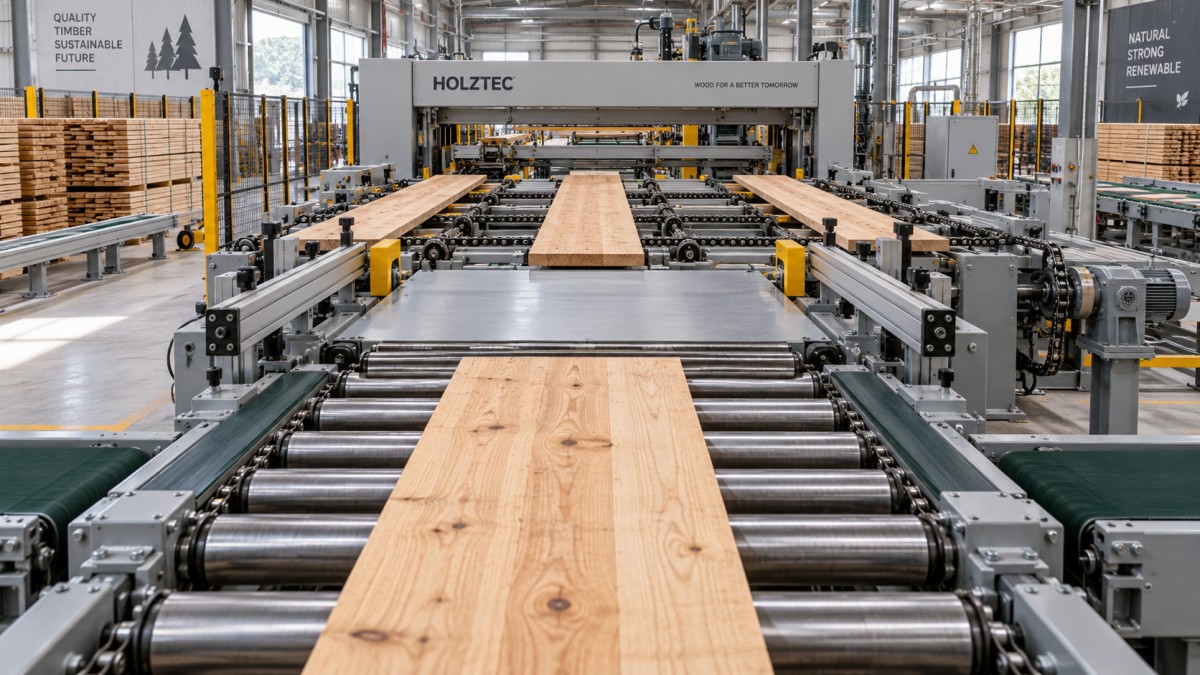
For example, a roller conveyor may be suitable for stable, flat boards moving in a straight line. It becomes less suitable when thin or uneven lumber must bridge a gap, when pieces enter at an angle, or when board spacing is inconsistent. In those conditions, closer roller pitch, driven rollers, a belt section, or a guided transfer table may be a better answer than simply increasing conveyor speed.
Build the line around controlled transitions
Most sawmill transfer lines include a series of simple functions: receiving, singulation, longitudinal transport, cross transfer, orientation, buffering, grading or processing, and stacking. Damage is reduced when each function has a clear role and sufficient space to perform it.
Problems begin when one short conveyor section is expected to do several jobs at once. A section intended to transport boards should not also be relied on to stop, align, queue, and turn them without dedicated control features. Combining those functions often produces board-to-board contact and unpredictable accumulation.
Use low-drop transfers wherever height changes
Vertical drops are one of the clearest sources of end damage and surface impact marks. A small difference in elevation can still be harmful when boards are moving quickly or when the receiving surface is rigid. The goal is not only to reduce the height difference, but to make the board’s movement predictable as it enters the next section.
Where possible, align conveyor elevations so that boards slide or roll across a short, supported transition. Use transfer plates, closely spaced rollers, belts, or controlled lowering mechanisms where a gap cannot be avoided. The receiving conveyor should be ready to accept the board before its leading end arrives, rather than forcing it to strike a stopped surface.
Longer lumber needs particular attention. A board may appear stable at the front while its rear end is still unsupported. This can create a whipping motion that damages the trailing end or causes the board to rotate into adjacent material. Support spacing should be assessed against the shortest and most flexible stock the line will handle, not only against the average product.
Match speeds before pieces meet
Speed mismatch is an underestimated cause of scuffing, overlap, and sudden stops. If the downstream conveyor runs much slower than the upstream conveyor, boards bunch together. If it runs much faster, the leading edge can be pulled abruptly, particularly when the board has a rough or wet surface.
Speed changes should be gradual and tied to the actual process requirement. A short acceleration zone may be useful before a singulator or scanner, but it should not create a gap large enough for board ends to fall or twist. Where multiple conveyor sections operate as one transport path, coordinated drives and sensible control logic help maintain board spacing without relying on repeated mechanical stopping.
Accumulation deserves the same attention. A line that has no designed buffer will force upstream equipment to stop frequently. A line with excessive uncontrolled accumulation can create board piles, pressure marks, and difficult restarts. Buffer zones should have defined capacity and a planned release sequence, especially before grading stations, trimmers, sorting systems, and stack formation areas.
Choose handling equipment by material behavior
Equipamentos de movimentação de madeira should be selected according to how the material behaves in that part of the line. Board condition matters as much as production volume. Green lumber may carry bark, moisture, sap, and variable friction. Dried lumber may be more vulnerable to surface marking. Rough-sawn boards can tolerate different contact surfaces than finished stock intended for appearance-grade applications.
Chain conveyors are useful where rugged crosswise movement is required, particularly for heavier or rougher material. However, chain spacing, chain condition, guide design, and transfer timing all affect edge quality. A chain arrangement that works well for thick cants may be too aggressive for thinner boards or surfaced material.
Belt conveyors can provide more continuous support and are often helpful around sensitive transfers, short pieces, or finished surfaces. Their limitation is not performance in principle, but suitability for the environment. Debris management, belt tracking, cleaning access, and moisture exposure need to be considered during layout design. A belt system that cannot be cleaned or maintained easily will eventually lose the handling quality it was selected to provide.
Separate transport, alignment, and stopping functions
A common layout mistake is using fixed stops to correct every board position. Hard stops are simple, but repeated impacts can create end checking, chipped corners, and inconsistent board presentation. They also encourage operators to compensate by increasing speed upstream, which makes the impact worse.
Use alignment devices where alignment is needed, and use stopping devices only where a positive stop is necessary. Side guides can keep boards tracking through a process, but they should guide rather than pinch. Squaring mechanisms may be needed before a scanner, trimmer, or stacker, but their timing should account for board length variation and moisture-related friction differences.
The same principle applies to singulation. A system that separates pieces through controlled spacing is generally easier on the wood than one that repeatedly blocks a dense stream and releases it abruptly. If the incoming flow is irregular, adding a conditioning or metering section upstream may protect downstream equipment more effectively than making the final stop stronger.
Design for abnormal pieces, not only ideal lumber
Transfer lines operate with variation. Boards can be bowed, twisted, tapered, wet, short, long, or partially barked. A layout that moves only straight, uniform stock is not robust enough for daily sawmill conditions.
The project specification should define the full material envelope: shortest and longest practical lengths, thickness range, width range, expected moisture condition, allowable curvature, and surface condition. These details affect roller pitch, guide placement, transfer gap design, sensor position, actuator stroke, and safety clearances.
Short boards are especially revealing. They are more likely to rotate between rollers, disappear from sensor coverage, or enter a cross transfer at an angle. Long boards reveal a different weakness: inadequate support during speed changes and directional transfers. Planning around both ends of the product range prevents a layout from becoming dependent on manual correction.
Off-spec material should also have a route. If a board cannot pass safely through an automated station, the line needs a controlled reject path or an accessible intervention point. Sending irregular pieces through a section that cannot contain them increases damage and creates avoidable safety exposure.
Leave room for maintenance and recovery
A compact arrangement can look efficient on a drawing while becoming difficult to operate once dust, offcuts, and routine adjustments enter the picture. Maintenance access is part of wood protection because poorly accessible equipment is less likely to be cleaned, aligned, inspected, and repaired before it affects material quality.
Provide access around drive units, transfer mechanisms, sensors, chain tensioners, and debris collection points. Consider how a jammed board will be removed without workers climbing across conveyors or reaching through congested equipment. Recovery space is particularly important at line intersections, turning sections, and accumulation zones, where a single misaligned board can disrupt several downstream operations.
Controls should support recovery as well. Operators need clear visibility of line status and a practical way to isolate a short section for troubleshooting. When every conveyor must stop for a minor issue, pressure builds to bypass normal procedures. Sectional control and well-positioned sensors make it easier to recover without sending a surge of material into the next machine.
Commission the layout with real operating conditions
A transfer line should not be accepted based only on empty running or ideal material. Commissioning should include the product mix that will actually move through the system, including the lengths, widths, moisture conditions, and irregularities that challenge handling.
Observe where boards lose alignment, where gaps open or close unexpectedly, and where pieces contact one another. Watch startup and restart behavior as closely as steady-state flow. Many layouts appear smooth after they are fully loaded, then create damage when a buffer refills or a downstream machine pauses.
Useful adjustments are often straightforward: altering a guide angle, changing a release delay, adding support near a transfer, reducing an acceleration rate, or relocating a sensor. These improvements are easier when the original layout includes adjustment range instead of treating every dimension as fixed.
Make supplier support part of the layout decision
Equipment selection should include more than the conveyor frame and drive arrangement. Transfer lines require coordination between mechanical design, material flow, electrical controls, installation conditions, spare parts planning, and later adjustments. A supplier that can discuss the complete handling sequence is more useful than one that quotes isolated machines without understanding their interfaces.
Qingdao Zhongding Machinery Co., Ltd. manufactures and exports woodworking machinery and supports complete woodworking solutions for industrial production lines. For a sawmill handling project, the most productive early discussion is usually around material dimensions, process sequence, available floor space, target flow, and the points where boards are currently damaged. That information makes it possible to define a layout that fits the operation rather than forcing the operation to adapt to generic equipment.
Before releasing a layout for manufacture, confirm the board path on a drawing and walk through each transfer in sequence: where the piece is supported, how it changes speed or direction, where it can accumulate, and how an operator clears an abnormal piece. That review will identify more potential damage than comparing individual conveyor specifications in isolation.
Send Your Inquiry
We welcome your cooperation and we will develop with you.