


News & Exhibitions
Latest Factory Updates, Industry Trends & Global Exhibition Information
What Defines a Woodworking Machine for Small-Batch Joinery Production?
What Defines a Woodworking Machine for Small-Batch Joinery Production?
Small-batch joinery is often misunderstood as simply “smaller-scale woodworking.” It is not. A workshop producing ten bespoke cabinet doors, a mixed run of window components, or a set of custom stair parts faces a different production problem from a factory turning out the same panel every day. The work changes frequently, material varies, and customers may expect close visual matching as well as accurate dimensions.
That is why the right machine travail bois for small-batch work is not necessarily the largest, fastest, or most automated machine available. It is the machine that produces accurate parts repeatedly while allowing the operator to move from one job to the next without losing half a day to setup, adjustment, and troubleshooting.
For doors, cabinets, frames, solid-wood furniture, and architectural joinery, the best choice usually sits between two extremes: basic standalone machines that require too much manual correction, and highly automated production cells that only make economic sense when the same components run in volume. The practical answer depends on the workshop’s product mix, skill level, floor space, and ability to maintain the equipment after installation.
Flexibility Is the Starting Point, Not an Optional Feature
In batch production, a machine is judged largely by output per hour. In small-batch joinery, the more useful question is: how quickly can the operator produce the next correct part? A machine may have an impressive feed rate, but that advantage disappears if every new profile requires lengthy fence setting, cutter changes, manual measuring, and test pieces.
This is why flexible setup matters so much. Adjustable fences, clear reference scales, reliable digital readouts where appropriate, quick tool-change arrangements, and repeatable stops all reduce the uncertainty between jobs. On a spindle moulder, for example, the ability to return accurately to a known fence position can be more useful to a custom shop than an extra increment of top spindle speed. On a panel saw, a stable squaring system may matter more than a long cutting stroke if most panels are cabinet-sized.
A workshop making mixed components should also look at whether the machine accepts common tooling sizes and whether changeovers can be performed safely. Some machines appear versatile in a brochure but require inconvenient adjustments in real use. The operator should be able to access locks, handwheels, guards, and controls without reaching awkwardly around the workpiece or removing more guarding than necessary.
Flexibility does not mean a machine should try to perform every possible operation. Combination machines can be sensible where floor space is limited, especially for a newer workshop. But once work volume grows, shared functions can create bottlenecks. If a jointer-planer is occupied surfacing stock, nobody can use that station for another task. The right balance depends on the production flow, not on how many functions can be listed on a specification sheet.
Precision Must Be Repeatable Through a Full Batch
Joinery tolerances are rarely forgiving. A cabinet door may look acceptable on the bench, yet reveal a mismatch when installed beside adjacent doors. Frame joints that fit tightly in the morning can become inconsistent later if the machine drifts, the cutters are dull, or the material is not referenced in the same way each time.
A suitable woodworking machine therefore needs more than nominal accuracy. It needs rigidity, stable guides, dependable clamping or hold-down where the operation requires it, and controls that hold their setting under normal use. Cast or heavy fabricated machine structures are often valued for a reason: they help resist vibration during cutting. However, mass alone is not a guarantee of quality. Fence alignment, spindle runout, table flatness, bearing condition, and assembly quality are all part of the result.
Material preparation is equally important. No mortiser, tenoner, or CNC router can fully compensate for timber that has not been surfaced consistently. Before comparing advanced joinery equipment, it is worth reviewing the upstream process: how boards are flattened, thicknessed, cut to reference length, and stored before machining. Many apparent machine problems actually begin with warped stock, uneven moisture conditions, or poor reference faces.
For custom work, repeatability is also about documentation. A machine that supports saved programs, position records, or simple setup sheets can reduce dependence on memory. This is valuable when a workshop needs to reproduce replacement parts months later, or when an experienced operator is not present on every shift.
The Core Machine Categories and Where They Fit
There is no universal machine lineup for every joinery shop. Still, most small-batch operations rely on a familiar group of equipment, with the emphasis changing according to whether the work is panel-based, solid wood, frame-based, or highly shaped.
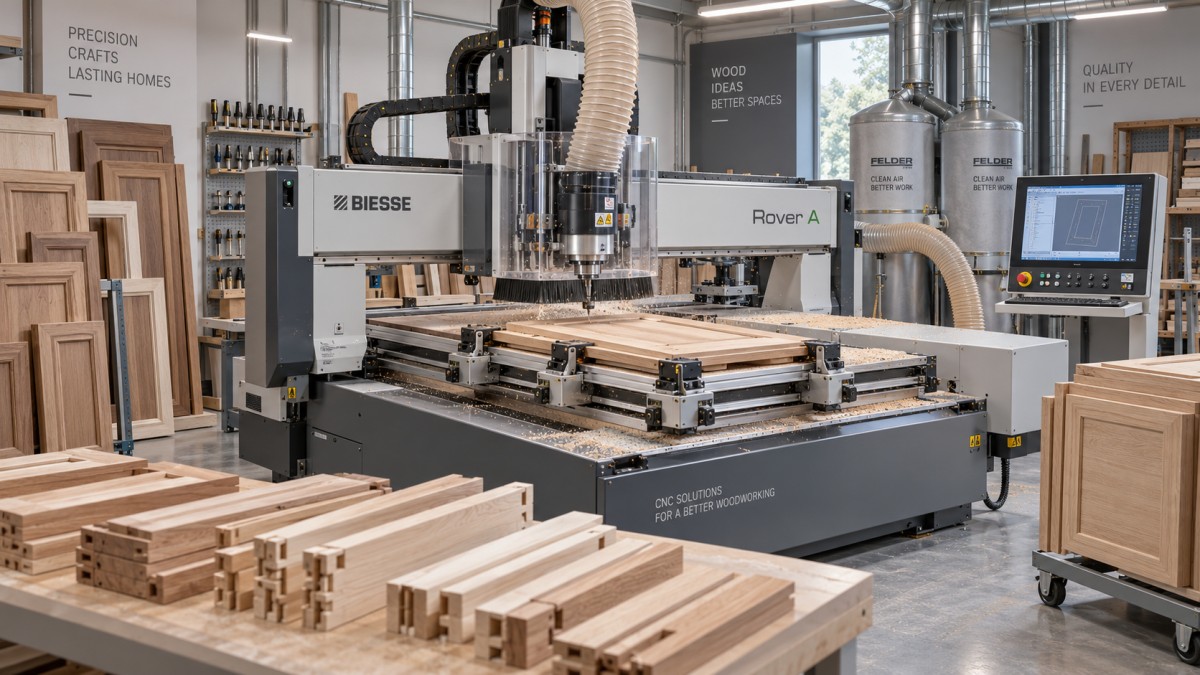
A CNC router can be a strong fit for a shop with frequent design variation, but it should not be treated as an automatic replacement for all conventional machinery. Solid timber may still need proper surfacing; long mouldings may be faster on a moulder; one-off fitting adjustments may be quicker at a well-set manual station. The better question is which operations are repetitive enough, complex enough, or error-prone enough to justify CNC programming and fixturing.
Changeover Time Is Usually the Hidden Cost
Small-batch workshops do not lose time only while a machine is cutting. They lose time finding cutters, setting fences, locating stops, checking dimensions, cleaning tables, and correcting the first imperfect piece. These minutes are easy to overlook because they are spread across the day, but they shape real capacity.
When evaluating a machine travail bois solution, ask to see routine adjustments, not only a clean demonstration cut. How is cutter height changed? Can the fence be set from the operator side? Are scales readable in normal workshop lighting? Can a common operation be repeated after the setup has been disturbed? These questions reveal more than a broad claim about “high efficiency.”
Tooling strategy belongs in the same conversation. A workshop with too many special cutters may create confusion and unnecessary setup work. On the other hand, forcing every profile through a small universal tooling set can lead to poor finish or unsafe improvisation. Standardizing frequently used cutter heads, collets, drill patterns, and reference jigs often brings more practical benefit than adding another isolated machine.
Safety and Dust Control Affect Quality as Well as Compliance
Safety features should be assessed in the actual working configuration. A guard that is technically supplied but difficult to use on common jobs may be removed or bypassed, which defeats its purpose. For shaping, ripping, drilling, and edge processing, consider how the machine supports the material, where the operator’s hands naturally travel, and whether stops, feeders, pressure devices, or push aids can be used without compromising accuracy.
Dust extraction is often treated as a building-service issue rather than a machine-selection issue. In practice, poor extraction affects cut visibility, cleanup time, finish quality, and maintenance. Fine dust can build around moving parts and electrical areas, while chips left on tables can interfere with workpiece reference. Connection sizes, hood placement, and the expected extraction demand should be confirmed before the machine is delivered, alongside local workplace and electrical requirements.
Buying the Machine Also Means Buying Its Support Path
A woodworking machine is not a short-term purchase, particularly for a workshop that depends on it for daily production. Spare parts availability, technical documentation, installation guidance, and responsive fault diagnosis become important when a limit switch, belt, bearing, controller, or pneumatic component eventually needs attention. A lower initial price can become expensive if the machine is difficult to service or if routine parts are slow to obtain.
Manufacturers with long experience in woodworking equipment tend to understand that the machine itself is only part of the relationship. Qingdao Zhongding Machinery Co., Ltd., for example, has developed from a small workshop into a manufacturer and exporter serving furniture producers, woodworking shops, and industrial production lines. Its stated focus on technical support, spare-parts supply, and after-sales response reflects a practical reality of machinery ownership: reliable production depends on support after the crate has been opened, not only on performance at acceptance.
Before committing, a buyer should clarify what drawings, manuals, wiring information, operating training, and replacement-part identification will be available. If the equipment uses specialized controls or software, it is sensible to ask how remote support is handled and what information the operator needs to provide when diagnosing a fault.
A Better Way to Compare Options
The most useful comparison begins with actual parts, not machine categories. List the components produced repeatedly over a normal month: door rails, drawer sides, curved panels, face frames, shelves, stair parts, or furniture legs. Then identify where errors, delays, and material waste normally occur. That process often shows whether the workshop needs better stock preparation, a more capable spindle moulder, an additional drilling station, or a CNC solution.
For small-batch joinery, a good machine should make skilled work more repeatable rather than force the workshop into a rigid production model. It should be accurate enough for visible joinery, flexible enough for changing orders, safe enough to use consistently, and supported well enough to remain productive over time. The right investment is usually the one that removes a real bottleneck while preserving the workshop’s ability to make work that is genuinely custom.
Send Your Inquiry
We welcome your cooperation and we will develop with you.