


News & Exhibitions
Latest Factory Updates, Industry Trends & Global Exhibition Information
When is customs clearance support needed for woodworking machines?
Customs clearance support is needed for woodworking machines when the import process involves more than a routine document handover. The need is driven less by the machine’s purchase price than by the possibility that classification, safety requirements, shipment configuration, valuation, or local import rules could delay release or create costs that were not included in the original equipment budget.
A small standalone machine shipped under a familiar import procedure may be handled internally or through a standard freight forwarder. A production-critical machine, a containerized line, or equipment entering a market with detailed conformity and electrical requirements should be treated differently. In those situations, customs clearance is part of project execution: a clearance delay can postpone installation, commissioning, staff training, and the first planned production run.
Clearance support becomes important when the machine is not a simple import item
Woodworking equipment often sits between several customs and compliance questions. Customs authorities need to identify what the goods are, how they are used, what components are included, where they originated, and what value should be declared. Import regulators may separately consider machine safety, electrical compatibility, emissions-related requirements for certain equipment, packaging controls, or local registration obligations.
The difficulty is not that every woodworking machine is inherently hard to clear. The difficulty is that the commercial description “woodworking machine” is too broad to resolve these questions on its own. A panel saw, CNC machining center, edge bander, sanding line, dust extraction unit, and spare-parts package may each require different classification analysis and supporting records. A shipment combining several of them can be more complex than a single invoice suggests.
Professional customs clearance support is justified when a business cannot confidently answer the following before cargo arrives:
- Which tariff classification applies to each machine and separately invoiced accessory?
- What duty, import tax, port charge, brokerage fee, inspection cost, or storage exposure belongs in the landed-cost estimate?
- Which documents must match exactly across the seller, carrier, customs declaration, and importer records?
- Whether the destination market requires conformity documents, local labeling, electrical declarations, permits, or pre-arrival filings?
- Whether the importer of record is eligible to import the equipment under its local registration and tax status?
If any of these items remains uncertain, support should be arranged before shipment rather than after the container reaches the port.
Tariff classification is a commercial issue, not merely a customs formality
Incorrect classification can affect duty calculations, import restrictions, statistical reporting, and the documents requested during an examination. Machinery is generally classified using the Harmonized System framework, but the detailed tariff code used for declaration is determined by the importing country or customs territory. The final code can depend on the machine’s principal function, degree of automation, processing method, and whether a component is a complete machine, an accessory, or a part.
For woodworking machinery, the distinction between a complete working machine and peripheral equipment is particularly relevant. A machine may be shipped with conveyors, tooling, control cabinets, vacuum equipment, pneumatic components, safety guards, or installation spares. These items should not automatically be assumed to share one classification or one treatment. Their declaration may depend on how they are invoiced, packed, and functionally connected to the main equipment.
Classification also matters when comparing supplier quotations. A low equipment price does not indicate a lower import cost if the declared classification, customs value basis, or country-of-origin documentation differs. Business evaluation should therefore distinguish between the ex-works or FOB machine price and the complete landed cost: freight, insurance where applicable, duties, taxes, broker charges, inland transport, port handling, inspection exposure, and the cost of a delayed release.
Clearance support is especially useful when there is uncertainty over whether the proposed code properly reflects the actual machine configuration. A broker, customs specialist, or qualified local adviser can review the technical description before departure. The strongest evidence is normally practical and specific: product photographs, operating descriptions, machine layout, catalog pages, electrical specifications, manuals, packing lists, and invoices that identify the equipment consistently.
Documentation risk rises quickly with machine size and configuration
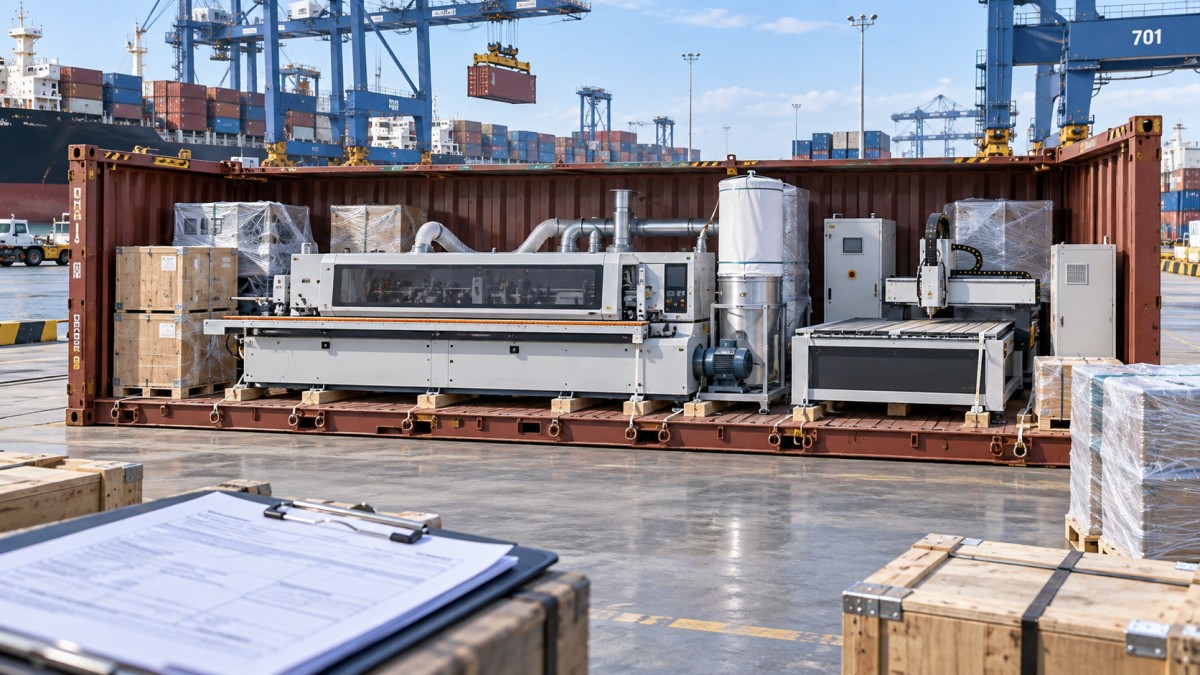
Woodworking machines are commonly heavy, oversized, or shipped in multiple packages. This makes documentation quality more important because customs records must reconcile with what is physically presented. A mismatch between the commercial invoice, packing list, bill of lading or air waybill, and declaration can lead to queries even when the machine itself is permissible to import.
Common points of friction include an invoice that uses a broad product name while the packing list names subassemblies differently; a net weight that does not align with package weights; an unclear separation between machinery, free spare parts, tooling, and installation materials; or a consignee name that differs from the registered importing entity. None of these errors necessarily indicates misconduct, but each can make an officer or broker seek clarification at the point when storage charges and installation deadlines become more pressing.
Documentation support is warranted when the shipment includes any of the following:
- Multiple machines packed in one container or under one transport document;
- Separate crates for control panels, motors, tooling, dust collection equipment, or conveyors;
- Free-of-charge spare parts, warranty replacements, or consumables;
- Used, refurbished, repaired, or demonstration equipment;
- Wooden packing material that may require treatment marks or supporting compliance evidence;
- Split shipments in which the main machine and essential components arrive separately;
- Payments involving deposits, staged payments, commissions, assists, or other additions relevant to customs valuation.
Used equipment requires particular attention. Authorities may request evidence of age, condition, valuation, or eligibility under local rules. A buyer should not assume that documentation suitable for a new machine will be sufficient for a second-hand unit. Likewise, a warranty replacement may have no new sale price, but it still requires an appropriate customs value and a clear explanation of its relationship to the original import.
Regulatory support is needed when compliance documents affect release or use
Customs clearance and product compliance are related but not identical. Customs determines whether goods may be released under the applicable import procedure. Product regulators may determine whether machinery may be placed on the market, connected to power, installed in a workplace, or operated commercially. In some destinations these processes overlap closely; in others they are handled by different authorities.
Woodworking machines raise compliance questions because they combine moving cutting or feeding components, electrical systems, pneumatic systems, guards, emergency-stop functions, and dust-related hazards. The applicable obligations depend on the destination and the product scope. It is not safe to assume that a document accepted in one market will satisfy another market’s requirements.
Support is appropriate when the importer must establish whether a declaration of conformity, technical file elements, local electrical approval, safety marking, translated manual, labeling, or importer identification is required. It is also useful where the project includes a machine that must be integrated into an existing line. The individual equipment may be capable of import, while the final installed system still requires a separate assessment of safeguarding, electrical integration, dust control, or workplace safety obligations.
A frequent mistake is treating a supplier-issued certificate as a universal clearance document. Certificates may be relevant, but their value depends on the issuing body, the standard cited, the exact model covered, and the destination’s legal requirements. The more reliable approach is to identify the destination-market requirement first, then request evidence that directly supports that requirement. Clearance support cannot replace product compliance work, but it can prevent a shipment from being sent with documents that are irrelevant, incomplete, or inconsistent.
Delivery terms can shift responsibility without removing risk
Incoterms define the allocation of delivery obligations and risks between seller and buyer, but they do not remove the need for an importer to understand customs responsibility. Under many common arrangements, the buyer is responsible for import clearance, duties, taxes, and local compliance even when the supplier arranges main carriage. A quotation described as “delivered” should be read carefully to confirm who is acting as importer of record, who pays destination charges, and whether duties and taxes are genuinely included.
For machinery imports, the choice between EXW, FOB, CFR/CIF, CPT/CIP, DAP, and DDP can materially change the clearance plan. EXW can place substantial export-handling responsibility on the buyer. FOB and similar shipment terms typically leave import formalities with the buyer. DAP delivers to an agreed destination but ordinarily leaves import clearance to the buyer. DDP places broad delivery obligations on the seller, yet it can be impractical or non-compliant if the seller cannot legally act as importer or manage local tax registrations.
Clearance support is valuable whenever the shipping term and the actual operating arrangement do not align. For example, a supplier may organize transportation to the port while the purchaser’s local entity must still provide tax details, import licenses, power-of-attorney documents, and funds for duties. If that responsibility is recognized only after arrival, the cargo may wait while paperwork is assembled.
Large machines turn clearance delays into project delays
The operational impact is more severe for equipment that cannot simply be stored and collected later. A long edge banding machine, for example, may require coordinated unloading equipment, factory access preparation, electrical readiness, compressed-air supply, and installation personnel. A unit such as the Beveling edge banding machine ZD450X, specified at 5900 × 950 × 1700 mm and 1600 kg, illustrates why clearance planning cannot be separated from logistics planning. Its dimensions, weight, and installation dependencies affect not only ocean or road transport but also the consequences of an unexpected customs hold.
That does not mean every large machine requires a specialist customs consultant. It means the clearance plan should match the cost of interruption. Where a delay would leave rigging contractors idle, interrupt a factory expansion, or create container demurrage and port storage exposure, the value of pre-arrival review rises sharply.
Support is also justified for shipments with a fixed commissioning window. Factory shutdown periods, leased-site handover dates, customer delivery commitments, and visa-dependent installation schedules can all make timing more valuable than the apparent saving from minimal clearance preparation.
Country of origin and valuation deserve review before the purchase order is finalized
Country of origin is not simply the country from which the vessel departs. It is determined under customs rules that may depend on where the machine was manufactured or substantially transformed. Origin can influence duty treatment, eligibility for preferential trade arrangements, trade-remedy measures, and documentation requirements. If preferential duty treatment is expected, the importer should confirm in advance what origin proof is required and whether the manufacturer can provide it accurately.
Customs value is another area where commercial arrangements can create unintended uncertainty. The invoice price is often central, but customs valuation rules may require consideration of items not visibly included in the unit price, such as certain commissions, packing, buyer-supplied components, royalties, or assists. Freight and insurance treatment can also vary according to the valuation method and local rules. A machine quotation that separates tooling, engineering, training, and spare parts should be reviewed for declaration consistency rather than consolidated casually after shipment.
Clearance support should be involved early when the transaction includes discounts, bundled equipment, no-charge items, third-party payments, related-party transactions, or unusual payment terms. These arrangements can be commercially legitimate; they simply need documentation that explains them clearly.
What a workable pre-shipment clearance review looks like
The useful question is not whether to outsource every customs task. It is whether the importer has enough verified information to authorize shipment with controlled risk. A practical review begins with the exact destination, importing entity, chosen delivery term, machine model, shipment composition, and expected arrival route. It then checks the commercial invoice, packing list, transport instructions, tariff treatment, required permits or compliance evidence, and the party responsible for filing and payment.
Technical information should be specific enough for a broker to understand the equipment without guessing. “Automatic woodworking machine” is weaker than a description that states the principal operation, material processed, power configuration, intended industrial use, dimensions, and included modules. The same discipline should apply to spare parts: each should have a recognizable description, quantity, unit value, and relationship to the main machine.
Importers should also confirm who can answer customs queries once cargo is in transit. The supplier may need to provide corrected documents or technical clarification; the broker may need authority to lodge declarations; and the receiving facility may need to coordinate delivery after release. The clearance process is more reliable when these responsibilities are assigned before loading rather than improvised at the destination.
The practical threshold for seeking support
Woodworking machine customs clearance support is most necessary when uncertainty could turn into a measurable financial or operational consequence. The threshold is reached when classification is unclear, documents describe a complex shipment poorly, destination compliance obligations are not confirmed, the importer’s role is uncertain, or a release delay would disrupt installation and production plans.
For a routine, well-documented repeat import into a familiar market, standard broker handling may be sufficient. For a first-time import, a multi-package machine, a high-value order, a used unit, a line integration project, or a shipment entering a tightly regulated destination, early specialist review is a risk-control measure rather than administrative overhead. The objective is not to guarantee that customs will never ask questions. It is to ensure that the answers, records, responsibilities, and cost assumptions are ready before those questions become expensive.
Send Your Inquiry
We welcome your cooperation and we will develop with you.