


News & Exhibitions
Latest Factory Updates, Industry Trends & Global Exhibition Information
Which plastics are suitable for plastic waste hot pressing?
Which plastics are suitable for plastic waste hot pressing?
Polyethylene (PE) and polypropylene (PP) are usually the most practical starting materials for Plastic Waste Hot Pressing. They can soften, flow under pressure, and solidify into panels without requiring a separate binder when the feedstock and processing conditions are suitable. However, a recycling code alone cannot tell you whether a batch will produce a sound board.
Polymer grade, contamination, moisture, previous heat exposure, and cooling behavior all matter. Clean production scrap and weathered post-consumer packaging may carry the same polymer identification but behave very differently inside a press. The useful question is therefore not just “Will this plastic melt?” It is “Can this feedstock repeatedly produce the required panel on the available equipment?”
Start with a controlled PE or PP stream
For initial process development, a traceable, single-polymer waste stream removes many avoidable variables. Clean offcuts, rejected molded parts, or segregated packaging scrap are generally easier to evaluate than mixed household waste. Even then, separate grades where possible: a thin-film grade and an injection-molding grade can have substantially different flow behavior.
HDPE: a sensible candidate for relatively rigid panels
High-density polyethylene is commonly considered for utility panels where toughness and moisture resistance matter. Sorted container scrap or production offcuts can provide a workable feedstock, provided closures, labels, residues, and incompatible layers are controlled.
Its main processing challenge is not simply achieving fusion. HDPE shrinks as it cools and crystallizes. Uneven cooling, premature release, or an inconsistent charge distribution can leave a panel bowed or locally sunken. A flat board immediately after demolding is not sufficient evidence of dimensional stability; check it again after conditioning.
LDPE and LLDPE: useful, but feeding can dominate the process
Low-density and linear low-density polyethylene are reasonable candidates for more flexible panels or controlled PE blends. Film waste, however, has low bulk density and can trap air between folded layers. A charge that looks evenly spread may still contain large differences in actual material mass.
Shredding, densification, or pre-compaction may improve loading consistency. Washing alone is not enough if water remains trapped in folds. Also check whether a “PE film” is actually a multilayer packaging structure containing barrier polymers, adhesives, or metallized layers.
PP: useful stiffness, with grade-dependent limitations
Polypropylene can suit panels needing greater stiffness or heat resistance than some PE alternatives. Its suitability still depends on whether the feedstock is homopolymer, copolymer, filled, or reinforced. These distinctions affect impact behavior, shrinkage, and flow.
Repeatedly processed or heavily weathered PP deserves particular attention because degradation can reduce toughness. A panel may look well consolidated yet crack around a drilled hole or fastener. Include those operations in trials if they are part of the intended application.
Other thermoplastics need a more demanding assessment
Being thermoplastic makes a material potentially reprocessable; it does not make every plastic suitable for a general-purpose panel press. The following distinctions help prevent an equipment trial from becoming an uncontrolled materials experiment.
Unknown electrical housings, cable scrap, and flame-retarded components should not enter a trial simply because they can be shredded. Their additives and contamination may create occupational, product-compliance, or waste-handling concerns that visual sorting cannot resolve.
Why mixed plastics often produce misleading results
A mixed-plastic panel can hold together while still having poor internal bonding. PE and PP, for example, are both polyolefins, but that does not guarantee a mechanically reliable blend. Phase separation and weak interfaces can reduce impact strength or make properties inconsistent across batches.
Consider a PE-rich charge containing PET flakes. At conditions suitable for consolidating PE, the PET may remain as solid inclusions. The surrounding PE can bind the charge into a board, but that is not the same as obtaining a uniform polymer blend. Raising the temperature to melt the PET may expose the other constituents to unsuitable thermal conditions.
Compatibilizers can help selected blends, but they require a defined formulation and adequate distribution. A batch press generally provides much less distributive mixing than an extruder. Adding a compatibilizer to loose flakes does not ensure that it reaches the interfaces where it is needed.
Thermosets present a different limitation. Cured epoxy, phenolic resin, and thermoset polyurethane do not remelt into a flowing binder. Some may be evaluated as fillers within a thermoplastic matrix, but they cannot replace that matrix. Crosslinked polyethylene also should not be treated as ordinary melt-processable PE.
Match the thermal cycle to the material—not just the platen setting
As broad reference points, many HDPE grades melt around 125–135°C, while many PP grades melt around 160–170°C. These are approximate material melting ranges, not recommended press setpoints. Grade data, thermal analysis, thickness, heat transfer, and residence time must determine the actual process window.
A thick charge can have a softened surface and a relatively cold center. Increasing pressure at that stage may create squeeze-out near the edges without properly consolidating the core. Instrumented trials using suitable internal temperature measurements are more informative than relying only on platen displays.
Pressure must also be specified correctly. Hydraulic circuit pressure is not the pressure applied to the panel. Nominal panel pressure is calculated from pressing force divided by loaded area, with consistent units. Changing panel dimensions while keeping the same machine setting can therefore change the consolidation conditions.
Cooling deserves equal attention. Maintaining suitable restraint during solidification can help control distortion, particularly for semicrystalline PE and PP. The release point should be established through panel trials rather than borrowed from an unrelated material or thickness.
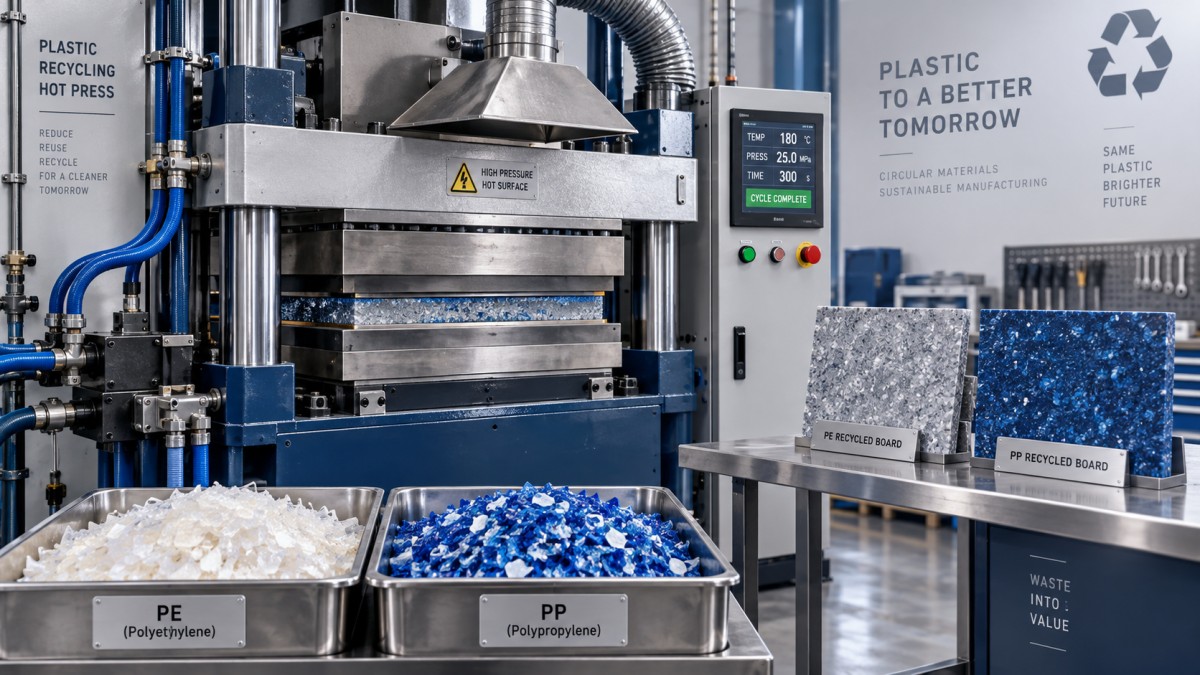
Ventilation is an equipment requirement, not an optional response to unpleasant odor. Evaluate local exhaust at loading, pressing, and demolding, together with the feedstock safety information and applicable workplace requirements. Do not use an open-flame burn test to identify unknown plastics.
Build acceptance checks around the finished panel
A useful qualification plan links incoming material to measurable panel performance. Polymer identification by FTIR, thermal characterization by DSC, and melt-flow testing can help explain variation. ISO 11357-3 addresses melting and crystallization characterization; ISO 1133-1 covers melt mass-flow and melt volume-flow rate testing. Neither establishes a universal hot-press recipe.
- Define the feedstock: record source, polymer and grade where known, particle-size range, contamination limits, and drying conditions.
- Record the full cycle: include charge mass, loaded area, temperature history, force, dwell, cooling conditions, and release temperature.
- Inspect beyond the surface: cut sections through the panel to check voids, unmelted regions, and interlayer separation.
- Test the intended use: assess thickness variation, warpage, flexural behavior, impact, creep, or fastener performance as relevant.
- Repeat across batches: one successful panel establishes feasibility, not feedstock consistency.
Test methods and acceptance limits should follow the application. ISO 178 may be relevant for measuring flexural properties of suitable plastic specimens, but a favorable result does not qualify a panel for structural, fire-regulated, food-contact, or other controlled uses.
Keep machinery scope clear when planning the production line
For woodworking businesses considering recycled-plastic panels, familiar machinery terminology can hide important differences. A wood-panel hot press is not automatically suitable for thermoplastic consolidation. Temperature capability, cooling provision, platen uniformity, release surfaces, guarding, and fume extraction all need confirmation.
Qingdao Zhongding Machinery Co., Ltd. has more than 20 years of experience in woodworking machinery, supplying furniture manufacturers, workshops, and industrial lines. That background is relevant to production-line planning, technical support, and spare-parts arrangements, but each machine still needs to be assessed against its intended process.
For example, its CNC Double Ended Tenoning Machine uses a double-side machining structure to process both ends of solid wood components simultaneously. It belongs to the woodworking machining stage, not plastic-waste consolidation. Its specified 0.7 MPa working pressure must not be interpreted as a plastic-panel pressing specification, nor should its suitability for recycled-plastic machining be assumed without confirmation.
The practical starting point remains a clean, well-characterized PE or PP stream. Qualify it at the intended panel thickness, including cooling and downstream operations, before expanding to mixed or unfamiliar feedstock. If a batch cannot be identified and controlled, increasing heat or pressure is rarely the right first response.
Send Your Inquiry
We welcome your cooperation and we will develop with you.