


News & Exhibitions
Latest Factory Updates, Industry Trends & Global Exhibition Information
Custom Woodworking Solutions: What to Include in Your Project Brief
A woodworking equipment quotation can look complete and still leave the most important questions unanswered. Will the proposed machine handle your longest component with the required finish? Can operators change between product families without losing the afternoon? Will the equipment fit the workshop once loading space and dust extraction are included?
For project managers sourcing custom woodworking solutions, the project brief is where those questions become measurable requirements. It connects production goals with workpiece specifications, machinery selection, factory conditions, and acceptance criteria. A useful brief does not need to prescribe every engineering detail. It needs to give your equipment partner enough evidence to propose a workable process—and make any remaining assumptions visible before you commit.
Start with the production problem, not a machine shopping list
“We need a CNC woodworking machine” is a purchasing request, not yet a project brief. Explain what the investment must change: perhaps inconsistent profiles are causing assembly problems, manual turning is limiting output, or frequent product changes are consuming skilled labor.
Describe the current process from incoming material to finished component. Identify where queues, rework, handling damage, or operator-dependent results occur. If the real constraint is sanding rather than machining, buying a faster cutting machine may simply move the queue downstream.
Keep the opening project statement short, but include:
- Product scope: the component families and end uses covered by the investment.
- Operational problem: the bottleneck or quality issue that needs resolving.
- Required outcome: measurable output, quality, labor, or changeover improvements.
- Project boundaries: whether the supplier is responsible for one machine, a production cell, or a wider workflow.
Separate confirmed requirements from future ambitions. Producing furniture legs today and accommodating longer wooden columns later are related goals, but they may lead to different equipment configurations and floor-space commitments.
Build a workpiece package that suppliers can evaluate
Machine suitability depends on the actual parts—not just their product category. “Stair components” could mean straightforward turned spindles or complex parts requiring additional operations. Provide representative drawings, photographs, and, where possible, physical samples.
Define the manufacturing envelope
List minimum and maximum finished dimensions alongside the incoming blank dimensions. Include gripping allowances, stock variation, and any features that restrict how the part can be supported. The longest finished component is not necessarily the longest blank the machine must accommodate.
A compact part matrix makes mixed production easier to assess:
Explain what “acceptable quality” means
Specify tolerances where they affect fit, function, or appearance. A joint interface may need tighter control than a decorative section that will be sanded. Mark critical dimensions on controlled drawing revisions rather than relying on general statements such as “high precision.”
Surface quality also needs context. State whether components proceed directly to finishing, receive light sanding, or undergo substantial secondary shaping. Approved samples can help communicate acceptable tear-out, tool marks, and profile transitions when words alone are ambiguous.
Wood movement complicates inspection. Record the intended moisture condition and measurement timing so that machining variation is not confused with dimensional changes after storage.
Turn output targets into realistic capacity requirements
A maximum feed rate does not tell you how many saleable parts a shift will produce. Loading, securing the blank, tool movements, unloading, inspection, and routine interruptions all affect actual capacity.
Give suppliers a production calendar: shifts per day, available hours, expected product mix, and typical batch sizes. Ask them to distinguish cutting time from complete cycle time and explain the assumptions behind their estimate.
For example: a requirement for 240 accepted parts during six net production hours implies an average of 90 seconds per accepted part across the proposed cell. That is a planning illustration, not a machine performance claim. The supplier still needs to demonstrate how handling, quality checks, rejects, and changeovers fit the target.
For high-mix workshops, request changeover estimates between representative parts. A machine that performs well on one long batch may be less suitable when operators must repeatedly change tooling, workholding, and programs.
Use machine specifications as a shortlist—not a final answer
Once the workpiece and output requirements are clear, individual machines can be evaluated against them. For solid-wood turning applications, the CA-1530 CNC Wood Lathe is relevant to furniture legs, stair components, wooden columns, and decorative parts.
Its listed maximum machining length is 1,500 mm, with 2,000 mm and 3,000 mm length options available for customization, and its listed maximum machining diameter is 300 mm. Those figures provide an initial capacity screen. Actual suitability still depends on blank geometry, support arrangements, tooling access, and the required profile.
The listed configuration includes a 4 kW motor, a spindle speed range of 0–3,000 r/min, super-hard-alloy tooling, and DSP control, with an LCD control panel optional. Include your wood species and representative profiles in the brief so the supplier can assess cutting conditions rather than assuming one setup will suit every material.
Be careful when interpreting control specifications. A minimum setting unit describes command increments; it does not, by itself, establish achievable part accuracy or surface finish. Ask for representative machining trials and documented inspection results before accepting a precision claim.
Describe the factory the solution must work inside
A machine drawing shows equipment dimensions. A production layout must also show how people, material, waste, and maintenance access move around it.
Supply a scaled floor plan with entrances, columns, clear heights, existing machines, storage areas, and proposed material routes. Identify where blanks arrive and where finished parts go next. Long components may need considerably more handling space than expected, particularly where operators turn or transfer them between stations.
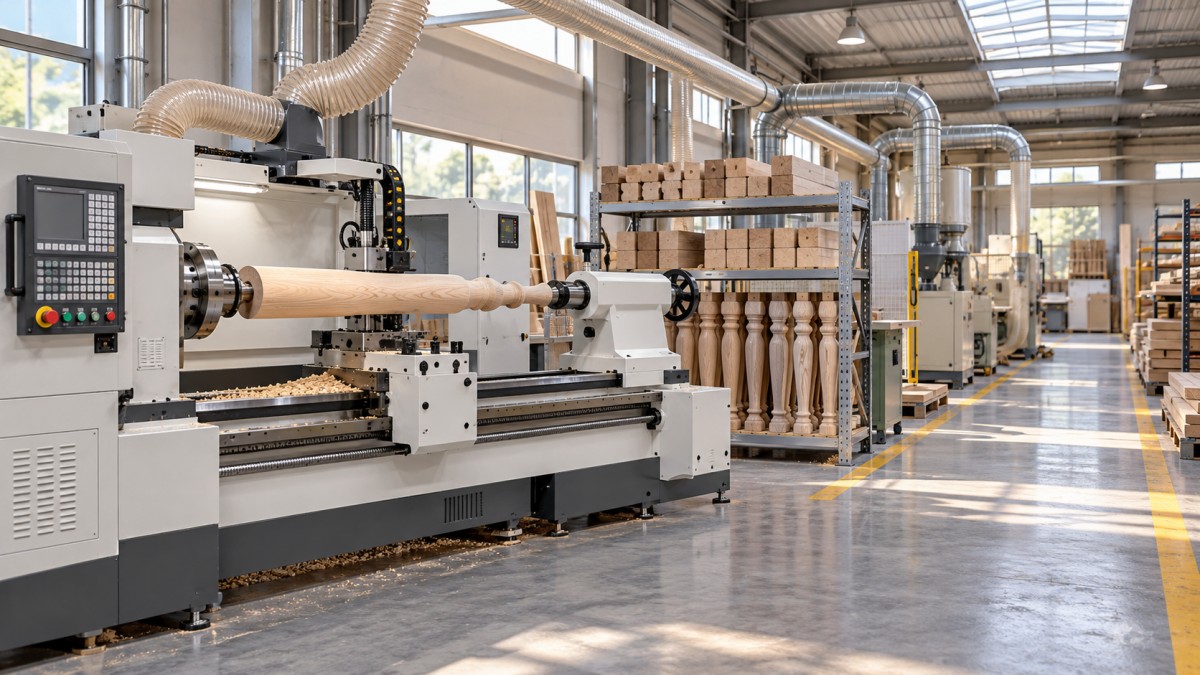
Document the available utilities rather than asking the supplier to assume standard conditions:
- Electrical supply: voltage, phases, frequency, available capacity, and connection location.
- Compressed air: available pressure, flow capacity, air quality, and connection points.
- Dust extraction: existing system capacity, proposed connections, and responsibility for ductwork.
- Installation access: delivery route, door openings, unloading arrangements, and floor constraints.
- Working environment: conditions relevant to equipment operation and local safety requirements.
For the lathe configuration discussed above, the listed electrical supply is AC 380 V, three-phase, 50/60 Hz, with 220 V customization available; listed air pressure is 0.6–0.8 MPa. Confirm the selected configuration and required utility capacity in writing.
Also distinguish shipping data from installed dimensions. Packaging measurements and gross weight support transport planning, but they do not define the operating footprint, service clearances, foundation requirements, or lifting procedure.
Specify automation around the operator’s actual work
“Fully automatic” can conceal very different responsibilities. Define who prepares blanks, loads parts, selects programs, checks the first component, removes waste, and handles exceptions. Then identify which tasks should be automated now and which may remain manual.
Describe operator experience, available programming skills, preferred interface language, and the source of design files. Ask the supplier to confirm supported file formats and the workflow from drawing to production; do not assume that CNC control guarantees direct compatibility with existing software.
For custom woodworking solutions involving several machines, allocate responsibility for interlocks, transfers, buffer storage, and controls integration. If future automation matters, ask what provisions can be incorporated now and what a later upgrade would require.
Training should be expressed as practical capability: operators should be able to set up an approved part, perform routine checks, recognize common faults, and restart safely under the agreed procedure. Maintenance staff need a separate handover covering scheduled tasks and troubleshooting boundaries.
Agree on acceptance before comparing final quotations
The most useful acceptance plan describes what will be demonstrated, with which material, and how the result will be judged. Include both factory acceptance testing before shipment and site acceptance after installation where appropriate to the project.
For each trial, define the sample parts, material condition, tooling, inspection method, and required documentation. Test representative difficult components as well as straightforward ones. A short, uncomplicated sample may not reveal problems with long workpieces, demanding profiles, or frequent changeovers.
- Quality: agreed critical dimensions, profile conformity, and surface condition.
- Capacity: observed complete cycle time under stated operating conditions.
- Repeatability: results across an agreed sample quantity, not one selected part.
- Changeover: demonstrated transition between specified product families.
- Handover: documentation, training records, and outstanding-issue closure.
Define who approves results and how deviations will be resolved. This gives both parties a shared basis for decisions when delivery pressure rises.
Make commercial scope and long-term support visible
A lower machine price may exclude tooling, extraction connections, installation labor, or training travel. Request itemized quotations that identify inclusions, exclusions, buyer responsibilities, delivery assumptions, and optional equipment.
Assess operating costs alongside purchase cost: tooling and sharpening, consumables, maintenance, spare parts, labor, energy, and expected secondary processing. Ask for the basis of any productivity or cost-saving estimate rather than accepting an unexplained payback figure.
For an international machinery project, support arrangements deserve particular attention. Confirm technical contact channels, service hours, remote troubleshooting requirements, recommended initial spares, warranty terms, and responsibility for onsite work.
Qingdao Zhongding Machinery Co., Ltd. brings more than 20 years of woodworking machinery experience to equipment and solution discussions, alongside technical support, spare parts supply, and after-sales service. A detailed brief helps turn that supplier experience into a defined project scope rather than a general equipment recommendation.
Send a decision-ready brief, even if some answers are pending
Before requesting a final proposal, assemble a controlled package containing the project objective, part matrix, drawings, production targets, site layout, utility information, automation responsibilities, acceptance plan, budget range, and schedule milestones. Assign an internal owner to approve changes affecting scope, cost, or performance.
Unknowns do not make a brief unusable. Unmarked assumptions do. Label open questions, assign responsibility for resolving them, and set a decision deadline. The strongest brief for custom woodworking solutions gives suppliers room to propose better methods while keeping the required outcome clear: a production process your team can install, operate, verify, and maintain.
Send Your Inquiry
We welcome your cooperation and we will develop with you.