


News & Exhibitions
Latest Factory Updates, Industry Trends & Global Exhibition Information
When does a turnkey woodworking production line fit panel furniture output?
For a panel furniture factory, the decision to install a Turnkey Woodworking Production Line is rarely about buying “more automation.” It is about removing the operational friction that appears when output grows beyond what separate machines, manual transfers, and spreadsheet-based scheduling can reliably handle. A standalone saw, edge bander, drilling machine, and packing station may work well in a smaller workshop. Once order volume rises, however, the gaps between those machines often become the real source of delay, rework, and missed delivery dates.
The right time for an integrated line is not defined by one universal production number. It depends on the mix of cabinet bodies, wardrobes, office furniture, shelving, kitchen components, and custom orders a factory must process each day. The more frequently panels change size, material, finish, and drilling pattern, the more important it becomes to manage the workflow as one connected system rather than a collection of individual workstations.
The point where standalone machines start creating hidden losses
Many expansion projects begin with a reasonable idea: add one machine where the bottleneck appears. If cutting is slow, buy a larger panel saw or nesting CNC. If edging is holding up assembly, add a faster edge bander. If drilling queues are growing, introduce a CNC drilling center. This approach can work when demand is stable and the existing layout still allows straightforward material flow.
The problem is that bottlenecks move. A faster saw may simply send more parts into an already crowded sorting area. A high-output edge bander can become underused because operators are still searching for the right cut panels. A drilling center may wait for batches because components were not sequenced correctly upstream. In these situations, the factory does not necessarily lack machine capacity; it lacks coordinated capacity.
A turnkey solution starts to fit when project managers repeatedly see symptoms such as unfinished work accumulating between processes, frequent manual panel identification, operators moving boards longer distances than expected, or production plans being changed because one department falls behind. These are not minor housekeeping issues. They indicate that output is constrained by flow, not just by machine speed.
Another warning sign is the growing cost of “keeping things moving.” Supervisors may spend a disproportionate amount of time assigning batches, tracing missing pieces, balancing overtime, or deciding which urgent order should bypass the normal route. When the production manager becomes the manual connection between every process, the plant is already operating like a line without the physical and digital structure of one.
Panel furniture output that usually benefits from integration
A Turnkey Woodworking Production Line is generally most suitable for factories producing repeatable panel-based products in meaningful volume: modular kitchens, wardrobes, flat-pack furniture, office desks, storage systems, cabinet carcasses, and similar products made from MDF, particle board, plywood, or laminated board. Repeatability matters because automation depends on predictable panel handling rules, machining sequences, and quality checkpoints.
This does not mean a factory must produce only standard products. Many panel furniture plants need to handle a large number of sizes and configurations. What matters is whether those variations can be driven from a structured bill of materials and machining data. If a cabinet order can be converted into reliable cutting, edging, drilling, and labeling instructions, an integrated line can manage variation far better than a manual batch workflow.
By contrast, a highly bespoke workshop may not need a full line immediately. If every job involves unusual materials, frequent hand fitting, irregular shapes, or changing construction details, flexible standalone equipment may remain the better commercial choice. Automation is valuable, but it should not force a factory into a production model that conflicts with its actual sales mix.
The key question is not, “How many boards do we process?” A better question is, “How many times do the same panels need to be touched, checked, sorted, or moved before they are ready for assembly?” If that answer is high, line integration deserves serious consideration.
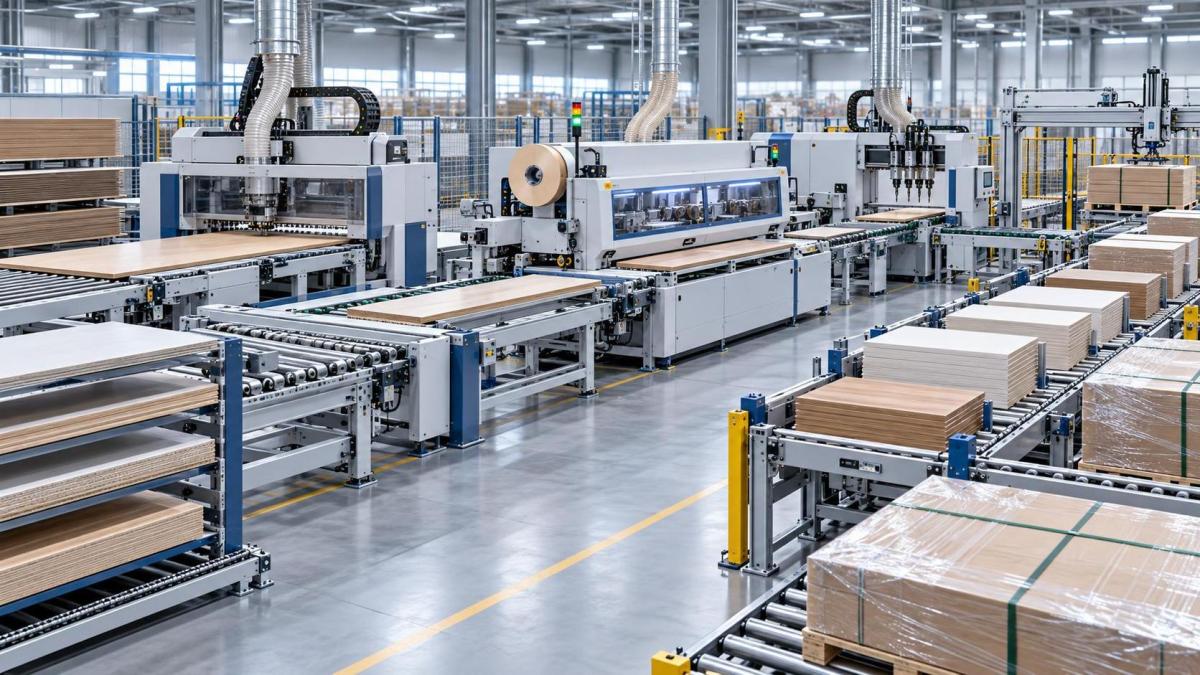
Where an integrated production line makes the biggest operational difference
In a well-planned panel furniture line, material movement follows the product route instead of operator convenience. Boards enter through storage and loading, move to cutting or nesting, receive identification, then continue through edging, drilling, routing where required, sorting, inspection, and packing. The exact sequence varies, but the principle remains the same: every process should receive the right component at the right time without unnecessary handling.
For project teams, this changes the discussion from individual machine specifications to system behavior. A saw may have an impressive cutting speed, but can downstream equipment accept that output? Can labels remain readable after machining and handling? Does the buffer provide enough breathing room for normal variation without becoming a warehouse of half-finished panels? Is there a practical route for rejected parts to be remade without disrupting the main flow?
These details are where turnkey projects succeed or fail. A line that looks efficient on a layout drawing can be awkward in operation if it ignores real issues such as forklift paths, dust extraction routing, maintenance access, panel orientation, shift handover, or the location of finished-goods staging. Experienced project planning is less glamorous than machine selection, but it prevents expensive changes after installation.
The finishing stage can determine the line’s real capacity
For factories producing their own decorative boards, lamination must be considered as part of the production strategy rather than as a separate material-preparation task. A shortage of finished boards, inconsistent surface quality, or slow changeovers in the pressing department will affect every downstream process.
A short-cycle press is relevant where the factory needs to laminate melamine-impregnated paper onto MDF, particle board, or plywood with a controlled and repeatable process. For example, the Short Cycle Melamine Paper Lamination Hot Press Machine for MDF, Particle Board & Plywood is designed for double-sided veneer processing with broadwise feeding. Its specified 2000-ton pressing capacity, heat-conduction-oil heating system, PLC and touch-screen control, and adjustable infeed and outfeed speed point to the type of equipment used in higher-throughput board finishing operations.
In practice, the important issue is not simply press force or installed power. It is whether temperature uniformity, pressing cycle, board alignment, loading, and unloading are matched to the decorative paper, substrate condition, and required surface finish. High-gloss, matt, textured, embossed, and wood-grain surfaces can each place different demands on plate condition and process control. Precision-ground heating platens and suitable cushion pads can help reduce risks such as uneven bonding, bubbles, or visible surface defects, but the final result still depends on disciplined material and process management.
When automation solves a labor problem—and when it does not
Labor availability is often a reason to investigate a turnkey line, especially where skilled operators are difficult to recruit or retain. Automated loading, panel transfer, alignment, labeling, stacking, and return systems can reduce repetitive manual tasks and make output less dependent on a few experienced individuals. That is a legitimate advantage, particularly for plants running multiple shifts.
Still, automation does not eliminate the need for capable people. It changes where their attention is needed. Instead of manually carrying panels and sorting piles, operators must understand machine status, material quality, software instructions, tool condition, and exception handling. If the factory has no plan for operator training, preventive maintenance, spare-parts management, or basic production data discipline, a sophisticated line may be underutilized.
Project managers should be particularly cautious about assuming that automation will fix poor order data. Wrong panel dimensions, incomplete hardware information, inconsistent naming conventions, and late design changes can travel through an automated line faster than they travel through a manual workshop. The result is not efficiency; it is faster production of incorrect parts.
A practical fit check before committing to a turnkey project
Before choosing a complete solution, map the current process with actual observations rather than assumed cycle times. Follow several orders from raw board to packed components. Record where panels wait, how often they are handled, where identification fails, and what causes remakes. Include the awkward work that is rarely shown in a formal process chart: searching for missing components, separating mixed batches, rechecking labels, and moving boards around a blocked aisle.
The following conditions usually support a stronger business case for a connected line:
- Output is constrained by repeated handling and waiting between existing machines.
- Product demand is sufficiently stable to justify a planned production route, even if sizes and configurations vary.
- Orders can be converted into reliable cutting lists, machining programs, and panel labels.
- The facility has enough space for machine flow, buffers, dust collection, electrical infrastructure, maintenance access, and safe material movement.
- Management is prepared to standardize part coding, scheduling discipline, quality checks, and maintenance responsibilities.
- The investment is evaluated against total operating cost, not only against the purchase price of each machine.
Conversely, it may be premature to install a full turnkey line when sales forecasts are uncertain, factory layout cannot support a logical flow, or core product specifications change too frequently to establish dependable routing. In those cases, a phased plan may be more sensible: improve data preparation and labeling first, replace the genuine bottleneck, then add automation modules as demand becomes clearer.
Do not treat layout, utilities, and service as afterthoughts
A turnkey project is an engineering project, not just a purchasing exercise. Electrical load, compressed air, dust extraction, heat management, foundations where required, transport routes, installation sequence, and access for service all need early review. This is especially important for presses and other heavy equipment. A machine’s nominal dimensions are not the same as the space needed to load materials, remove panels, maintain hydraulic components, or safely access control cabinets.
The supplier’s role should extend beyond shipping equipment. Qingdao Zhongding Machinery Co., Ltd., with more than 20 years in woodworking machinery manufacturing and export, approaches complete woodworking solutions with attention to equipment reliability, technical support, spare-parts availability, and after-sales response. Those elements matter because production lines are long-term operating assets. A low initial price has limited value if replacement parts, troubleshooting, or process support are difficult to obtain later.
During technical discussions, ask for clarity on line boundaries. Which conveyors, loaders, safety devices, software interfaces, dust connections, and commissioning tasks are included? Who is responsible for coordinating third-party systems? What site conditions must be ready before installation? Vague responsibility lines are a common source of schedule pressure during commissioning.
The decision is about control, not maximum automation
A Turnkey Woodworking Production Line fits panel furniture output when the factory needs to control flow across several connected processes, not merely increase the speed of one machine. It becomes more compelling when recurring orders, rising labor pressure, frequent handling errors, surface-quality requirements, and delivery commitments expose the limits of disconnected production.
The best projects are usually neither the smallest nor the most automated on paper. They are the ones sized around the factory’s real product mix, available infrastructure, material strategy, and operating discipline. Start with the process that causes the most daily disruption, test the proposed flow against actual orders, and make sure every automated section has a clear purpose. That is how a complete line becomes a practical production tool rather than an expensive collection of machines.
Send Your Inquiry
We welcome your cooperation and we will develop with you.