


News & Exhibitions
Latest Factory Updates, Industry Trends & Global Exhibition Information
When should cabinet makers upgrade their production machinery?
When Should Cabinet Makers Upgrade Their Production Machinery?
For cabinet makers, upgrading production machinery becomes necessary when current equipment limits profitable growth, creates recurring quality problems, or makes delivery performance unreliable.
The strongest signal is not simply machine age. It is the widening gap between what the factory can consistently produce and what customers expect.
For decision-makers, wood product manufacturing machinery for cabinets should be evaluated as an operational investment, not merely as a replacement purchase.
Start With the Business Problem, Not the Machine Specification
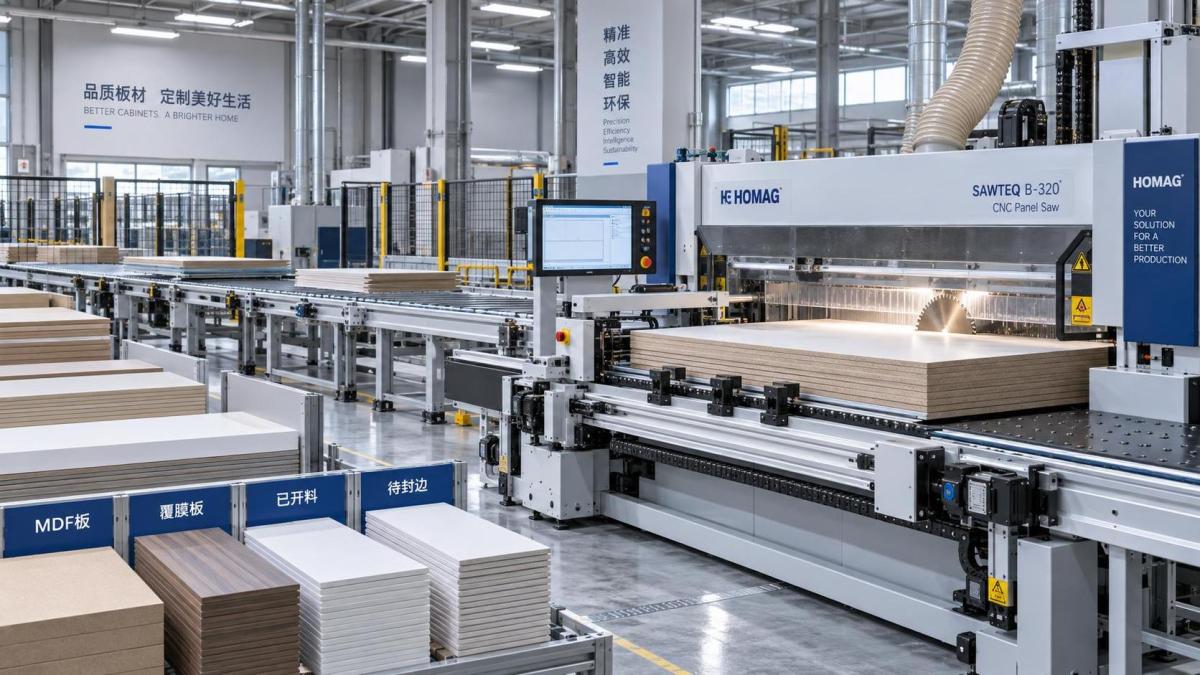
Before comparing equipment, cabinet manufacturers should identify which business problem requires correction: insufficient capacity, poor precision, excessive labor cost, material waste, or delayed orders.
A machinery upgrade makes sense when the existing process prevents the business from accepting profitable work or serving strategically important customers with confidence.
Many factories first notice the problem through overtime. Operators work longer hours, yet order backlogs remain, production schedules change frequently, and delivery dates become difficult to protect.
However, overtime alone does not prove that new equipment is required. Management should determine whether the constraint is cutting, drilling, edge banding, assembly, planning, or material handling.
For example, a cabinet factory may have sufficient assembly labor but lose production time because panel cutting requires repeated manual measurement, repositioning, and correction.
In that situation, adding more workers may increase cost without resolving the underlying bottleneck. Better cutting automation can create more usable capacity across the entire line.
The most effective upgrade decisions begin with measurable evidence. Track machine downtime, setup time, daily output, reject rates, rework hours, material yield, and late deliveries.
Once these figures are visible, decision-makers can distinguish a temporary workload spike from a structural production limitation that justifies capital expenditure.
Recognize the Warning Signs of an Equipment Bottleneck
Production machinery should be upgraded when its limitations occur repeatedly, rather than only during unusual seasonal demand or an isolated large customer project.
One common warning sign is unstable dimensional accuracy. Cabinet components that require repeated trimming, adjustment, or re-cutting consume labor and can delay downstream operations.
Another sign is excessive setup time between cutting lists. If operators spend too much time entering measurements, moving panels, and checking cuts, throughput declines quickly.
Manual cutting methods can remain appropriate for custom work, prototypes, and low-volume workshops. They become less efficient when order variety and batch frequency increase.
Frequent material damage is also important. Chipped laminate surfaces, inaccurate panels, and incorrect nesting reduce gross margin because panel material is expensive and difficult to recover.
Management should also examine whether maintenance interruptions are becoming normal. Rising repair frequency, unavailable spare parts, and unpredictable stoppages create risks beyond direct repair expenses.
Older machinery may still function, but it can become commercially inadequate when its speed, repeatability, safety features, or controls no longer support customer requirements.
A practical threshold is reached when supervisors spend much of each day manually coordinating problems that a more integrated production system could prevent.
Calculate Whether the Upgrade Can Deliver a Real Return
Capital decisions should be based on expected financial improvement, not on a supplier quotation alone. The correct question is how the equipment changes cost, capacity, and risk.
Begin by calculating the current cost of the bottleneck. Include operator hours, overtime premiums, rejected panels, rework, unplanned downtime, delayed shipment penalties, and lost sales opportunities.
Then estimate the improvement conservatively. Avoid assuming every available production hour will become billable output, especially during installation, operator training, and initial process adjustments.
In many cabinet operations, labor savings are only one part of the return. Better accuracy can reduce material loss while faster cycle times release capacity for additional orders.
Capacity has value only when demand exists or can reasonably be developed. Decision-makers should connect projected output to current order forecasts, sales pipelines, and customer commitments.
Consider the effect on contribution margin rather than revenue alone. High-volume cabinet programs may be attractive only if cutting precision and material utilization remain under control.
A useful payback model compares total investment with annual gains from lower operating costs, reduced waste, higher profitable throughput, and avoided outsourced processing expenses.
Total investment should include transportation, installation, electrical work, compressed air preparation, software, tooling, training, maintenance arrangements, and the working capital needed during implementation.
Management should also consider downside scenarios. Test whether the investment remains reasonable if utilization reaches only seventy percent of the planned level or material savings are lower than expected.
Why Panel Cutting Often Becomes the First Upgrade Priority
For many cabinet factories, panel cutting is the foundation of production performance. Errors at this stage are carried into drilling, edging, assembly, packing, and installation.
Inaccurate cutting can cause visible gaps, poor alignment, unusable doors, and difficult assembly. These defects damage both direct margins and the customer’s perception of workmanship.
Fast, repeatable panel cutting also improves planning. Production managers can issue optimized cutting schedules with greater confidence when equipment follows programmed dimensions consistently.
This matters particularly for furniture manufacturers processing MDF, plywood, particleboard, and laminate boards in multiple sizes, finishes, and cabinet configurations each day.
Automated saws can reduce reliance on individual operator judgment. Skilled employees remain valuable, but standardized controls make results less dependent on one person’s experience.
For businesses expanding from project-based work into repeatable cabinet programs, a reliable cutting platform can provide the consistency required to scale without proportionally increasing headcount.
That does not mean every workshop needs a fully automated line immediately. The suitable level of automation depends on volumes, panel formats, available space, and workflow maturity.
The decision should focus on removing the most expensive constraint first. A sophisticated machine will not provide expected value if poor planning or weak downstream capacity remains unchanged.
Match Machinery Capacity to Your Cabinet Production Model
Cabinet makers should select machinery according to their actual operating model, not simply the highest available specification. Production patterns determine which capabilities matter most.
Custom cabinet workshops often need fast changeovers, flexible programming, and dependable accuracy across small batches. Large cabinet factories may prioritize speed, automation, and continuous panel handling.
Manufacturers serving developers or furniture brands should assess peak demand periods. Equipment capacity must support scheduled surges without creating excessive idle capacity during normal months.
Panel dimensions are equally important. The machine must accommodate the factory’s common sheet sizes, required cutting thicknesses, and narrow component requirements without unnecessary secondary processing.
Layout constraints deserve early attention. Machinery dimensions, loading access, safety zones, material flow, electrical requirements, and compressed air connections can affect installation cost and daily usability.
Decision-makers should map movement from panel storage through cutting, sorting, edging, drilling, assembly, and packing. Good machinery performs poorly when material handling creates new delays.
Integration requirements should be reviewed before purchase. Ask whether the machine can accept production data from existing design, optimization, or enterprise systems with manageable operational complexity.
The goal is not maximum automation at any price. It is an equipment configuration that improves throughput, quality, and control at a utilization level the business can sustain.
Assess Precision, Speed, and Automation in Practical Terms
Technical specifications matter because they influence production outcomes, but they should be translated into practical questions about cabinet quality, output stability, and operating cost.
Cutting accuracy affects whether parts fit correctly on the first attempt. Servo positioning accuracy supports repeatability when identical dimensions are required across many cabinet components.
Sawing speed matters when panel volumes are high, but the factory should evaluate complete cycle time, including feeding, positioning, cutting, unloading, sorting, and operator intervention.
Automatic feeding systems can improve consistency and reduce physical handling demands. Their value increases when factories process many panels per shift or face recurring labor availability challenges.
For example, the HEAVY DUTY CNC BEAM SAW ZD280 is designed for automated and precise cutting of wood panels, MDF, plywood, and laminate boards.
Its listed sawing accuracy of plus or minus 0.1 mm and servo positioning accuracy of 0.02 mm can support cabinet factories seeking more repeatable panel processing.
The ZD280 handles cutting lengths and widths up to 2850 mm, with standard cutting thickness up to 100 mm and an optional 120 mm configuration.
Its cutting speed and return speed can reach 120 meters per minute, while intelligent CNC control and automatic positioning help reduce manual measurement requirements during repetitive production.
Specifications should still be verified against the buyer’s actual materials, cut lists, production volume, tooling needs, operator skills, and local service expectations before a final purchase decision.
Reduce Implementation Risk Before Placing the Order
A good machinery decision can fail through poor implementation. Management should treat commissioning as a production change project with defined responsibilities, milestones, and performance targets.
Ask suppliers for a clear pre-installation checklist covering foundations, floor conditions, power supply, compressed air, dust extraction, machine access, and material loading arrangements.
Training should cover more than basic operation. Operators and supervisors need instruction on programming, daily inspection, blade selection, error handling, cleaning, and safe shutdown procedures.
It is also important to establish new production standards. Without accurate cutting lists, labeling methods, material identification, and work sequencing, automation cannot deliver full benefits.
Before acceptance, test representative cabinet parts rather than only simple demonstration panels. Include common materials, narrow strips, laminate surfaces, and frequently ordered cabinet dimensions.
Define acceptance criteria in advance. These may include cutting precision, cycle times, waste levels, machine availability, operator safety, and the quality of technical response from the supplier.
Spare parts support should be discussed early, particularly for international purchases. Confirm normal lead times, recommended critical spares, remote diagnostics options, and available service channels.
Qingdao Zhongding Machinery Co., Ltd. emphasizes long-term technical support, spare parts supply, and after-sales responsiveness, which should be evaluated alongside the machine’s technical capabilities.
Know When to Repair, Retrofit, or Replace
Replacing machinery is not always the right answer. A repair or retrofit may be financially sensible when the machine frame remains sound and the limitation is isolated.
Retrofit options can include updated controls, improved safety devices, replacement drives, or new measuring systems. These choices may extend useful life at lower initial cost.
However, retrofitting becomes less attractive when core mechanical wear, inaccurate movement, obsolete components, weak safety performance, and repeated downtime occur together.
Managers should compare the lifetime cost of continuing repairs with replacement. Include lost production, quality risk, emergency labor, unavailable parts, and the opportunity cost of limited capacity.
A replacement is usually justified when existing equipment cannot meet current customer standards even after reasonable maintenance, calibration, and process improvements have been completed.
The decision is especially urgent when equipment failure threatens key accounts. Losing a reliable customer because of repeated late delivery often costs more than planned modernization.
Replacement should also be considered when company strategy changes. A factory entering higher-volume cabinet production may need different equipment than a workshop serving local custom projects.
Build a Decision Framework for the Next Machinery Upgrade
Cabinet makers should upgrade production machinery when the investment solves a verified operational constraint and produces a defensible improvement in profitability, quality, or customer reliability.
The decision should be supported by production data, realistic demand forecasts, total cost analysis, workflow planning, supplier due diligence, and a practical implementation schedule.
For wood product manufacturing machinery for cabinets, the best purchase is rarely the lowest-priced option or the most advanced model. It is the machine aligned with business needs.
When cutting bottlenecks, material waste, inconsistent dimensions, and delivery pressure become recurring problems, modern CNC equipment can provide a clear path toward scalable cabinet production.
Decision-makers who measure the current constraint, evaluate lifetime value, and plan commissioning carefully can turn machinery investment into stronger margins and more dependable customer service.
Send Your Inquiry
We welcome your cooperation and we will develop with you.