


News & Exhibitions
Latest Factory Updates, Industry Trends & Global Exhibition Information
Which machinery features prevent chipping when machining MDF?
Which Machinery Features Prevent Chipping When Machining MDF?
Clean, chip-free MDF edges depend on more than cutting speed. They are the result of a controlled machining system in which the machine structure, cutter condition, panel support, feeding accuracy, dust removal, and operator safeguards all work together. For quality-control and safety managers, choosing wood product manufacturing machinery for MDF is therefore not only a production decision. It is a decision about repeatability, reject rates, workplace cleanliness, and the ability to keep operators away from preventable hazards.
MDF has a smooth, uniform core, but its surface layers can be unforgiving. A dull tool, an unstable spindle, a poorly aligned pressure beam, or insufficient support near an exit point may leave fuzzy fibers, breakout, corner damage, or visible chipping beneath a decorative finish. These faults may look minor at the machine, yet become expensive when panels reach edge banding, assembly, inspection, or the customer.
The most reliable selection process begins by asking a practical question: What keeps the panel and the cutting tool stable at the exact moment the material is being cut? The following features provide the clearest answer.
Start with machine rigidity, not feed-speed claims
Machine rigidity is the foundation of edge quality. If the spindle carriage, saw unit, routing head, or machine bed vibrates under load, the cutting edge repeatedly strikes the MDF surface instead of shearing it cleanly. The result can be a ragged edge that varies from one panel to the next. A machine may still appear productive, but quality inspection will reveal inconsistent chip patterns, especially on long cuts and thin or narrow parts.
When evaluating equipment, inspect the construction of the base frame, linear guides, spindle mounts, pressure units, and working tables. A well-supported machine frame reduces vibration transmission. Precision guideways help the cutting head follow a stable path, while firmly mounted spindles keep runout under control. These details are particularly important in operations that run several shifts, because small mechanical play can grow into visible quality variation over time.
For quality teams, a useful acceptance check is not simply whether the machine makes one clean sample. Request repeated cuts using the same MDF type, thickness, coating condition, and program. Then compare edge quality from the first panel to the last. Repeatability is more meaningful than a single demonstration piece.
Precision spindle systems protect the cut line
A stable spindle is one of the most direct chipping-prevention features in MDF machining. The spindle must maintain the intended tool speed without excessive radial runout, heat buildup, or vibration. Even a high-grade compression cutter cannot compensate for a poorly controlled spindle. If the cutter rotates off-center, each flute contacts the board differently, producing a rough edge and uneven wear.
Look for machinery that supports accurate spindle alignment, reliable bearings, and appropriate speed control for the planned operation. CNC routers, boring machines, panel saws, and edge-processing lines should allow operators to match cutter geometry and rotational speed to panel density, thickness, laminate type, and feed rate.
Tooling choices matter just as much. For exposed MDF edges, sharp carbide or diamond-tipped cutters are commonly used depending on production volume and material demands. Compression tooling can reduce breakout on coated boards by applying opposing cutting directions along the panel face. However, its benefit depends on setting the correct cutting depth and ensuring the compression zone is positioned properly relative to the panel surface.
Quality managers should include cutter wear in routine inspection plans. Chipping is often blamed on the machine when the real cause is a tool that has exceeded its usable life. A documented change schedule based on material type, running hours, edge appearance, and cut length is more dependable than replacing tools only after defects become obvious.
Controlled feed systems prevent tearing at entry and exit
MDF does not respond well to uncontrolled movement. A panel that hesitates, slips, tilts, or shifts sideways during cutting can tear at the edge even when the spindle and tool are in good condition. This is why feed design deserves the same attention as the cutting unit.
In wood product manufacturing machinery for MDF, look for servo-controlled feeding, pressure beams, synchronized conveyor belts, and adjustable hold-down devices. These systems maintain a steady relationship between the tool and the panel. Smooth, constant feed prevents sudden cutter loading; secure hold-down pressure keeps the workpiece flat; accurately aligned fences and guides stop lateral drift.
The best pressure setting is not necessarily the highest one. Too little pressure allows vibration and movement. Too much may mark the board surface, deform lightweight panels, or cause excessive friction. The machine should make adjustments straightforward enough that production and quality personnel can establish settings for different board thicknesses and surface finishes.
Narrow panels require special attention. A minimum panel-width specification is not just a capacity figure in a brochure; it can affect safety and finish quality. If a workpiece is insufficiently supported, it may wobble at the cutter or become difficult to guide safely. Where narrow components are common, evaluate auxiliary support devices, automatic positioning, and the machine’s ability to maintain stable pressure along short or small parts.
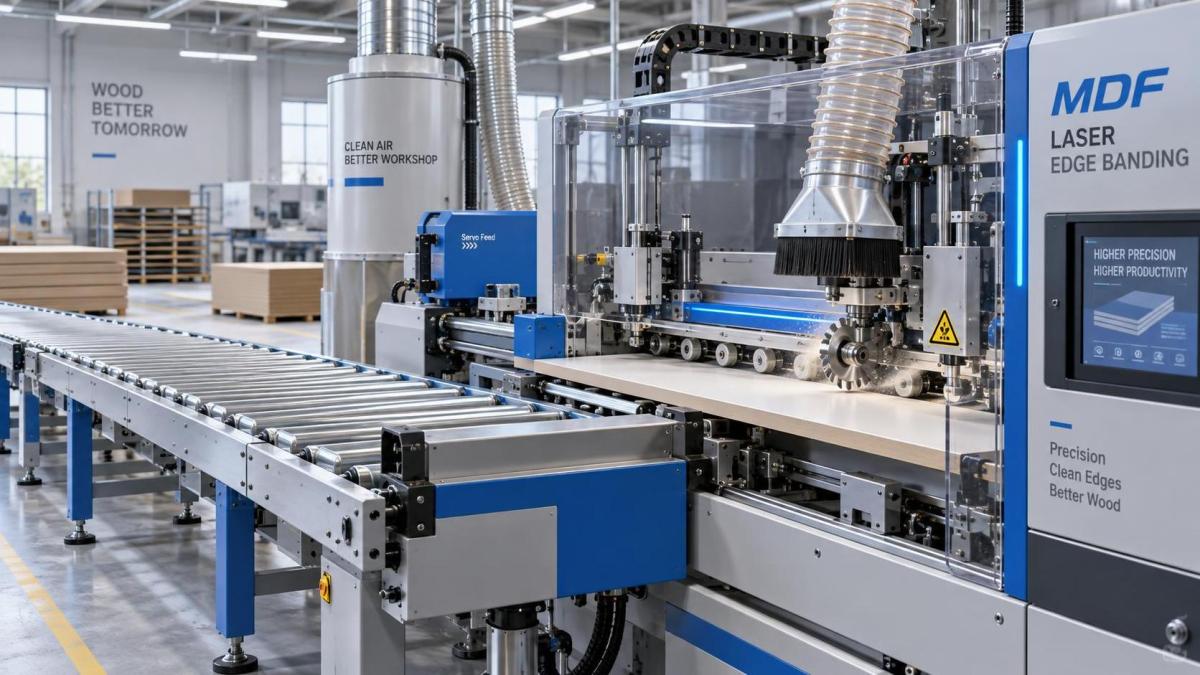
Scoring, pre-milling, and trimming units each solve a different defect
Not all chipping originates in the same stage, so a machine should be assessed according to the actual process route. For panel sizing, a correctly adjusted scoring saw can reduce breakout on laminated or melamine-faced MDF. The scoring blade creates a controlled shallow cut on the underside before the main saw blade completes the cut. Its alignment must match the main blade kerf; otherwise, the scoring action may create its own visible defects.
For edge banding, pre-milling units are especially valuable when panel edges have saw marks, minor breakout, or inconsistent squareness. A pre-milling station removes a small amount of material and creates a clean, consistent substrate before adhesive or laser edge tape is applied. This can improve the visual quality of the finished edge and reduce the risk that small chips remain visible beneath the banding.
Fine trimming, scraping, and buffing units should be judged as finishing controls rather than cosmetic extras. Their role is to remove excess banding material without cutting into the panel face or damaging the edge. Accurate copying systems, stable trimming motors, and easy adjustment are important because a poorly set trim unit can create a fresh chip after the earlier machining stages have already produced a good edge.
Dust extraction is a quality feature and a safety control
MDF dust is extremely fine, and it quickly finds its way into cutting zones, guides, sensors, and moving parts. Inadequate extraction can leave dust packed around a cutter, interfere with panel contact surfaces, obscure inspection, and increase the chance of heat and friction at the tool. It also creates a serious occupational health concern that safety managers cannot treat as secondary.
Effective dust extraction begins with properly designed hoods positioned close to the cutting or trimming point. The extraction system should capture dust before it is carried across the panel surface or deposited inside the machine. Evaluate duct connection size, hood access for cleaning, airflow compatibility with the plant’s central extraction system, and whether the design leaves blind areas where debris accumulates.
A clean machine also makes quality issues easier to diagnose. If a defect is covered by dust, operators may continue producing nonconforming parts before the problem is noticed. Clear visibility around the cutting zone, together with scheduled cleaning and filter maintenance, supports faster intervention.
From a safety perspective, machine selection should also include guarding, interlocks, emergency stops, lockout points, and safe access for tool changes and cleaning. A guard that is difficult to open, a dust hood that obstructs maintenance, or an emergency control that is poorly located often leads to unsafe workarounds. The safer design is usually the one that makes correct daily behavior easier.
Panel support after the cut is often overlooked
Chipping can occur after the cutter has done its job. As a panel exits a saw, router, or edge-processing machine, an unsupported offcut may drop, twist, or strike a guide. Corners can break, fragile edge treatments can crack, and operators may be tempted to catch moving material by hand.
Outfeed tables, roller supports, air flotation systems, automatic stackers, and correctly positioned side guides all contribute to better results. The appropriate arrangement depends on panel size, weight, throughput, and whether the parts are transferred directly to edge banding or assembly. Quality managers should observe the entire travel path, not only the point of machining. A clean edge can be damaged in the few seconds between cutting and stacking.
Why edge banding technology affects the perception of chipping
In furniture and cabinet production, customers frequently judge MDF quality by the finished edge, not by the raw machined board. A precision edge banding process can therefore protect the work already achieved during sizing and pre-milling. Seamless application is particularly relevant for visible cabinet doors, retail fixtures, modern furniture, and high-touch interior components.
For manufacturers using PVC, laser edge tape, and wood-panel applications, the Laser Edge Banding Machine ZD450F is designed for zero-joint edge banding with automated processing functions. Its stated feed-speed range of 10–23 m/min allows production teams to align operating pace with panel condition and finishing requirements rather than treating maximum speed as the only target. The machine accommodates panel thicknesses from 10–40 mm, edge banding thicknesses of 1.0–3.0 mm, and panel widths of at least 60 mm.
Those figures should be reviewed against the factory’s real product mix. If narrow cabinet parts, thicker worktops, or delicate decorative panels are part of the daily schedule, the quality team should verify that feeding pressure, pre-milling setup, trimming adjustments, and outfeed support remain consistent across those variations. A zero-joint finish cannot hide a severely chipped substrate; it works best when the preceding machining stages have already created a clean and stable edge.
A practical evaluation routine before approving MDF machinery
Instead of evaluating a machine only through specifications, involve production, quality, maintenance, and safety personnel in a shared trial. Each department sees a different risk: production notices cycle interruptions, maintenance notices difficult access, quality sees edge inconsistency, and safety personnel see exposure points that may not appear in a sales demonstration.
- Run representative MDF samples: Include coated and uncoated panels, different thicknesses, and the smallest parts commonly produced.
- Inspect all four edges: Check entry points, exit points, corners, and areas near changes in feed direction. Use consistent lighting and agreed visual acceptance criteria.
- Test at realistic production settings: A slow sample run does not prove performance at normal feed rates or during longer shifts.
- Review adjustment access: Confirm that operators can safely set fences, pressure elements, scoring blades, and trimming units without improvised methods.
- Check dust behavior during operation: Look beyond the extraction port. Observe airborne dust, buildup inside guards, and debris on the panel surface.
- Ask how faults are detected: Sensors, clear controls, accessible emergency stops, and simple maintenance indicators can limit the number of defective panels produced before intervention.
The right machine is the one that holds quality steady
Preventing MDF chipping is rarely about finding one “magic” feature. It comes from selecting machinery with a rigid structure, accurate spindle performance, secure panel feeding, suitable cutting and pre-milling options, effective extraction, and safe material support. Just as importantly, those features must remain accessible for inspection, cleaning, adjustment, and maintenance.
For quality-control and safety managers, the most valuable wood product manufacturing machinery for MDF is equipment that makes good practice repeatable. When the machine controls movement, dust, tooling conditions, and operator access in a disciplined way, clean edges become less dependent on luck or individual operator technique. That creates a calmer production floor, fewer rejected panels, and a finished product that better reflects the care invested in every stage of manufacturing.
Send Your Inquiry
We welcome your cooperation and we will develop with you.