


News & Exhibitions
Latest Factory Updates, Industry Trends & Global Exhibition Information
Can automated wood product manufacturing machinery reduce handling errors?
Automation can reduce handling errors, but only when it controls the error-prone handoffs
Automated wood product manufacturing machinery can reduce handling errors substantially, especially where panels, veneers, doors, or laminated components move through repeated cutting, feeding, pressing, stacking, and transfer steps. The benefit does not come simply from replacing operators with motors or conveyors. It comes from making the movement, orientation, timing, and process conditions repeatable.
For a project manager, the useful question is therefore more specific: which handling mistakes are causing loss on the existing line, and can automation remove the decision or physical action that creates them? A line may suffer from incorrect panel orientation, missed adhesive open time, off-center loading, damage during transfer, mixed batches, or inconsistent stacking. Each has a different root cause. Equipment that automates one transfer point may improve output without solving errors created upstream by poor material identification or unstable incoming panel quality.
The strongest results usually appear where manual handling is frequent, the workpiece is large or awkward, and a small positional deviation affects the next operation. Panel production, veneer lamination, plywood work, melamine-faced boards, decorative panels, and door manufacturing all fit this pattern. In these operations, automated loading, guided transfer, controlled feeding, and programmed press cycles can reduce variation that is difficult to manage through operator training alone.
Where handling errors originate on a woodworking line
Handling is often treated as a simple supporting activity between value-adding machines. In practice, it determines whether the machine receives the correct material in the correct condition. A precision saw, CNC router, edge bander, or press cannot compensate reliably for a board that arrives skewed, damaged, mismatched, or outside the planned process window.
Common handling errors can be grouped into four practical categories.
- Position and orientation errors: a panel is loaded off-center, reversed, skewed, or presented with the wrong reference edge.
- Material identity errors: veneers, cores, decorative surfaces, or panel batches are mixed, resulting in a mismatch that may only become visible after pressing or finishing.
- Timing errors: a component waits too long after adhesive application, is fed into the next station too early, or is transferred before it has cooled or stabilized sufficiently.
- Physical damage: corners chip, faces are scratched, veneers shift, or panels flex during lifting, stacking, or conveyor transfer.
Manual work does not automatically create these problems. Skilled operators remain essential in many low-volume, high-variation, repair, and inspection tasks. The difficulty arises when the process depends on people repeating the same positioning or transfer action under changing production pressure. Fatigue, shift changes, interruptions, and material variation create opportunities for inconsistency. Automation is most effective when it removes a repetitive judgment that should not need to be made repeatedly in the first place.
For example, if panels must enter a laminating press square to the platen, a guided loading system and fixed datum strategy can be more reliable than asking operators to visually align each panel. If the issue is face damage caused by forklift movement between stations, an automated buffer and conveyor route may offer a clearer improvement than faster manual handling. The first task is to connect the defect record to the exact transfer or loading point where the error enters the process.
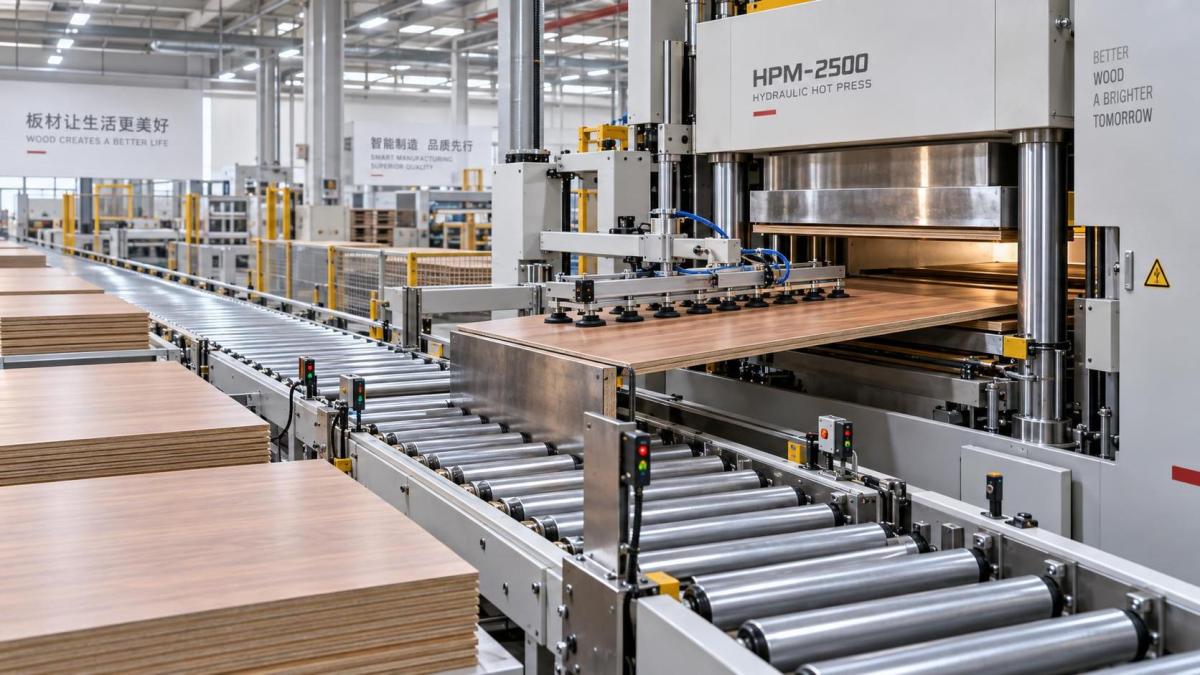
Automation improves consistency at interfaces, not only at machine stations
A manufacturing line is a chain of interfaces: storage to feeder, feeder to machine, machine to buffer, buffer to press, press to unloading, and unloading to packing or finishing. Handling errors often occur at these interfaces because ownership of the part becomes unclear. One machine has completed its cycle, but the next one is not ready; an operator intervenes; the material waits; the original sequence is lost.
Automated wood product manufacturing machinery reduces this exposure by establishing predictable rules for movement. Sensors can verify that a panel is present. Stops, guides, vacuum devices, rollers, and alignment mechanisms can establish position. Control logic can prevent a transfer until the receiving machine is ready. Recipe-driven instructions can associate a production order with dimensions, press time, temperature, layer arrangement, or downstream routing.
That level of control is particularly relevant around pressing and laminating operations. A press is often viewed as a standalone process machine, yet its quality result depends on what happens before the platen closes: board preparation, adhesive condition, layup sequence, loading alignment, and dwell-time control. A hydraulic Hot Press Machine with automatic platen opening can support a controlled workflow, but the handling concept must also ensure that the panel enters cleanly, squarely, and at the required process stage.
In a multi-opening configuration, the handling requirement becomes more demanding. Higher layer capacity can increase throughput, but it also increases the consequences of an incorrect loading sequence. Project teams should examine how each opening is supplied, whether panels can be positively identified before loading, and how the system prevents a worker or transfer device from placing the wrong workpiece in the wrong layer. Faster cycling without reliable flow control can merely produce more defects in less time.
Press automation illustrates the difference between repeatability and capacity
Consider a hot press used for veneer lamination or engineered panel production. Uniform pressure and stable heating are important, but they are only part of the system. A press with a rigid frame, a strong hydraulic system, controlled heating, and a platen size matched to the workpiece can make the pressing cycle repeatable. Automatic opening also gives material-handling equipment a more consistent release point than a manual sequence.
For a machine such as the ZD214x8/12 series, specified with 1200 KN total pressure, 1300 x 2500 x 42 mm heated platens, an 80-150 mm opening range, and one to four working layers, the project implication is not simply that more panels can be processed. The line designer must confirm whether the chosen loading and unloading method can support the press geometry and cycle time without forcing manual correction at every cycle.
A mismatch can be easy to miss during procurement. The press may close at a stated speed, while the upstream handling system takes longer to build and position the layup. Alternatively, the automated feeder may deliver panels quickly, but the downstream area lacks a safe buffer for hot, freshly pressed material. In either case, operators step back into the line to keep production moving. That intervention often reintroduces the alignment, timing, and damage risks the investment was expected to eliminate.
Errors that automation will not solve by itself
It is easy to overstate the value of automation by assuming that every defect connected to handling is caused by human handling. Some are actually material or process-control problems. A panel that bows because of moisture imbalance may not track correctly through an automated loader. Veneer with inconsistent dimensions may defeat a positioning routine designed around a stable reference edge. Poor adhesive preparation can produce bonding defects even when loading is accurate and repeatable.
Automation can also make a poorly defined process less visible. If a line has no reliable method for identifying work orders, panel grades, or surface direction before the first automated transfer, then the system may carry the wrong part through several stations with impressive consistency. The resulting error is more expensive because it is discovered later, after labor, energy, adhesive, and machine time have already been consumed.
Another limitation is variation in product mix. A plant producing a narrow range of panel sizes, construction types, and routing patterns is usually better suited to fixed automation than a workshop handling frequent custom sizes and short batches. This does not mean automation has no place in a high-mix operation. It means the equipment should be selected for controlled flexibility: adjustable guides, accessible settings, recipe management, quick changeover, and a realistic manual exception path.
Projects also fail when automated transfer equipment is specified independently from the machines it serves. The conveyor width, vacuum gripping pattern, stack height, platen opening, panel weight, surface sensitivity, and safe clearance all need to be treated as one material-flow problem. A supplier may provide capable individual machines, yet the line will still require manual correction if those interfaces are not engineered together.
How to judge whether the investment targets the right problem
Before selecting equipment, project managers should map a representative production route from material release to finished stack. The map should show each handoff, each decision made by an operator, every place where a part can wait, and every point at which it can be mixed with another order. This is more useful than measuring labor count alone.
Then classify the issue. If scrap is concentrated around skewed layups, loading alignment and positive location deserve priority. If damage occurs during movement between stations, focus on transfer surfaces, gripping methods, buffer design, and travel path. If rework follows mixed panels or surfaces, introduce part identification and order control before increasing machine speed. If delays are caused by operators having to clear jams or compensate for inconsistent supply, investigate the stability of the upstream process before automating the downstream station.
The specification should define acceptable behavior when the line is not operating normally. It should cover jam detection, panel misalignment, missing material, emergency stops, restart procedures, manual mode, and rejected parts. These details can appear secondary during a capacity discussion, but they determine whether the line remains controlled during real production interruptions. A system that works only under uninterrupted ideal conditions does not offer dependable handling-error reduction.
Measures that are more useful than a simple labor comparison
Labor savings may be part of the justification, but they do not reveal whether automation is improving control. A better project review tracks the frequency and location of handling-related defects, the number of manual interventions per shift, rejected panels by cause, unplanned waiting time between operations, and the proportion of parts that require rework after transfer or pressing. These measures point to the mechanism of improvement rather than only its financial result.
It is also sensible to establish a baseline before commissioning. Without a clear record of defect types and transfer delays, a team may see higher output after installation but remain unable to tell whether handling quality actually improved or whether defects merely moved to another stage. The purpose is not to create a complex reporting exercise. It is to retain enough evidence to tune guides, sensor positions, recipes, buffer limits, and operator procedures after the line begins running.
What a practical implementation sequence looks like
Handling automation is usually more reliable when introduced around the most stable, repeatable section of the process. A press loading and unloading cell, for example, may be a stronger first target than attempting to automate every movement across a factory at once. Its inputs, outputs, cycle events, and quality requirements can often be defined clearly. Once the cell operates predictably, upstream feeding and downstream stacking can be connected with less uncertainty.
During design, insist on trials with the actual range of workpieces that matter to the project: thin veneer-faced panels, heavier plywood, MDF, particle board, decorative surfaces, and any parts with higher scratch sensitivity or unusual dimensions. Nominal panel size alone is not enough. Surface friction, board flatness, weight distribution, edge condition, and stack quality influence how a transfer system behaves.
Commissioning should include the exception cases that operators will face: a panel that arrives skewed, a missing panel, a damaged corner, a stopped press, a delayed unloading cycle, and a job change. The aim is to verify that the system detects the condition, protects the material, preserves tracking where possible, and gives the operator a clear recovery route. This is where a technically sound machine becomes a workable production system.
Automated handling is therefore a credible way to reduce errors in wood product manufacturing, provided the project is built around the actual error mechanism. It delivers the greatest value when material identity, physical alignment, process timing, and recovery procedures are designed together. For teams evaluating a new line or a press-cell upgrade, the most productive next step is to identify the handoffs that currently require the most manual correction and determine whether those corrections can be replaced by a defined, repeatable control method.
Send Your Inquiry
We welcome your cooperation and we will develop with you.