


News & Exhibitions
Latest Factory Updates, Industry Trends & Global Exhibition Information
How platen pressure affects bond quality in a woodworking lamination press
Platen pressure has a direct effect on whether a laminated panel leaves the press with a durable glue line or with defects that may only become visible later in machining, finishing, or service. In a Woodworking Lamination Press, pressure must be high enough to bring the bonded surfaces into continuous contact, but not so high that it forces excessive adhesive out of the joint, damages the substrate, or creates uneven compression across the panel.
For technical evaluators, the practical question is not simply how much tonnage a press can generate. It is whether the machine can apply the required pressure uniformly, repeatably, and in a range that matches the materials, adhesive system, panel construction, and production method being considered. A press with a high maximum pressure rating can still produce weak bonds if pressure distribution, platen flatness, temperature control, or loading practice are poor.
Pressure creates contact, but it does not create bond strength by itself
Adhesive needs intimate contact between the two surfaces during its open time and curing period. Wood surfaces are rarely perfectly smooth at a microscopic level. Veneer, plywood, particleboard, MDF, solid wood strips, and laminates all contain surface variation, local porosity, machining marks, and dimensional movement. Applied platen pressure closes these gaps and helps spread the adhesive into the contact area.
That function is especially important when laminating thin veneer, producing furniture panels, bonding decorative faces to engineered boards, or assembling multi-layer constructions. If pressure is too low, some parts of the panel may not contact fully. The resulting glue line can contain voids or discontinuities. A panel may appear acceptable immediately after pressing but later show veneer lifting, edge separation, bubbling, or localized delamination after cutting and finishing.
However, a stronger press force does not automatically produce a stronger panel. Excessive pressure can starve the glue line by squeezing out too much adhesive before it cures. It can also press adhesive deeply into an absorbent substrate, leaving too little material at the actual bond interface. The risk is greater with low-viscosity adhesive, porous core materials, rough-faced panels, or long dwell times before the adhesive reaches sufficient cure.
A useful way to frame the issue is that pressure must overcome surface irregularity and hold the assembly still, while preserving a continuous adhesive film. The correct setting sits within a process window rather than at the top end of the machine's capability.
The required pressure depends on the entire layup
Pressure targets cannot be selected responsibly from the press specification alone. The same nominal panel size may require very different conditions depending on the combination of face material, substrate, adhesive, and process temperature.
Substrate density and surface condition
Dense plywood and solid hardwood substrates tend to resist compression and may need sufficient pressure to ensure full contact, particularly when their surfaces are not freshly machined or sanded. At the same time, high-density materials can limit adhesive penetration. The objective is to obtain a complete glue line without simply driving adhesive into isolated surface defects.
Particleboard and some lightweight boards behave differently. Their faces may be relatively smooth, but the core can compress under load. Excessive pressure can leave permanent thickness variation, depressions around edges, or damage beneath a decorative surface. When evaluating a press for these boards, pressure control and platen parallelism are often more useful indicators than a very high maximum pressure figure.
MDF presents another common evaluation case. Its uniform surface can support consistent lamination, but its absorbency and density vary by grade and thickness. A stable pressure setting may work well for one board supplier and give a different glue line with another. Process validation should therefore use the actual board grades intended for regular production.
Veneer thickness and flexibility
Thin veneer can conform to minor surface variation, which helps the press establish contact, but it also makes defects more visible. Local pressure variation may print through as surface marks, telegraphing, or uneven appearance after finishing. Thicker veneer and engineered decorative layers can bridge shallow hollows rather than follow them, so the press must provide enough pressure to close those areas without crushing the board beneath.
Curly, highly figured, brittle, or moisture-sensitive veneers introduce another concern. They may crack or buckle when the layup is poorly balanced, improperly conditioned, or forced down too aggressively over a nonuniform substrate. In those cases, increasing pressure is often the wrong response. The root cause may be veneer moisture, panel flatness, glue spread consistency, or inadequate caul plates and support materials.
Adhesive chemistry and viscosity
Different adhesives respond differently to pressure, temperature, and time. Some systems need firm clamping to achieve close contact, while others require more restraint because they can be displaced easily. Adhesive supplier instructions should establish the initial process range, but those instructions must be tested against the actual materials and press cycle.
Pressure must also be read together with glue spread. A low spread rate combined with high pressure can create an adhesive-starved bond even where the panel looks clean and flat. A generous spread rate cannot always compensate for inadequate pressure, because pockets of poor contact may remain. The press setting and adhesive application rate should therefore be treated as paired variables during trials.
For hot pressing, temperature changes the behavior further. Heat can lower adhesive viscosity, accelerate cure, and affect moisture movement in wood-based materials. If a process is moved from cold pressing to heated platens, or if platen temperature is increased to shorten cycle time, the established pressure setting may no longer deliver the same bond line. The changes should be qualified together rather than one at a time on the production floor.
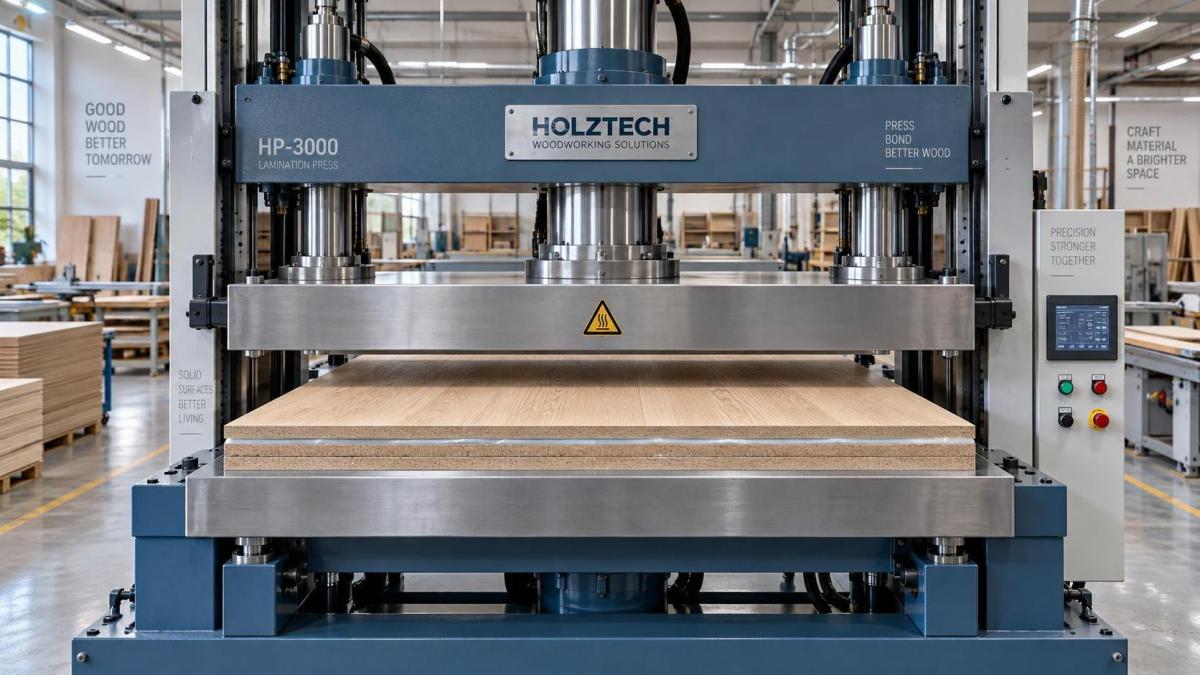
Uniformity across the platen matters more than a single pressure number
Technical specifications often state total press force, platen dimensions, and hydraulic pressure. Those values are necessary, but they do not by themselves show how evenly force reaches every part of a panel. Bond failures commonly begin in zones that receive less pressure: corners, outer edges, areas near damaged platen surfaces, or locations affected by an uneven stack-up.
Platen flatness and parallel movement are central to this issue. If one side of the platen closes earlier than the other, the first-contact area can receive a disproportionate load while another area remains under-compressed. A press may still reach its indicated system pressure, yet the panel can leave with poor bonding at one edge. This is why a hydraulic gauge should not be treated as proof of pressure distribution.
The construction of the pressing system affects repeatability. Evaluators should look at platen rigidity, guide arrangement, cylinder layout, frame stiffness, and the mechanism used to maintain parallel closing under full load. For larger panels, these characteristics become increasingly important because a small deviation across a wide platen can materially change the load at the panel edges.
The workpiece stack also influences distribution. Dust, cured glue, veneer offcuts, damaged cauls, warped boards, or inconsistent panel thickness can create high spots. A high spot receives early concentrated pressure and may prevent the rest of the assembly from closing evenly. In a multi-opening or multi-daylight press, variations between openings should be considered as well; one setting at the hydraulic system does not guarantee identical conditions in every daylight.
When higher pressure causes misleading results
Increasing pressure is a common reaction when delamination appears. It may solve a genuine low-contact problem, but it can also hide the actual cause long enough for a more expensive defect to emerge.
- Glue starvation: Excessive squeeze-out reduces the adhesive remaining between the surfaces. The panel can look well pressed while its bond strength is poor.
- Core crushing: Lower-density boards may lose thickness or develop local compression, reducing panel quality and creating problems in later assembly.
- Surface telegraphing: Pressure can reveal substrate defects, particles, seams, or unevenness through thin veneer or decorative faces.
- Uneven moisture response: Hot pressing and high compression can intensify moisture migration or restraint within the panel, contributing to bowing or distortion after release.
- False diagnosis: A pressure increase may temporarily improve one area while leaving adhesive spread, open time, surface contamination, or platen alignment uncorrected.
Bond quality should therefore be evaluated after conditioning and through an appropriate destructive or functional test, rather than only by visual inspection at press discharge. Edge trimming can be revealing because it exposes the glue line. Peeling, chisel separation, and other internal quality checks should be selected according to the product construction and relevant customer or product requirements.
Press time and pressure must be evaluated as one process
Pressure has a time dimension. A suitable pressure held for too short a period may not allow the adhesive to set enough for handling. A long pressing period at excessive load may increase adhesive squeeze-out, panel compression, or heat exposure without improving the bond.
Open time before closing is equally important. Once adhesive has lost too much ability to wet the mating surfaces, additional pressure cannot restore a proper bond. This is particularly relevant for large panels, manual layup, complex assemblies, and high-temperature conditions where the effective working time can be shorter than expected. A press with fast closing and stable pressure control may support a more reliable process than a slower machine with a higher theoretical force rating.
Cycle planning should also account for pressure build-up. Some lamination processes benefit from controlled closing that allows the stack to settle before full pressure is reached. Others require rapid closure to stay within adhesive open time. The appropriate sequence depends on the adhesive system and layup, but a technically suitable press should allow the operator to control and repeat the intended sequence rather than relying on approximate manual adjustment.
What to verify when assessing a lamination press
For equipment selection, pressure capability should be translated into usable panel pressure. Total force must be considered against the maximum working area, because a force that is adequate for a small panel may be insufficient when distributed across a full-size platen. The intended product mix matters: a press used primarily for narrow cabinet components is assessed differently from one used for full-size veneered doors or wide furniture panels.
A meaningful technical review should include the following points:
- The pressure range required by the planned adhesive and material combinations, including the lowest stable setting as well as the maximum available load.
- Whether the platen size, rigidity, flatness, and guiding system support uniform loading over the largest intended panel.
- How pressure is measured, adjusted, displayed, and maintained throughout the cycle.
- Whether the press can repeat closing speed, dwell time, and pressure settings from batch to batch.
- The condition and serviceability of hydraulic components, seals, hoses, controls, and platen surfaces.
- How the press accommodates caul plates, protective sheets, mixed thicknesses, and the actual loading method used in the plant.
- Whether hot platen temperature control, where applicable, is sufficiently even for the selected adhesive process.
It is also sensible to distinguish between a machine's rated maximum and the operating range that can be maintained day after day. A Woodworking Lamination Press is selected for production stability, not for a single maximum-force demonstration. Pressure drift, uneven hydraulic response, platen contamination, and poor loading discipline can all erode that stability over time.
A practical approach to setting pressure
Start with the adhesive supplier's recommended range for the relevant wood species, board type, and temperature condition. Then run controlled trials using production-intent materials. Keep glue spread, open time, pressing time, temperature, and panel stack consistent while adjusting pressure in deliberate increments. Assess bond integrity, surface appearance, thickness change, and panel flatness after the assembly has had time to stabilize.
The preferred setting is usually the lowest pressure that consistently produces full contact and acceptable bond performance across normal material variation. This leaves process margin without imposing unnecessary stress on the substrate, veneer, and press. It also makes subsequent troubleshooting clearer: when defects occur, the team can investigate material condition, glue application, timing, and equipment alignment before raising pressure beyond the validated range.
Platen pressure deserves attention because it influences both visible quality and hidden bond reliability. Yet it should be treated as part of a controlled laminating system. When pressure distribution, adhesive behavior, material construction, and pressing time are aligned, the press becomes a repeatable production tool rather than a source of intermittent panel defects.
Send Your Inquiry
We welcome your cooperation and we will develop with you.