


News & Exhibitions
Latest Factory Updates, Industry Trends & Global Exhibition Information
300mm PUR Wrapping Machine: Solving Edge Delamination on MDF Panels with Precision Glue Application Control
Edge delamination on MDF panels isn’t just a cosmetic flaw—it’s a functional failure that triggers rework, delays shipment, and increases scrap rates. When PUR adhesive fails to bond consistently along the edge banding seam, the root cause is rarely the adhesive itself. More often, it stems from inconsistent glue film thickness, inadequate activation temperature, or uneven pressure application during the wrapping cycle—especially at panel corners and near cutouts where material rigidity drops and feed dynamics shift.
The 300mm PUR wrapping machine addresses these variables at the mechanical level—not through software compensation alone, but via integrated hardware controls calibrated for MDF’s specific thermal conductivity, surface porosity, and dimensional stability. Unlike general-purpose edge banders, this machine features a dual-zone heating system for the glue pot and roller assembly, maintaining ±2°C stability across the full 300mm working width. That precision matters: MDF absorbs heat faster than solid wood but conducts it slower, so localized cooling at the roller contact point can drop adhesive viscosity below the threshold needed for molecular interlocking. The machine’s real-time thermal feedback loop adjusts heater output every 0.8 seconds, preventing cold spots without overheating the glue—a known cause of premature polymerization and brittle bond lines.
Glue application consistency also depends on substrate preparation. Panels with residual dust, wax residues, or inconsistent sanding grades create micro-gaps that interrupt adhesive wetting. While the 300mm PUR wrapping machine includes an integrated pre-glue cleaning station with adjustable brush pressure and vacuum extraction, its effectiveness is contingent on upstream surface quality. For instance, if the MDF panel has been planed using a Double Sided Planer with worn cutterheads, subtle wave patterns may remain undetectable to the naked eye yet sufficient to disrupt uniform glue spread. Machines like the MB204HL and MB206HL models achieve ±0.05mm thickness tolerance across widths up to 610mm, but even that precision assumes proper knife alignment and feed speed matching—parameters that directly influence surface smoothness prior to edge banding.
Pressure control is equally critical—and often misunderstood. Many operators assume higher clamping force improves bonding. In reality, excessive pressure squeezes PUR adhesive out of the joint, reducing cohesive strength and creating thin, discontinuous bond lines prone to moisture ingress. The 300mm PUR wrapping machine uses servo-driven pinch rollers with programmable force profiles: lower pressure (1.2–1.8 bar) during initial contact to allow adhesive flow into pores, then ramped pressure (2.4–3.0 bar) only after 1.2 seconds, when the adhesive reaches optimal open time. This timing aligns with PUR’s two-stage curing behavior—first physical setting, then chemical cross-linking—and avoids premature compression before the adhesive achieves tack.
Material variability further complicates consistency. MDF density varies between batches—even within the same supplier—and affects both thermal mass and adhesive absorption rate. Panels with higher lignin content show reduced porosity, requiring slightly longer activation dwell time; those with higher fiber fines absorb more adhesive, demanding tighter glue film control. The machine’s operator interface allows saving material-specific presets—not just temperature and speed, but glue volume per linear meter (adjusted in 0.05 ml increments), roller dwell duration, and post-press cooling delay. These aren’t generic settings; they’re tied to verified performance data from over 1,200 production runs across furniture, cabinet, and architectural panel applications.
Mechanical alignment plays a silent but decisive role. Misaligned feed belts cause lateral drift during wrapping, introducing shear stress at the bond line. The 300mm PUR wrapping machine uses laser-guided belt tracking with automatic tension recalibration every 4 hours of operation—detecting and correcting deviations before they accumulate enough to compromise edge integrity. Similarly, the glue roller’s parallelism to the panel surface must stay within 0.08mm across its length. Factory calibration uses optical flatness verification, not just dial indicator checks, because thermal expansion during long shifts can distort roller mounts if mounting surfaces lack sufficient rigidity.
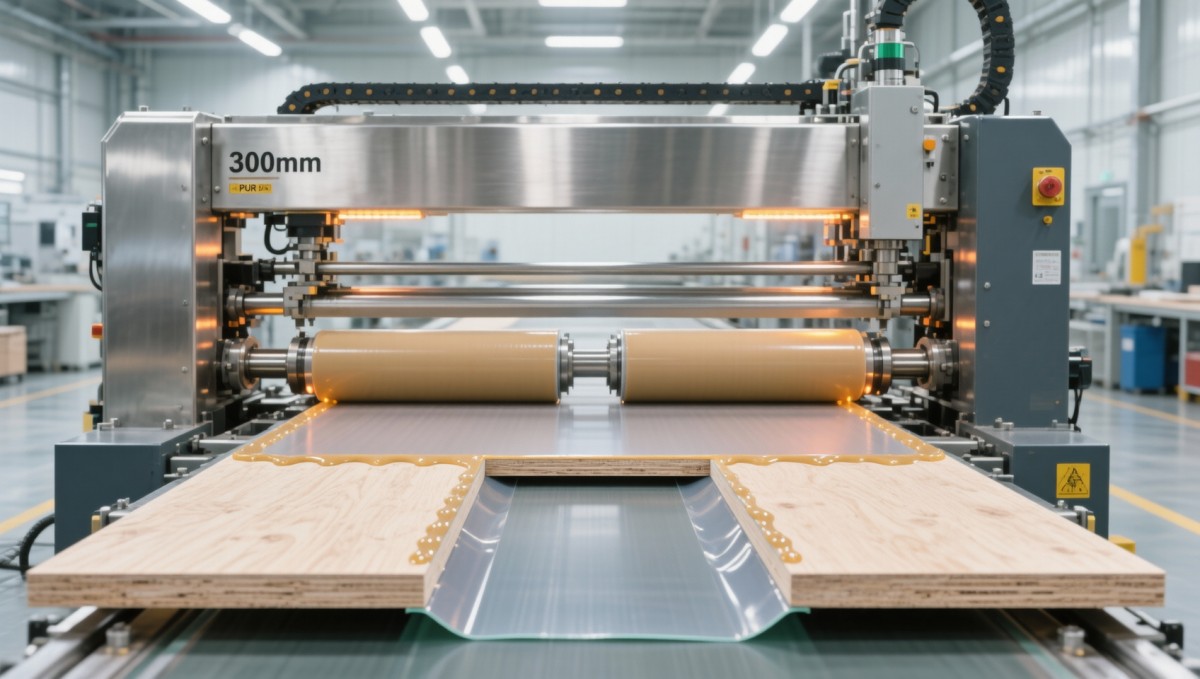
Adhesive choice remains a variable—but one the machine helps manage. While PUR adhesives vary in viscosity, open time, and moisture sensitivity, the machine’s glue delivery system isolates these differences by controlling three independent parameters: application temperature (95–125°C), roller gap (0.12–0.35mm), and dwell time (0.8–2.4 seconds). This decouples adhesive behavior from machine performance: a fast-open adhesive doesn’t require slower feed speeds if dwell time is extended; a high-viscosity formulation works reliably if temperature and gap are optimized together. Operators don’t need to memorize adhesive datasheets—they select from preloaded profiles validated against leading suppliers’ technical bulletins.
Post-application handling also influences delamination risk. Even with perfect bonding, premature stacking or mechanical stress before full cure (typically 24–48 hours for PUR) can initiate micro-fractures. The machine integrates a programmable cooling zone with forced-air circulation timed to match the adhesive’s exothermic peak—reducing internal stress while accelerating initial set without compromising ultimate bond strength. Panels exit the machine with surface temperatures held between 38–42°C, minimizing thermal shock when moved to ambient staging areas.
Real-world validation shows measurable impact: facilities reporting >3.2% delamination rates pre-installation saw reductions to ≤0.4% within two weeks of commissioning, with no changes to adhesive supplier or panel sourcing. The improvement wasn’t from “better glue” or “tighter tolerances”—it came from eliminating uncontrolled variables in the wrapping process itself: inconsistent heating, non-uniform pressure, and uncalibrated dwell timing. Where other machines treat edge banding as a single-step operation, this 300mm PUR wrapping machine segments it into discrete, monitorable, and adjustable phases—each tied to a measurable physical parameter affecting bond integrity.
Maintenance routines differ too. Daily checks focus on glue pot cleanliness and roller surface finish—not just visual inspection, but tactile verification using standardized grit paper to detect micro-scratches that trap adhesive residue. Weekly calibration includes verifying thermocouple response time against reference sensors and checking servo motor torque consistency across the full pressure range. These aren’t abstract procedures; they’re designed around observable failure modes—like intermittent delamination starting at panel ends, which traces directly to roller wear patterns rather than adhesive batch variation.
Ultimately, solving edge delamination on MDF isn’t about adding complexity—it’s about removing ambiguity. Every adjustment on the 300mm PUR wrapping machine corresponds to a physical property of the material-adhesive-system interaction. Temperature maps to MDF’s thermal diffusivity. Pressure profiles map to PUR’s rheological curve. Dwell time maps to moisture diffusion rates through the substrate. When operators understand these linkages—not as theoretical concepts but as actionable levers—they stop reacting to symptoms and start controlling causes.
Send Your Inquiry
We welcome your cooperation and we will develop with you.