


News & Exhibitions
Latest Factory Updates, Industry Trends & Global Exhibition Information
Can aluminum honeycomb panel edge banding machines meet EU safety certification requirements?
Yes — aluminum honeycomb panel edge banding machines can meet EU safety certification requirements, but compliance is not automatic. It depends on how the machine is designed, what components are integrated, how safety functions are implemented and verified, and whether documentation aligns with the essential health and safety requirements (EHSRs) of the Machinery Directive 2006/42/EC. Unlike general-purpose woodworking edge banders, machines handling aluminum honeycomb panels introduce specific operational hazards: higher feed speeds for lightweight yet rigid substrates, increased risk of panel deflection or slippage during glue application and trimming, and potential for sharp edge fragments during end-trimming or corner finishing. These demand targeted safety integration — not just bolt-on guards.
Why Standard Edge Bander Certification Isn’t Enough
Many manufacturers assume that if a base model carries CE marking for solid wood or MDF, it automatically qualifies for aluminum honeycomb panels. That assumption is technically invalid. The Machinery Directive requires risk assessment to be performed for the intended use — and aluminum honeycomb panels behave fundamentally differently under processing forces. Their low mass-to-surface-area ratio means they accelerate faster under drive rollers, increasing ejection risk if clamping or tracking fails. Their cellular core also creates unpredictable fracture patterns during routing or scoring, generating high-velocity debris that standard polycarbonate guards may not fully contain. A machine certified only for 18 mm MDF does not, by default, satisfy EHSR 1.2.3 (protection against mechanical hazards) when feeding 30 mm thick aluminum honeycomb at 22 m/min.
The Three Non-Negotiable Layers of EU Compliance
Meeting EU requirements hinges on three interdependent layers — each must be validated, not assumed:
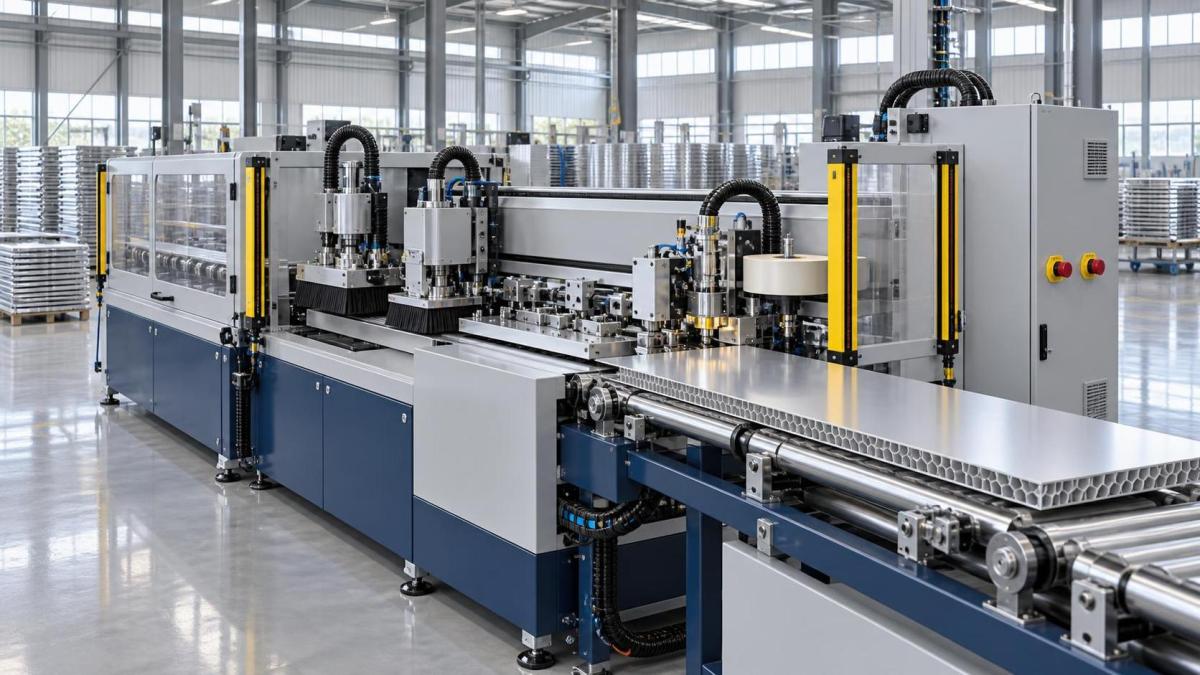
- Design-level integration: Safety must be embedded in the machine architecture — not added later. This includes dual-channel, monitored emergency stop circuits (EN ISO 13850), light curtains with minimum resolution ≤ 30 mm (EN ISO 13855) covering all pinch points between feed belts and pre-milling units, and torque-limited roller drives to prevent sudden acceleration if a panel jams mid-process.
- Component traceability: Every safety-critical component — from the PLC’s safety module (EN 62061 SIL2 or EN ISO 13849-1 PLd) to the pneumatic clamp valves — must carry valid CE declarations of conformity. Using a non-certified servo driver for the end-trimming unit, even if the main frame is certified, voids the entire declaration.
- Application-specific documentation: The technical file must include test reports for the exact configuration used with aluminum honeycomb: verification of glue pot temperature stability under continuous 8-hour operation (to prevent thermal runaway), measurement of noise emission at operator position (EN ISO 7010:2014 limits apply), and validation of dust extraction interface performance when capturing fine aluminum particles (not just wood dust).
Where Misalignment Commonly Occurs
Three practical gaps frequently derail certification efforts:
First, material feed dynamics. Aluminum honeycomb panels often require vacuum-assisted bottom support to prevent flutter during edge glue application. If the vacuum system lacks monitored pressure sensors and automatic feed halt on loss-of-vacuum, it violates EHSR 1.2.1 (stability and resistance to overturning). Second, trimming geometry. End-trimming units using oscillating knives generate different kinetic energy profiles than rotary cutters. Certification bodies now routinely request dynamic force calculations for knife carriage movement — especially when trimming 3 mm aluminum face sheets over honeycomb cores. Third, electrical grounding continuity. Aluminum panels conduct electricity. If the machine frame isn’t bonded to earth with ≤ 0.1 Ω resistance (verified per EN 60204-1 §8.2.3), static discharge or fault currents can arc across guide rails, creating ignition risks in glue mist environments.
Testing Protocols That Matter — Not Just Paperwork
Third-party verification is only meaningful if it reflects real-world operation. A compliant test sequence includes:
- Dynamic load testing: Feeding 10 consecutive 1200 × 2400 mm aluminum honeycomb panels at maximum rated speed while monitoring roller torque variance (must stay within ±7% of nominal).
- Guard integrity validation: Firing a 1.2 g steel projectile at 12 m/s into side-access guards — impact resistance must exceed EN 1010-1 Annex D requirements for “medium risk” machinery.
- Emergency stop latency measurement: From button press to full mechanical brake engagement, measured at both feed-in and trim-out stations — must be ≤ 200 ms (EN ISO 13850).
- Thermal mapping: Infrared scans of glue pot, drive motors, and control cabinet under continuous load — no hot spot exceeding 65 °C above ambient.
These tests aren’t optional extras. They form the evidentiary backbone of the EU Declaration of Conformity. Skipping any one — or conducting them only on prototype units without revalidation after software updates or hardware revisions — invalidates the CE claim.
Operational Conditions That Trigger Re-Assessment
Certification isn’t a one-time event. Changes in how the machine is used can necessitate partial or full re-evaluation. For example:
- Switching from polyurethane (PUR) to hot-melt glue changes thermal load distribution and requires updated thermal hazard analysis.
- Adding an automated corner rounding module introduces new moving parts, requiring fresh risk assessment per EN ISO 12100:2018, Clause 6.
- Relocating the machine to a facility with ambient temperatures below 5 °C affects pneumatic valve response time and adhesive viscosity — both fall under EHSR 1.1.5 (environmental conditions).
Manufacturers often overlook that the user manual itself is part of the certification. It must specify minimum panel thickness (e.g., “not suitable for panels < 12 mm due to insufficient clamping force”), list compatible glue types with flash point data, and define required extraction airflow (m³/h) at the trim station — not just generic “connect to dust system” language.
What “Compliant Design” Actually Means in Practice
It means engineering decisions made at the drawing board level reflect EU expectations — not retrofitting. Examples include: positioning the glue application nozzle so its heating element is physically inaccessible without removing two independent fasteners; designing the pre-mill unit so depth adjustment requires a dedicated tool (preventing accidental overcut); and routing all 24 V DC control wiring separately from 400 V AC motor cables to avoid electromagnetic interference that could disable safety relays. These aren’t aesthetic choices — they’re direct responses to clauses in EN 60204-1 and EN ISO 13857.
Ultimately, EU safety certification for aluminum honeycomb panel edge banding machines is achievable — but only when safety is treated as a functional requirement woven into mechanical design, electrical architecture, control logic, and documentation — not as a final-stage administrative step.
Send Your Inquiry
We welcome your cooperation and we will develop with you.