


News & Exhibitions
Latest Factory Updates, Industry Trends & Global Exhibition Information
When production process consultation pays off in woodworking upgrades
When Production Process Consultation Pays Off in Woodworking Upgrades
A woodworking machinery upgrade can look straightforward on a quotation: replace an older panel saw, add an edge bander, install a CNC nesting machine, or automate material handling. The difficult part is rarely choosing a machine from a catalog. It is deciding whether that machine will solve the production constraint that is actually costing the business money.
That is where Woodworking Production Process Consultation becomes commercially useful. Done properly, it does not begin with a preferred machine model. It begins with the real route of a board, panel, door component, or furniture part through the factory: receiving, storage, cutting, machining, edging, drilling, sanding, assembly, inspection, packing, and dispatch.
For a business decision-maker, consultation pays off when it prevents a capital purchase from becoming an expensive workaround. A faster machine at one station may create a queue at the next. A highly automated system may be difficult to justify if order sizes are small and designs change daily. Conversely, a modest upgrade in cutting accuracy, dust extraction, tooling control, or workpiece flow can sometimes remove more waste than a much larger equipment investment.
The central question is not, “What is the newest woodworking machine available?” It is, “What limits our profitable output today, and what change will remove that limit without creating another one?”
The Upgrade Problem Is Usually a Process Problem
Many woodworking plants recognize the symptoms before they identify the cause. Operators work overtime, but shipments still slip. The cutting department appears busy, while the edge-banding line waits for parts. Rework increases around drilling or assembly. Finished goods occupy valuable floor space because packaging cannot keep up. Management may conclude that the most visibly overloaded department needs another machine.
Sometimes that conclusion is correct. Often, it is incomplete.
Consider a cabinet manufacturer whose panel saw has become a source of delays. Replacing it may be sensible, but consultation should first examine why it is delayed. Is the saw genuinely short of cutting capacity? Are sheets repeatedly moved because storage is poorly positioned? Are cutting lists released in batches that create peaks and idle periods? Are operators spending too much time checking dimensions because downstream drilling tolerances are inconsistent? Does material quality vary enough that setup and rejection time are becoming the real issue?
Those questions affect what should be purchased. A higher-capacity beam saw, for example, addresses a different problem from a better optimized cutting workflow, barcode-based part identification, an additional unloading arrangement, or a revised layout. Buying before understanding the flow can lock a factory into the wrong answer for years.
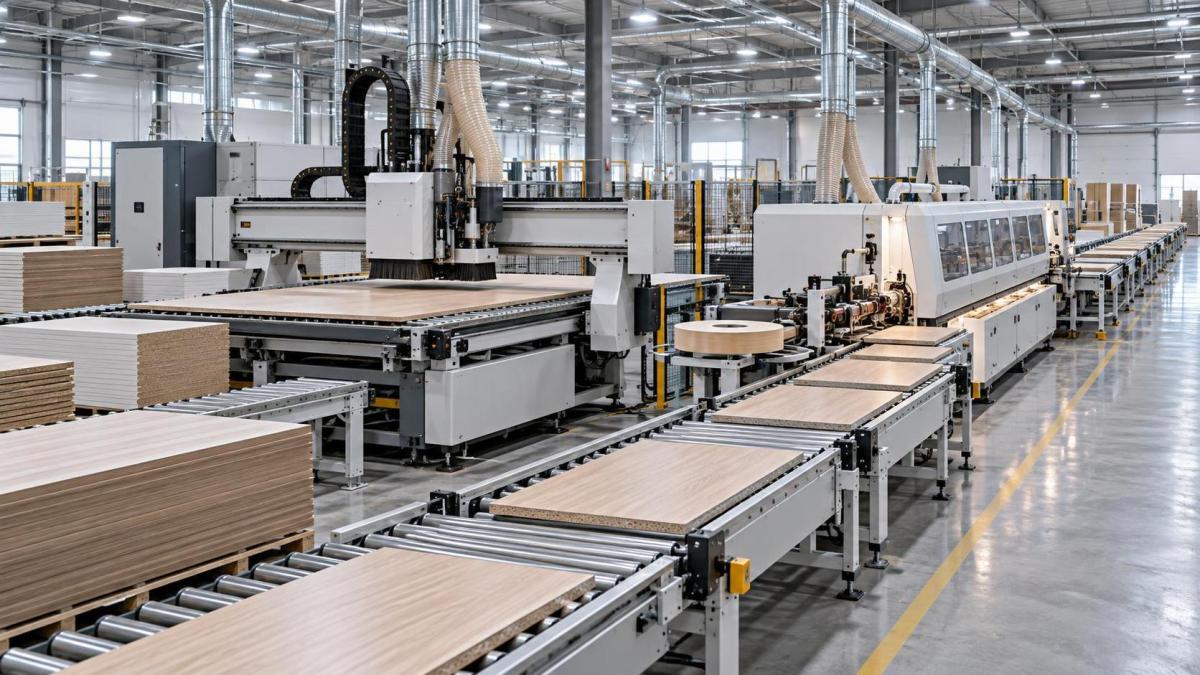
In furniture production, bottlenecks also move. A plant may install a faster CNC router and then discover that manual loading, part sorting, edge treatment, or hardware fitting becomes the next constraint. This is not an argument against automation. It is an argument for looking at the entire production route before deciding where automation belongs.
What a Useful Consultation Should Examine
A practical assessment is not a generic factory tour followed by a recommendation for the most sophisticated line. It should be tied to the product mix, output pattern, available labor, board materials, finish requirements, factory space, and maintenance capability.
The first step is usually to map the current process using representative orders rather than an idealized production sequence. A standard kitchen cabinet order may behave very differently from custom reception furniture, hotel casegoods, solid-wood doors, or batch-produced wardrobes. One-off work has frequent setup changes. Repetitive work may justify tighter automation and data integration. A factory producing both needs a deliberate choice about which work should run on which equipment.
Consultation should also separate machine cycle time from total production time. The machine may cut or drill quickly, but the workpiece still needs to be loaded, aligned, labelled, inspected, stacked, moved, and matched to the next operation. If operators are waiting for forklifts, searching for panels, or manually sorting mixed parts, the published speed of a machine tells only part of the story.
Quality loss deserves the same attention as output volume. Chipped laminate edges, inconsistent holes, inaccurate panel dimensions, poor glue application, sanding variation, and damage during handling all have a cost beyond the rejected component. They consume labor, interrupt schedules, use additional materials, and can delay final assembly. A process review should identify where defects originate rather than simply where they are discovered.
Where the Financial Return Usually Comes From
The return on a woodworking upgrade is often discussed in terms of labor savings. Labor matters, but it is rarely the only financial lever. A stronger business case may come from a combination of lower scrap, less rework, shorter lead times, more stable quality, reduced dependence on a single highly skilled operator, and improved material yield.
Material yield is especially important in panel processing. When sheet goods are expensive or volatile in price, cutting plans, trim loss, remakes, and damaged panels can materially affect margins. The right cutting solution may improve consistency, but its value depends on the factory’s panel sizes, order mix, nesting requirements, remnant policy, and the discipline used to manage production data. There is no universal “best” machine configuration.
Downtime is another area where procurement teams should look beyond the purchase price. A less expensive machine may be costly if spare parts are difficult to obtain, technical support is slow, or routine adjustments require outside intervention. On the other hand, a complex automated system may introduce maintenance requirements that the factory is not yet equipped to manage. The right level of technology is the one the business can operate reliably, not merely the one that looks most advanced in a demonstration.
A consultation-led investment review should therefore include the full cost of ownership: installation preparation, electrical and pneumatic requirements where applicable, dust collection compatibility, tooling, software or programming needs, operator training, maintenance routines, spare parts planning, and anticipated production disruption during commissioning. These costs do not make an upgrade unattractive; they make the budget realistic.
When Consultation Is Most Worth Paying For
Not every machinery purchase requires an extensive process study. Replacing a like-for-like machine with a familiar specification may need only a careful technical check. Consultation becomes more valuable when the decision changes the way work moves through the factory.
It is particularly useful when a business is moving from manual or semi-automatic production toward CNC processing; expanding into a new furniture category; dealing with recurring quality complaints; consolidating several operations into one machine; relocating a workshop; or planning a line where multiple machines must work together. In these situations, a poor interface between machines can undermine an otherwise sound purchase.
The same applies when a company is under pressure to quote shorter delivery times. Faster production is not always the answer. If order information arrives late, drawings change after release, or parts cannot be identified correctly after machining, more machine speed may simply produce more work-in-process. A process review can expose whether the constraint is operational, technical, or administrative.
For owners and directors, this is the practical value of consultation: it tests assumptions before capital is committed. It can show whether the best decision is a major equipment purchase, a phased upgrade, a layout change, a maintenance improvement, or a different production planning method. Sometimes the most valuable recommendation is to postpone a machine purchase until the conditions for using it properly are in place.
Questions to Ask a Machinery Partner Before Committing
A supplier should be able to discuss the production process, not only individual machine specifications. Before signing an order, it is sensible to ask how the proposed equipment fits the existing workflow, what information is needed to confirm compatibility, and which assumptions in the proposal still need to be verified on site.
Useful questions include:
- Which current bottleneck is this machine expected to address, and how was that conclusion reached?
- What product sizes, materials, edge types, machining patterns, and production volumes must be confirmed before final configuration?
- What happens upstream and downstream once the new machine operates at its intended pace?
- Which site conditions, utilities, safety arrangements, and dust collection requirements need review before installation?
- What training, preventive maintenance, consumables, and spare parts support will be needed after commissioning?
- Can the investment be phased so that the factory learns from the first change before committing to the next?
Clear answers do not guarantee a perfect project, but vague answers are a warning sign. A supplier that immediately recommends the largest possible configuration without asking about drawings, material flow, product variation, or service expectations is not yet solving the customer’s actual problem.
Choosing a Partner That Can Support the Line After Delivery
Woodworking machinery is not a one-time transaction. Its value is shaped over years by setup quality, operator familiarity, tooling decisions, maintenance discipline, availability of replacement parts, and access to technical support when production is interrupted.
Qingdao Zhongding Machinery Co., Ltd. has developed from a small workshop into a manufacturer and exporter focused on woodworking machinery and complete production solutions. With more than two decades of industry experience, the company works with furniture manufacturers, woodworking workshops, and industrial production lines in different markets. That background matters most when it is applied to the practical details of a customer’s production route rather than treated as a sales claim.
For buyers, the relevant evaluation points are straightforward: whether the supplier asks the right technical questions, whether machine configuration matches the intended workload, whether installation and training expectations are clear, and whether support and spare parts can be planned as part of the investment. Reliable equipment is essential, but reliable follow-through is what keeps an upgrade from becoming a production risk.
A well-run Woodworking Production Process Consultation does not make every upgrade larger. In many cases, it makes the purchase more focused. It connects machinery decisions to the realities of throughput, quality, labor, material use, floor space, and service capability. Before comparing quotations, map the process that creates the cost. The right machine usually becomes much easier to identify after that work is done.
Send Your Inquiry
We welcome your cooperation and we will develop with you.