


News & Exhibitions
Latest Factory Updates, Industry Trends & Global Exhibition Information
How woodworking machine export packaging prevents transit damage
How Woodworking Machine Export Packaging Prevents Transit Damage
A woodworking machine can leave the factory in perfect operating condition and still arrive with problems that have nothing to do with manufacturing quality. A cracked control panel, moisture-marked table surface, bent fence rail, damaged spindle cover, or missing accessory box can all occur between loading and final delivery. For equipment moving through ports, warehouses, containers, and local trucking networks, export packaging is not a finishing detail. It is part of the machine’s delivery reliability.
Woodworking Machine Export Packaging has to account for more than the weight of the machine. It must protect precision components, painted surfaces, electrical systems, loose accessories, and vulnerable protruding parts while allowing the shipment to be lifted, inspected, unloaded, and delivered safely. The right approach is rarely just “use a stronger crate.” Good packaging starts with understanding how a specific machine can be damaged and where that risk is most likely to occur.
With more than 20 years of experience in woodworking machinery manufacturing and export, Qingdao Zhongding Machinery has seen that packaging decisions affect more than freight claims. They influence installation time, spare-parts control, customer confidence, and the amount of work required before a machine can enter production. A package that looks solid from the outside may still fail if the machine moves inside it, if condensation reaches electrical components, or if small but essential accessories are not secured properly.
Transit Damage Usually Starts with Movement, Moisture, or Misjudged Handling
International shipping subjects machinery to repeated forces rather than one dramatic impact. A machine may be loaded by forklift, transferred into a container, shifted during ocean transit, unloaded at a port, held in a warehouse, and moved again for inland delivery. Even when each step is handled reasonably well, vibration accumulates. Bolts can loosen, guide rails can rub against protective material, and unsecured assemblies can shift enough to damage themselves.
This is especially relevant for woodworking equipment because many machines combine a heavy base with relatively delicate working components. A panel saw may have long guide rails and an extended sliding table. An edge banding machine may include feeding assemblies, pressure rollers, glue-related components, and electrical controls. A CNC router can have a gantry, spindle, vacuum table fittings, or control cabinet that should not be treated like ordinary steel framework. The transport risk is uneven: some parts can tolerate rough handling, while other parts need specific restraint or separation.
Moisture is another common concern, particularly in sea freight. Temperature changes can create condensation inside a container or package. This can affect bare metal, precision surfaces, electrical enclosures, paper manuals, and cardboard accessory cartons. A crate may keep out direct water exposure but still allow humid air and condensation to create trouble inside. That distinction is often missed when packaging is planned only around impact resistance.
Then there is handling risk. Forklift forks do not always enter from the ideal direction, and not every warehouse team will know which side of a machine contains the heaviest assembly. Clear lifting points, stable pallet design, and visible handling marks reduce ambiguity. They do not guarantee careful treatment, but they give handlers practical information before an avoidable mistake occurs.
Protection Begins Before the Machine Is Put into a Crate
The strongest outer package cannot compensate for a machine that has not been prepared for transport. Export packing should begin with a pre-shipment check: moving components should be locked or secured, detachable assemblies should be removed where practical, and surfaces requiring protection should be covered before the machine is fixed to its base.
For example, a sliding table should not be allowed to travel freely. Long linear parts are vulnerable because a small amount of movement can become leverage. Fences, handwheels, dust hoods, extension tables, pneumatic fittings, and exposed sensors may need to be removed, folded, supported, or packed separately. The correct decision depends on the machine design. Removing too many parts can make installation needlessly difficult; removing too few can leave a high-risk component exposed. This is where practical familiarity with the specific equipment matters.
Bare cast-iron worktables and machined steel surfaces also need attention. A protective coating, corrosion-inhibiting material, or suitable wrap may be used depending on the expected route and storage period. The important point is that surface protection should be compatible with the machine and easy to remove during installation. Packaging that leaves adhesive residue or traps moisture against a metal surface solves one problem while creating another.
Electrical parts deserve a separate check. Control panels, touchscreen interfaces, cables, inverters, and electrical cabinets are not necessarily exposed during transit, but they can still be affected by vibration and moisture. Covers should be closed securely, loose cables should not be left where they can rub against sharp edges, and documents or small electronic accessories should not be placed where condensation is likely to collect.
A Packaging System Works in Layers
Effective Woodworking Machine Export Packaging usually combines several protective layers, each addressing a different risk. The inner layer protects surfaces and sensitive components. Internal blocking prevents movement. The pallet or skid carries machine weight and creates a stable lifting base. The outer crate or protective enclosure helps defend against impact, stacking pressure, dust, and handling exposure.
The skid is more important than it appears. It must support the machine at points that can safely carry the load, not simply wherever timber can be placed. Poor support can put stress on a machine frame, deform lower covers, or leave the center of gravity unstable during forklift handling. If a machine has an offset motor, a large worktable, or a mounted control cabinet, the load distribution should be reflected in the skid design.
Internal bracing should restrain the machine without transferring force to fragile parts. Packing against a painted cover, a handwheel, or a thin sheet-metal guard is not the same as bracing against a structural frame. Wood blocks, fastening points, straps, and cushioning materials should work together. A crate with ample empty space may look clean, but unused space allows momentum to build when the package is jolted.
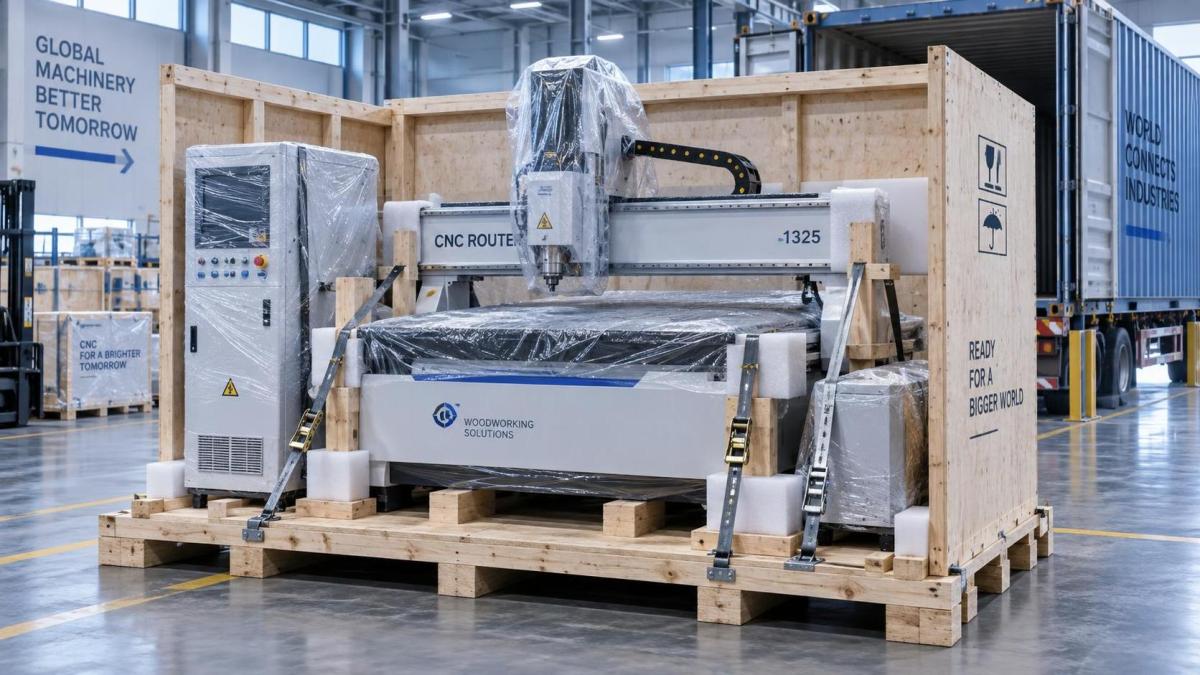
Outer protection should match the shipping method. Fully enclosed wooden crates are often chosen when machinery will move through multiple handling stages or when surface protection is a priority. Open-frame packing may be suitable for some robust machines when loading conditions are controlled, but it offers less protection against weather, dust, and incidental contact. Shrink wrapping can help keep external dirt and moisture away, yet it should not be viewed as a substitute for a properly supported base and secure internal restraint.
When wood packaging is used for international shipment, the receiving market may have phytosanitary requirements for wood packaging material. ISPM 15 is widely relevant to solid wood packaging used in cross-border trade, but the exact documentation and acceptance requirements should be checked for the destination and shipment arrangement. It is unwise to assume that every wood component is treated the same way or that a forwarding agent will resolve a packing compliance issue after cargo is already at the port.
Container Loading Is Part of the Packaging Decision
Packaging cannot be designed in isolation from container loading. A crate that is safe on a factory floor may be difficult to secure in a container. A machine loaded near a container wall may face different exposure than one positioned in the center. Heavy equipment needs appropriate blocking, bracing, lashing, or other securing methods based on its dimensions, center of gravity, route, and transport plan.
Full-container shipments and less-than-container-load shipments also require different thinking. In a dedicated container, there is usually more control over placement and securing. In LCL shipment, cargo may be consolidated, handled more frequently, and exposed to neighboring freight. That does not mean LCL is unsuitable for woodworking machinery, but it does mean the outer protection and internal stability deserve extra scrutiny. A package should not rely on surrounding cargo to keep it upright or prevent lateral movement.
For large machines, disassembly can improve loading efficiency and reduce transport risk, but only when the reassembly process is well managed. Separating a long sliding table from its main body may make sense. Splitting an assembly with complex alignment requirements may not. The cost of a smaller package can be quickly outweighed by difficult commissioning at destination. Packaging should support a practical installation sequence, not merely reduce cubic volume.
Small Parts Cause Disproportionate Delivery Problems
A machine can arrive structurally intact and still be unusable because a small component is missing. Tool kits, bolts, manuals, fences, pneumatic connectors, dust collection adapters, blades, cutter heads, and electrical accessories should be controlled as carefully as the main unit. These items are easy to overlook because they are light, but they are often the first things needed during installation.
A sensible approach is to pack accessories in clearly identified cartons or sealed boxes, then secure those boxes within the main crate or on a designated pallet location. Loose cartons should not be left on top of the machine unless the crate design specifically prevents movement. If multiple packages are required, package numbering and a packing list help the receiving team confirm that all pieces have arrived before unpacking begins.
It is also helpful to distinguish between installation accessories and spare parts. Mixing them together creates unnecessary confusion at the customer site. Installation teams need fast access to the items required for assembly; spare parts should remain protected, labeled, and traceable for later use. This is a small organizational detail, but it can save time when a machine is being commissioned under pressure.
What to Check Before a Shipment Leaves the Factory
The final packaging inspection should be practical rather than ceremonial. The question is not whether the crate looks professional in photographs. The question is whether the machine can survive the actual route. A useful pre-shipment review normally checks whether moving components are fixed, whether exposed surfaces are protected, whether the center of gravity is considered, and whether forklift entry points remain clear.
- Confirm that machine feet, frames, or designated fixing points are secured to the skid.
- Check that no internal component can strike another part during vibration.
- Make sure accessory cartons are fixed in place and listed in shipment documents.
- Verify crate dimensions, lifting direction, weight marking, and handling labels before booking transport.
- Review whether destination requirements affect wood packaging, documentation, or unloading arrangements.
Photographs taken before the crate is closed, along with photos of the finished package and loading condition, can be useful for shipment records. They are not a replacement for proper packaging, but they can clarify how the machine was secured before handover to the carrier. For high-value or complex equipment, this record is often worth keeping with the packing list and shipping documentation.
The Best Package Supports Installation, Not Just Arrival
A well-packed woodworking machine should be straightforward to unload, inspect, unpack, and install. If the receiving team has to cut through layers of unmarked material, search through several crates for basic hardware, or guess which direction the machine should be lifted, packaging has added friction to the delivery process.
For a machinery manufacturer, packaging is closely tied to after-sales service. Qingdao Zhongding Machinery supplies woodworking equipment for furniture production, workshops, and industrial processing lines, where downtime during installation is rarely convenient. Clear packing logic, protected components, accessible documents, and controlled accessories make remote technical support more effective because the equipment arrives in a condition that can be inspected and assembled systematically.
The practical lesson is simple: export packaging should be selected around the machine, the route, the loading method, and the final installation plan. A light-duty package may be enough for a short, controlled shipment; it may be a poor choice for a machine facing ocean freight, transshipment, warehouse handling, and long inland delivery. Asking those questions before packing is far less expensive than explaining damage after the container has been opened.
Send Your Inquiry
We welcome your cooperation and we will develop with you.