


News & Exhibitions
Latest Factory Updates, Industry Trends & Global Exhibition Information
Choosing interior decoration material processing machinery for dust control
Dust Control Should Be Treated as a Machine-System Requirement
For a quality or safety manager, the dust-control performance of interior decoration material processing machinery should be evaluated before purchase, not corrected after installation. Cutting, routing, sanding, drilling, trimming, and edge-processing equipment can all release fine particulate matter at the point where material is being shaped. Once that dust escapes into the workshop, an extraction upgrade may help, but it rarely performs as well as a machine designed from the beginning with effective enclosure, collection hoods, and airflow paths.
The first purchasing decision is therefore straightforward: select machinery whose dust collection design matches the materials, process intensity, and operating pattern of the production line. A machine with a high nominal extraction connection size is not automatically a clean machine. Dust control depends on whether the cutter zone is properly covered, whether the extraction path remains open during movement, whether the workpiece blocks the hood, and whether the central collector can maintain the required airflow under real operating conditions.
This matters especially for manufacturers processing MDF, particleboard, plywood, veneered panels, laminate boards, PVC-faced boards, acrylic sheets, gypsum-based decorative panels, and similar interior materials. These materials do not create the same dust profile. Fine MDF dust behaves differently from large wood chips. Abrasive sanding dust differs from chips produced by panel sawing. Decorative surfaces can also generate mixed waste containing wood fibers, resins, coatings, laminates, or plastic particles. Machinery selection should start with this production reality rather than a general statement that the equipment is “dust-proof” or “compatible with dust extraction.”
Start With the Dust Generated at Each Processing Stage
Interior decoration material processing machinery is often evaluated by spindle power, feed speed, cutting accuracy, or automation level. Those are important production criteria, but they do not reveal where dust will actually escape. Safety managers should map the dust-generating operations across the intended workflow and identify the points where collection is likely to be weakest.
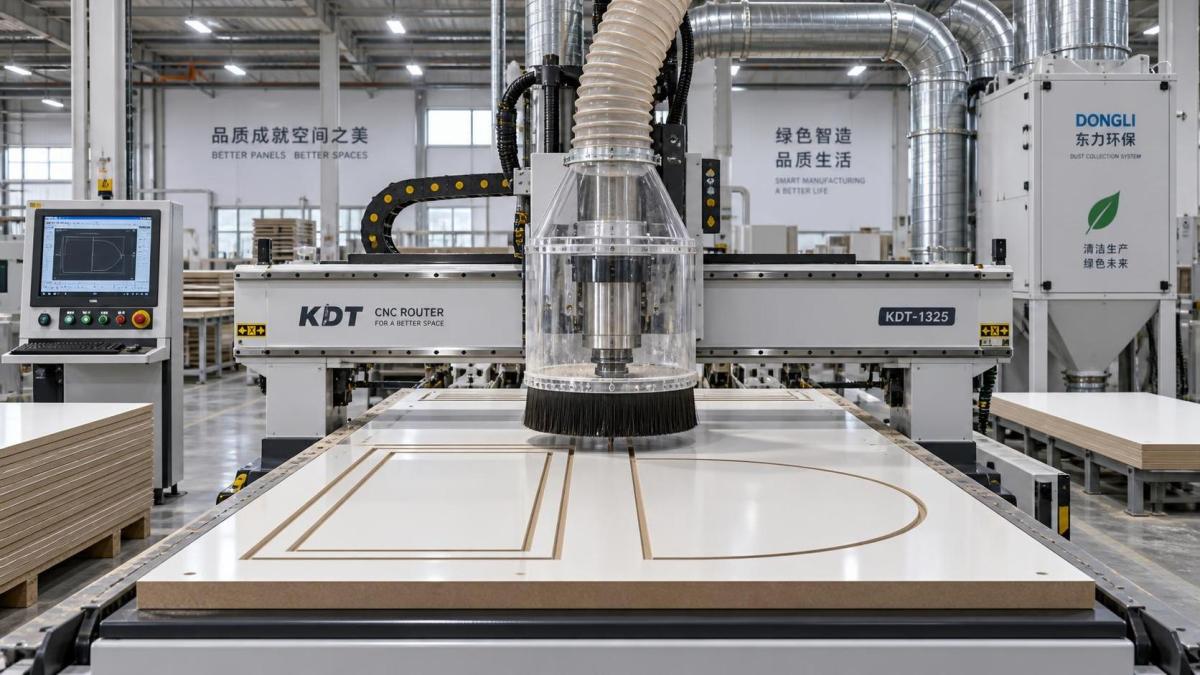
Panel saws and beam saws typically create a combination of larger chips and fine airborne dust around the main blade, scoring blade, pressure beam openings, and panel exit areas. CNC nesting machines may produce considerable dust around the router spindle, especially when machining open contours, deep pockets, narrow parts, or small components that reduce the effectiveness of a surrounding hood. Edge banding lines can release trimming waste, adhesive-related residues, and fine dust from end trimming or scraping stations. Wide-belt sanders require particularly close attention because sanding creates high volumes of fine particulate matter that can remain airborne if collection velocity is insufficient.
A useful evaluation question is: where does the dust go when the machine is running normally, rather than when it is stationary? A transparent guard, a large extraction port, or a clean machine exterior at an exhibition does not answer that question. Dust behavior changes when the spindle moves, the feed rate increases, the panel size changes, vacuum pods are exposed, or an operator opens a guard for adjustment.
Ask suppliers to explain the collection arrangement for each process head and each machine state. The answer should cover machining, tool change, loading, unloading, automatic cleaning cycles, and maintenance access. If the supplier can describe only the main extraction port but cannot explain collection around individual cutting or sanding zones, the dust-control design may be incomplete.
Assess the Machine, Ductwork, and Collector as One Operating System
A frequent selection error is to evaluate the machine and the dust collector separately. The machine may have suitable extraction outlets, while the installed collector lacks the airflow or pressure capability needed to serve several machines at once. Conversely, a strong collector cannot compensate for poorly designed hoods, leaking covers, crushed flexible hoses, or unbalanced branch ducts.
Before approving a machine, the buyer should obtain the manufacturer’s stated extraction requirements and use them as an input to the facility design. The information should be specific enough to support engineering review: number and size of extraction ports, expected airflow demand, recommended duct arrangement, operating conditions that require extraction, and whether multiple ports must be active simultaneously. For equipment with several processing units, it is important to know whether dampers are automatically controlled or whether full extraction demand is required throughout the cycle.
Do not assume that a port diameter alone establishes extraction performance. Air volume, air velocity, static pressure losses, duct length, bends, branch design, filter loading, and the operating condition of blast gates all affect collection. A system that appears adequate on a layout drawing may become underpowered once additional machines, long duct runs, or clogged filters are introduced.
For a new line, dust-control review should be part of the layout approval process. For a replacement machine in an existing workshop, compare its extraction demand with the capacity and condition of the installed system. A higher-output CNC router or sander may place a substantially different load on an extractor than the older machine it replaces. The machine purchase can otherwise create a hidden plant-level problem: production capacity rises, while airborne dust and housekeeping burden rise with it.
Questions that should be resolved before purchase
- Which extraction ports operate during each machining or sanding stage?
- What airflow and pressure conditions are expected at the machine connection points?
- Does the machine include collection hoods, brush skirts, guards, or internal channels for every major dust source?
- How does the design perform when processing small parts, narrow strips, perforated panels, or irregular shapes?
- Can the existing dust collection system support the machine at full production load?
- Are flexible connections, duct access points, and cleaning locations practical to inspect and maintain?
- Will the machine’s extraction design interfere with tool changes, panel handling, visibility, or routine adjustment?
Enclosure and Hood Design Often Matter More Than Promotional Claims
Effective source capture depends on keeping dust close to the extraction point. This is why guards, enclosures, hood geometry, and brush contact arrangements deserve close inspection. The goal is not merely to connect a hose to the machine; it is to prevent dust from gaining enough momentum or distance to disperse into the room.
On CNC routers, the spindle hood should remain effective across the full working area and through expected Z-axis movements. A brush skirt can improve capture near the cutter, but its performance may decline when machining stepped surfaces, deep cavities, uneven workpieces, or very small components. Check whether the skirt is easily replaceable and whether worn brushes can be detected before dust control deteriorates.
For saws, look at openings around the blade, guards above the workpiece, and extraction beneath the cutting zone. Dust may escape from the underside of the panel or from exposed blade sections even when the upper guard appears well designed. For sanding equipment, inspect the contact area, conveyor interface, access doors, and the points where dust can bypass the intended extraction channel.
Sealed enclosures can provide better containment, but they also create operating considerations. Operators need adequate visibility, access for setup, and a safe method for clearing jams or offcuts. An enclosure that is difficult to open, clean, or align may be left partially open during production. That turns a sound design feature into a routine dust leak. The practical test is whether the machine can be operated, cleaned, and maintained without defeating its own containment measures.
Do Not Separate Dust Control From Product Quality
Dust control is often discussed only as an occupational health issue. It also affects the quality stability of interior decoration products. Fine dust settling on panel surfaces can contaminate bonding zones, interfere with coating preparation, reduce edge-banding cleanliness, or create defects in laminated and finished surfaces. In high-precision CNC work, accumulated chips can affect panel support, vacuum holding, tool path clearance, and edge quality.
The risk is particularly relevant where processed panels move directly from cutting or sanding into edge banding, painting, lamination, assembly, or packaging. Dust that remains on surfaces may transfer downstream and become harder to trace back to its source. A quality manager should therefore consider whether extraction is integrated with material flow. The issue is not only how clean the machine looks, but whether parts leave the machine in a condition suitable for the next operation.
There is also a maintenance dimension. Dust accumulation inside electrical cabinets, around sensors, on moving components, and near pneumatic systems can lead to unreliable machine behavior or more frequent cleaning interventions. A machine that requires repeated manual cleaning during a shift may reduce its effective output even if its cycle time is competitive on paper.
Match the Evaluation Method to the Material Mix
Wood-based panels are common in furniture and interior fit-out production, but many facilities process mixed materials. Decorative board workshops may alternate between melamine-faced particleboard, MDF, plywood, compact laminate, acrylic, PVC sheet, aluminum composite panel, or coated substrates. The dust collector, filtration arrangement, waste handling process, and machine cleaning method should be appropriate for that actual mix.
Materials containing coatings, adhesives, resins, films, or plastic layers can create dust that behaves differently from untreated solid wood waste. Fine particles may load filters more quickly, cling to machine surfaces, or complicate segregation of collected waste. A selection review should include how waste will be conveyed, stored, removed, and prevented from re-entering the production area. The answer may influence the choice of machine enclosure, cleaning access, and collection routing.
For operations involving potentially combustible dust, the assessment should also consider the applicable local requirements for dust hazards, electrical equipment, ignition control, explosion protection, housekeeping, and collector installation. Requirements vary by jurisdiction, material, and facility arrangement. It is not enough for a machine supplier to state that a machine is suitable for woodworking; the buyer should establish which standards and site rules apply to the complete process, including the extraction and waste-handling system.
Documentation should be reviewed with the same discipline used for other safety-critical equipment. Useful records may include machine manuals, extraction connection specifications, electrical documentation, maintenance instructions, safety guarding details, and any available information concerning the intended use of the machine with relevant materials. Gaps in documentation are not always proof of poor machine performance, but they make commissioning, validation, and future audits more difficult.
Look Beyond Initial Capture Performance
New equipment can appear clean during a brief demonstration because hoods are undamaged, filters are clean, ducts are unobstructed, and processing conditions are controlled. The more relevant question is whether collection performance will remain stable after routine production, tool wear, operator changeovers, and repeated cleaning cycles.
Durability of the extraction components deserves attention. Thin guards that deform, poorly supported hoses, awkward access panels, and hard-to-replace brush strips can all affect performance over time. For machinery expected to run continuously, maintenance access should be assessed before installation. Can operators safely clear chips? Can maintenance personnel inspect the internal channels? Are wear parts identifiable and available? Does cleaning require removal of major covers or lengthy downtime?
Tool condition also affects dust generation. Dull saw blades, worn router cutters, incorrect feed settings, and unsuitable machining parameters can turn chips into finer debris and increase the collection burden. This does not eliminate the need for a well-designed extraction system; it reinforces the need to connect dust-control performance with preventive maintenance and process discipline.
A practical commissioning plan should include observation under representative production conditions, not only idle testing. Process the panel sizes, material types, cut patterns, and feed rates that the line will normally handle. Inspect residual dust on the machine, surrounding floor, workpiece surfaces, conveyor sections, and downstream equipment. Review whether operators must use compressed air for cleanup, since this can redistribute fine dust into the workspace rather than remove it.
A Better Basis for Comparing Suppliers
When several machines offer similar processing capacity, dust-control design can be a meaningful differentiator. The comparison should focus on evidence that helps the plant operate safely and consistently: detailed extraction requirements, visible collection features, maintainability, integration support, and a willingness to discuss operating limitations.
Suppliers of woodworking machinery may provide equipment with different levels of standard guarding, extraction interfaces, optional enclosures, or automation. The buyer should make dust-control expectations part of the technical specification rather than leaving them as informal discussion points. This gives quality, safety, engineering, and production teams a common basis for evaluating proposals.
The strongest selection outcome is usually a machine whose extraction needs are understood before delivery, whose collection points match the processing tasks, and whose maintenance requirements fit the site’s operating discipline. For interior decoration material processing machinery, clean production is rarely achieved by one component alone. It is the result of compatible machine design, correctly sized extraction infrastructure, disciplined operation, and inspection that continues after the equipment enters service.
Send Your Inquiry
We welcome your cooperation and we will develop with you.