


News & Exhibitions
Latest Factory Updates, Industry Trends & Global Exhibition Information
Where furniture factory automation delivers the fastest payback
Furniture factories see the fastest automation payback in operations where the same action is repeated hundreds of times per shift, a mistake creates scrap or rework, and a skilled operator is tied up moving material rather than adding judgment. For most plants, the first returns do not come from automating every workstation. They come from removing the few bottlenecks that limit output across the whole production flow.
Panel cutting, edge processing, drilling, and internal material movement are usually the strongest candidates because they combine labor demand with direct effects on material yield, lead time, and product consistency. A factory with highly variable custom work may still benefit, but it should automate the stable portion of its order mix first. The right question is not “How automated should the factory become?” It is “Which constraint is costing us the most capacity and margin today?”
Start where one bottleneck holds back several downstream processes
Automation pays back fastest when it relieves a constraint that causes waiting elsewhere. A manual cutting area is a common example. If panels are queued for cutting, then edgebanding, drilling, assembly, and packaging staff may all spend part of the day waiting for parts. Adding labor downstream does little to solve that problem. Improving the cutting cell can release capacity throughout the factory.
Decision-makers should map the actual route of a typical order before comparing machinery. Follow a panel from receiving through nesting or cutting, edge treatment, drilling, sorting, assembly, and packing. Record where parts wait, where operators repeatedly search for information, and where completed parts are returned for correction. The process with the longest queue is often more important than the process with the largest headcount.
There is an important qualification: a visible queue does not always prove that the machine at its head is undersized. The queue may result from poor batch scheduling, missing material, inconsistent drawings, or a lack of part identification. Automation cannot correct weak production control on its own. It can, however, make a stable and well-defined process much faster and more predictable.
Precision panel cutting often creates the clearest early return
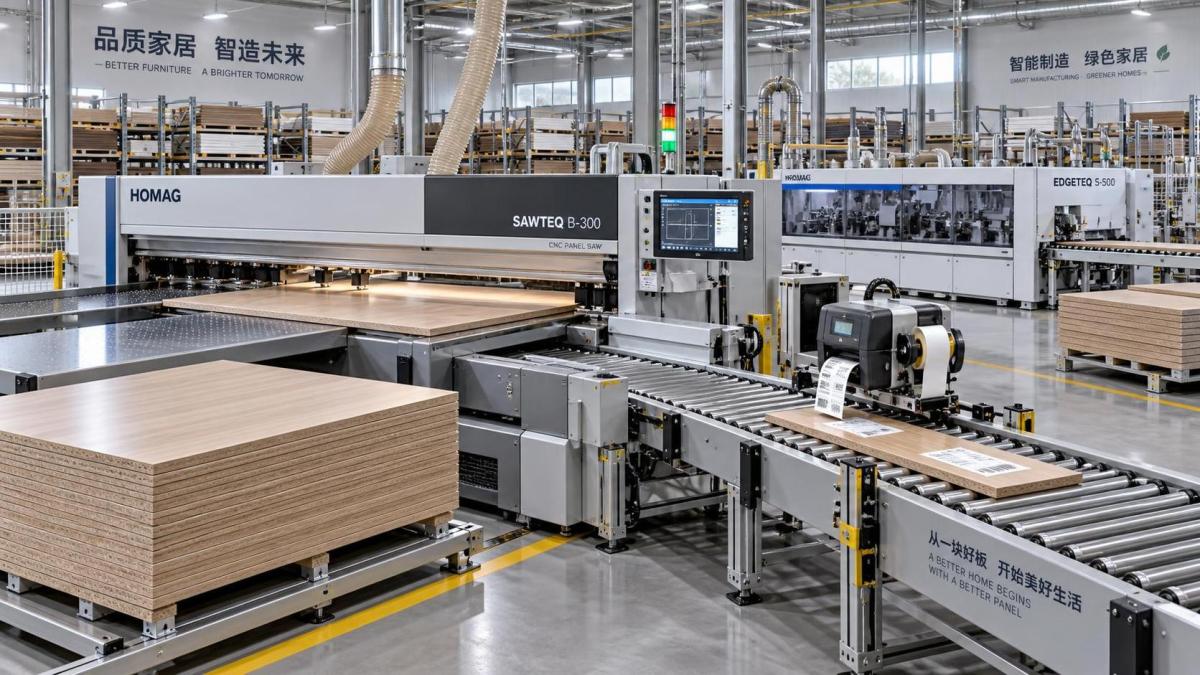
For cabinet, office furniture, wardrobes, and other panel-based products, cutting affects almost every subsequent operation. An inaccurate or poorly optimized cut can consume more material, create fitting problems at assembly, and force additional handling before a part ever reaches the customer. This is why automated panel saws, beam saws, CNC nesting systems, and associated labeling workflows are frequently evaluated early in a Furniture Factory Automation program.
The financial case is stronger when the factory handles high panel volumes, uses expensive decorative boards, produces recurring cabinet dimensions, or experiences recurring setup and measurement errors. Faster cutting alone is useful, but the larger benefit often comes from a controlled flow of correctly identified parts. When each piece is cut to the right dimension, labeled at the point of production, and sent to the next operation with clear routing information, operators spend less time checking, sorting, and tracing mistakes.
Cutting automation should be selected according to the factory’s product mix rather than the advertised speed of a machine. A beam saw can suit repetitive rectangular panels and batch-oriented output. A nesting CNC can be attractive where the product range includes shaped components, frequent design changes, or a need to combine drilling, routing, and cutting in one program. Neither format is automatically superior. A factory that purchases the wrong cutting architecture may gain speed in one step while creating congestion or excessive manual sorting afterward.
Material utilization deserves close attention, but it should be assessed carefully. Optimization software can improve sheet layouts, yet savings depend on the order mix, panel sizes, grain-direction requirements, remnant policies, and how reliably operators follow the generated cutting plans. A theoretical yield improvement is less valuable if usable remnants are never stored, identified, or reintroduced into production.
Before approving a cutting investment, management should ask:
- How many labor hours are spent measuring, setting stops, loading, unloading, sorting, and correcting cut parts?
- Which defects originate in cutting, and how often do they cause rework in downstream operations?
- Can production data flow from design or order processing into machine programs without repeated manual entry?
- Will the machine’s output rate exceed the capacity of labeling, edgebanding, drilling, and part sorting?
- Does the factory have a practical system for offcuts and reusable remnants?
A cutting cell with automatic loading may look like a major step forward, but loading automation should be justified by actual panel volume and handling conditions. In a low-volume operation with frequent material changes, a well-organized semi-automatic workflow may deliver a better return than a fully automated loading system that spends too much time changing stacks.
Edgebanding delivers value when quality variation is expensive
Edgebanding is often underestimated because the operation appears simple: apply the edge material, trim it, finish it, and send the panel onward. In production, it can become a persistent source of visible quality defects. Glue-line inconsistency, chipped edges, poor corner finishing, incorrect band selection, and panel damage can all produce parts that are technically complete but unacceptable for shipment.
Automation in this area pays back quickly when a factory produces a large number of edged panels with repeatable specifications. An automatic edgebander can reduce manual handling and improve repeatability across gluing, trimming, scraping, buffing, and, where needed, corner processing. The gain is especially meaningful for products where edge appearance is highly visible to the buyer, such as kitchen doors, office panels, retail furniture, and laminated cabinet components.
The purchase decision should not focus only on how many stations a machine includes. More processing units can expand capability, but they also increase setup demands, maintenance requirements, and the consequences of incorrect adjustment. A factory producing straight panels in a narrow range of thicknesses may achieve a better result from a robust, appropriately specified machine than from a complex line with features used only occasionally.
Edge quality is also a system issue. Board storage conditions, panel squareness, adhesive choice, edge-band quality, dust extraction, operator training, and maintenance discipline all influence the finished result. A new machine cannot compensate indefinitely for warped panels, unstable power conditions, poor glue preparation, or inadequate cleaning. During evaluation, managers should inspect sample parts across the full planned range of panel materials, thicknesses, colors, and edge types rather than approving a machine based on a single demonstration piece.
Drilling and hardware preparation can remove a hidden labor drain
Furniture assembly is slowed by small inaccuracies that begin much earlier. A hinge cup drilled slightly off position, a connector hole at the wrong depth, or a missing dowel hole may not be found until parts arrive at assembly. By then, the cost includes more than a defective panel. Assemblers are interrupted, replacement parts must be identified, and completed orders may be delayed while a single component is remade.
CNC drilling centers and point-to-point machining are most compelling where product configurations repeat, hardware patterns are numerous, or manual layout is consuming skilled labor. They reduce dependence on measuring each panel individually and make it easier to apply standard drilling patterns across product families. The business value comes from fewer interruptions and more reliable assembly, not merely from a shorter drilling cycle.
Factories with highly customized products should examine programming workload before choosing advanced drilling equipment. A machine can process complex patterns efficiently, but every order still needs accurate production data. If drawings are incomplete, revision control is weak, or programmers must rebuild jobs from scratch for every order, the benefit may be delayed. Establishing a controlled library of common cabinets, hardware rules, and machining templates can be more valuable than purchasing additional machine capacity.
Material handling can be the best investment when machines are already waiting for people
Factories often concentrate their automation budget on the machining process while overlooking the time spent loading sheets, turning panels, stacking components, moving carts, and searching for completed parts. In panel furniture production, these activities may not change the product directly, but they determine whether expensive machinery runs consistently.
Automatic loading and unloading, return conveyors, transfer systems, lift tables, panel buffers, and barcode-based sorting can generate strong returns when they remove repetitive lifting and keep equipment supplied. The case becomes particularly persuasive when large panels create safety concerns, operators are regularly pulled away from machines to move material, or work-in-progress accumulates between operations.
Material handling automation should follow a defined production route. Installing conveyors without resolving batch logic can simply move disorder faster. Parts need a clear destination, an identification method, and enough buffer capacity to absorb normal variation. A transfer system also needs to fit the factory’s physical constraints: aisle width, turning space, machine access for service, loading patterns, and the way finished goods leave the line.
For many medium-sized factories, the practical first step is not a fully integrated production line. It may be a return conveyor at the edgebander, a lift-assisted loading station, organized carts for sorted components, or a labeling process that prevents parts from becoming anonymous once they leave the saw. These measures can free operator time and reveal where a larger investment would have the greatest effect.
Calculate payback from avoided losses, not machine speed alone
Cycle-time claims are easy to compare. Payback is harder because it depends on whether the factory can convert faster processing into useful output. A machine that cuts twice as quickly does not automatically double production if the next process is constrained, order volume is inconsistent, or the factory lacks enough demand to use the added capacity.
A credible investment model should identify the specific losses the equipment will reduce. These may include direct labor assigned to repetitive tasks, overtime caused by bottlenecks, material scrap, remakes, outsourced processing, lost production from frequent setup, and delayed order completion. Capacity should be valued conservatively. It has commercial value only when the factory can use it for additional sales, shorter lead times, greater schedule reliability, or reduced overtime.
Ownership cost is where many payback estimates become too optimistic. The machine price is only one part of the decision. New equipment may require foundation work, material storage changes, power upgrades, dust collection capacity, software integration, tooling, operator training, and a stock of wear parts. These are not arguments against automation; they are costs that should be included before management commits to a return target.
Do not automate unstable work before standardizing it
Automation magnifies both good processes and poor ones. If a factory has unclear bills of materials, uncontrolled drawing revisions, inconsistent panel identification, or frequent last-minute order changes, adding CNC capacity may make errors travel through the plant more rapidly. The first investment may need to be process discipline: product coding, approved machining data, job release rules, and traceable part labels.
That does not require a large software project before every machinery purchase. A focused preparation effort can be enough. Define the product families that will run through the new equipment, identify the information needed at each stage, assign ownership for program changes, and establish how operators flag exceptions. The equipment supplier should be evaluated on its ability to support this operating model, including installation, training, documentation, spare parts availability, and technical service after commissioning.
Furniture Factory Automation delivers its fastest payback when it is used to remove a measurable production constraint, protect material and quality, and stabilize the flow of parts from cutting to assembly. Factories that begin with the highest-cost bottleneck, build the business case around real losses, and leave room for downstream processes to keep pace are far more likely to turn machinery investment into durable operating improvement.
Send Your Inquiry
We welcome your cooperation and we will develop with you.