


News & Exhibitions
Latest Factory Updates, Industry Trends & Global Exhibition Information
Woodworking Machinery Installation Support: A Commissioning Checklist for Furniture Lines
A furniture line can be mechanically complete and still fail its first production week. The usual causes are not dramatic machine faults: an unfinished dust system, unstable compressed air, missing material for calibration, a rushed handover between riggers and technicians, or operators asked to run recipes they have not yet verified. For a project manager, woodworking machinery installation support should be treated as a controlled commissioning process, not as a delivery-day service.
The practical test is simple: can the line produce representative parts at the planned pace, with safe material flow, acceptable quality, recorded settings, and a team that can recover from routine interruptions? If the answer is no, the project is still in commissioning, regardless of whether every machine has been powered on.
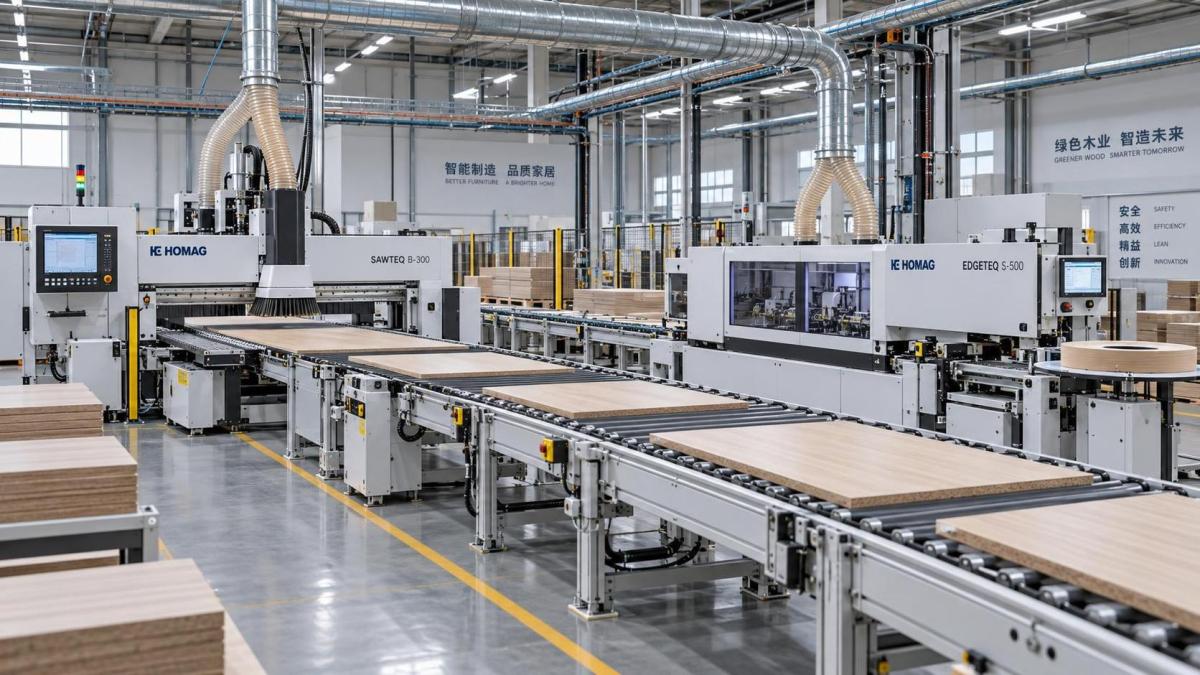
Furniture lines create dependencies that are easy to underestimate. A CNC nesting cell affects edge-banding throughput; panel saw cut quality affects downstream squareness; sanding performance can expose problems that began in panel preparation. Installation support is most effective when it follows that production flow rather than treating each machine as an isolated asset.
Start with a commissioning owner and a shared acceptance plan
Before equipment arrives, appoint one person on the buyer's side to coordinate decisions across civil works, utilities, production, maintenance, safety, IT where relevant, and the equipment supplier. This does not mean that one manager must solve every technical issue. It means there is one visible owner for priorities, open items, deadlines, and escalation.
The commissioning plan should define more than an installation date. It should state what counts as mechanical completion, what conditions allow electrical energization, what sample products will be used for trials, who can approve changes, and what evidence is required before handover. Without this agreement, teams often declare success at different stages: the installer may consider the machine positioned and connected, while production expects saleable furniture components.
For a furniture line, acceptance criteria should be tied to the intended product mix. A line planned for cabinet carcasses, for example, should be tested on the panel sizes, materials, edge types, drilling patterns, and tolerances that matter in daily work. A generic trial board proves only that motion is possible. It does not prove that the machine settings, tooling, dust extraction, material handling, and operator workflow are ready for production.
A useful commissioning file usually includes:
- Layout drawings showing machine positions, service clearances, infeed and outfeed paths, operator zones, and maintenance access.
- A responsibility matrix covering unloading, positioning, electrical work, air and extraction connections, anchoring, software input, safety checks, and operator attendance.
- A utility schedule specifying the required connection points and the party responsible for verifying each one.
- A punch-list process with an owner, due date, status, and impact on commissioning for every unresolved item.
- A trial plan based on representative production parts rather than a convenient demonstration sample.
- A handover package covering manuals, wiring diagrams, parameter backups, spare-parts information, maintenance requirements, and training records.
Keep this file active during the project. A binder assembled after startup may document the installation, but it cannot manage it.
Verify the site before the technicians arrive
Site readiness is where many commissioning schedules are lost. Machinery technicians can adjust a machine, but they should not be waiting for floors to cure, openings to be enlarged, power cabinets to be completed, or extraction ducting to be fabricated. Each delay compresses the time available for calibration and production trials, which are usually the phases that reveal the meaningful problems.
Floor conditions deserve close attention. Heavy panel-processing equipment, automated feeders, return conveyors, and sanding machines need the planned levelness and load-bearing condition across their working footprint, not simply a floor that appears flat by eye. Uneven support can complicate alignment and can contribute to repeatability problems. Confirm anchor locations, embedded services, drainage channels, and expansion joints before final positioning. A machine moved after alignment may need the process repeated.
Material movement should be reviewed as seriously as machine placement. Check the route from unloading to staging, from staging to the first machine, and between every major process. Consider the turning space for forklifts, panel trolleys, vacuum lifters, and waste collection. A layout can fit dimensionally while still forcing operators to cross conveyor paths, carry panels around guarding, or stack work-in-process in a safety zone.
Access also includes overhead space. Ducting, cable trays, lighting, sprinkler systems, and crane coverage can conflict with loading frames, maintenance doors, lifting points, and sheet-handling equipment. Resolve those conflicts using the supplier's installation drawings before shipment where possible. Fixing an overhead clash after machinery is in place is often slower and more disruptive than expected.
Utilities are production inputs, not construction closeout items
Electrical supply, compressed air, dust extraction, and sometimes network connectivity need to be commissioned as systems. Connecting a machine to an available service is not sufficient. The service must remain within the machine's operating requirements during the conditions that create peak demand.
Electrical supply
Confirm the required voltage, frequency, phase arrangement, protective devices, cable sizing, earthing, and isolation arrangement against the machine documentation. Verify rotation direction before operating motors that depend on it. Electrical cabinets should be accessible, correctly labeled, and free of construction dust and moisture. Where several machines start under central control, review startup sequences and load effects with the responsible electrical team.
Power quality issues may show up as intermittent drives, communication faults, nuisance trips, or inconsistent performance. Those symptoms are easy to misclassify as machine defects. Record supply conditions early when troubleshooting is needed, rather than relying on a one-time reading taken while the equipment is idle.
Compressed air
Air demand is often underestimated because each actuator appears small in isolation. On a furniture line, clamps, pneumatic stops, tool changers, cleaning jets, and handling devices can create rapid demand changes. Confirm pressure at the machine inlet during active cycles, not only at the compressor room. Inspect filtration, moisture removal, hose routing, leaks, and shutoff access. Water or oil contamination may not stop commissioning immediately, but it can shorten the life of valves and affect consistent operation.
Dust extraction
Extraction should be tested while the line is cutting, routing, edge processing, or sanding the materials it will actually process. Duct diameter, branch design, blast-gate logic, airflow balance, collection capacity, and chip disposal all affect performance. Poor extraction is more than a housekeeping issue. It can interfere with cut quality, sensor reliability, operator visibility, fire risk management, and the ability to keep a line running without repeated cleaning stops.
Do not accept “the fan is running” as an extraction test. Look at accumulation around machine hoods, inside cabinets where permitted, at transfer points, and on finished components. Confirm that dust collection remains effective when multiple connected machines operate together.
Install in sequence, then align to the production flow
Large machines are commonly set in place first, followed by conveyors, extraction connections, guarding, electrical services, and final leveling. The sequence should reflect the line's physical dependencies. A return conveyor cannot be meaningfully aligned if the connected edge bander is still moving. A loading system cannot be calibrated until its reference positions, safety zones, and downstream transfer height are stable.
Mechanical installation should include checks that are often left implicit: machine orientation, level, anchor condition, joint alignment, conveyor height, transfer gap, sensor position, guard clearance, cable and hose strain relief, lubrication points, and access to wear parts. For linked machinery, verify how parts transfer at the lowest, highest, narrowest, and widest planned workpiece conditions. A transfer that works with one test panel may jam or skew another format.
Allow enough time for precision adjustment. On panel saws, nesting routers, drilling centers, edgebanders, wide-belt sanders, and automated handling systems, setup quality affects output quality and recoverability. Rushing alignment to begin trial production can create a false sense of progress: the line runs, but operators compensate through manual adjustments that later become undocumented routine.
During this stage, require technicians and the internal maintenance team to identify service tasks that will be needed after handover. They should be able to locate lubrication points, change wear components, reset ordinary alarms, isolate energy safely, clean accessible areas, and distinguish a normal adjustment from a supplier-support issue. Installation support has limited value when this knowledge leaves with the commissioning crew.
Run trials in layers instead of chasing full-line speed immediately
Commissioning becomes more reliable when testing moves from stable individual functions to connected production. Start with safety circuits, axes, sensors, material transfer, and manual movements. Then test each machine with its intended material and tooling. Only after individual equipment is stable should the team attempt full-line flow and planned cycle times.
This staged approach makes faults easier to isolate. If a panel enters a CNC machine correctly but arrives misaligned at an edgebander, the team can inspect the transfer interface, conveyor settings, part orientation logic, and material behavior without simultaneously questioning the entire line.
Trial parts should represent the difficult conditions of the planned range, not only the easiest ones. Include small and large panels where relevant, narrow strips, parts with drilling patterns, different edge materials, common board thicknesses, and components that require tight visual finish. Use production-grade boards, coatings, adhesives, and tooling whenever possible. Substituting easier material can mask problems with chip-out, edge bonding, sanding marks, dust capture, or feed stability.
Capture evidence during trials. Record the selected programs, tool identifiers, offsets, pressure settings, temperature settings where applicable, feed rates, alarm events, reject reasons, and manual interventions. A first-article approval should include dimensional and visual checks appropriate to the product, but it should also document how the approved result was achieved. Otherwise, the first shift after technician departure may spend hours recreating a setup that already worked.
Train for decisions, recovery, and maintenance
Operator training should not end with start, stop, and emergency-stop functions. Furniture production involves frequent variation in panel dimensions, materials, tooling condition, recipes, and edge requirements. Operators need to understand what a normal setup looks like, what checks must be completed before a run, and when an abnormal result should trigger maintenance or process review.
Separate training by role. Operators need operating sequences, quality checks, safe loading and unloading, cleaning routines, and basic alarm response. Maintenance personnel need deeper instruction on lubrication, adjustment limits, fault diagnosis, backups, electrical and pneumatic isolation, and recommended spare parts. Supervisors need to understand the production constraints that determine whether a schedule is realistic: warm-up or setup time, tool-change practices, cleaning intervals, planned maintenance, and the recovery path after a stop.
Training is stronger when it uses the buyer's own parts and production programs. Ask operators to perform a complete setup, run the part, inspect it, and recover from a controlled interruption while the technician is present. Observation alone can hide uncertainty. A supervised hands-on run reveals where instructions, program naming, material staging, or shift communication need to be improved.
Close commissioning with open issues visible
A practical handover does not require every minor item to disappear before production begins. It does require the remaining items to be understood, assigned, and separated from issues that affect safety, quality, capacity, or equipment reliability. Do not allow serious defects to be buried in a long general punch list.
Before closing the installation phase, confirm that approved operating settings are saved, software and parameter backups are stored in an accessible location, electrical and pneumatic drawings match the installed condition, and the maintenance schedule has a named owner. Review initial consumables and critical spares in relation to the line's planned workload and replenishment lead time. A missing cutter, belt, sensor, or pneumatic component can turn a small post-startup issue into an extended stoppage.
The best indicator of effective woodworking machinery installation support is not a ceremonial sign-off. It is a production team that can start the line safely, produce defined furniture components consistently, diagnose ordinary deviations, and give the supplier precise information when deeper support is needed. That outcome depends on preparation before delivery, disciplined trials during commissioning, and a handover built around the way the line will actually run.
Send Your Inquiry
We welcome your cooperation and we will develop with you.