

News & Exhibitions
Latest Factory Updates, Industry Trends & Global Exhibition Information
Woodworking Machine Voltage in Canada: Supply and Electrical Approval Checks
Woodworking Machine Voltage in Canada: Supply and Electrical Approval Checks
A woodworking machine can match your shop’s voltage and still fail electrical approval checks in Canada. Checking woodworking machine voltage for Canada means confirming the available supply, phase, and frequency alongside machine nameplate ratings, control circuits, and applicable provincial or territorial approval requirements. Before purchasing or commissioning imported equipment, verify recognized certification marks or whether an accepted field evaluation is needed. These checks help prevent installation delays, reduce electrical risks, and give the supplier and local electrical authority a clear basis for reviewing the machine.
The costly mistake is treating “Canadian voltage” as a complete specification. A panel saw, wide-belt sander, or edge banding machine may contain several motors, heaters, drives, and control power supplies. Compatibility has to cover the assembled machine—not just its largest motor.
Start with the supply at the actual installation point
Canada does not have one universal machinery supply. Depending on the building, available systems may include 120/240 V single-phase, 120/208 V three-phase, or 347/600 V three-phase. Other arrangements exist, including supplies established through facility transformers. Industrial equipment often carries utilization ratings such as 230 V or 575 V; these should not be confused with nominal distribution voltages.
Ask the facility electrician to document the supply at the intended connection point. An old machine’s nameplate or a building lease description is not enough. The incoming building service may differ from the voltage available on the production floor.
- Nominal voltage and measured conditions: Record line-to-line voltage and, where relevant, line-to-neutral voltage. A single reading does not establish performance during starting or peak production.
- Phase and frequency: Confirm single-phase or three-phase service and the Canadian supply frequency of 60 Hz.
- Conductors and grounding: Establish whether a neutral is available and what bonding and grounding arrangements apply.
- Circuit capacity: Check available capacity, existing loads, and the proposed branch circuit with the electrician.
- Available fault current: Obtain the information needed to assess the machine’s short-circuit suitability and protective-device coordination.
A neutral and an equipment bonding conductor serve different purposes. A three-phase machine that needs a neutral for auxiliary loads cannot simply use the bonding conductor instead. Identify this requirement before the cable and disconnect are selected.
Read beyond the main motor nameplate
A motor marked 230/460 V does not establish that the whole machine can operate at either voltage. Dual-voltage motor windings may be reconnectable, while the control transformer, contactor coils, heaters, brakes, and drives remain configured for one incoming supply.
Request the complete machine nameplate, electrical schematic, and relevant component ratings. The declared incoming supply should agree with the drawings and the delivered configuration. Any voltage conversion should follow an engineered manufacturer procedure, with its effect on electrical approval reviewed—not an informal instruction to “change a few wires.”
For a multi-function woodworking machine, trace the incoming supply through each power branch. An edge bander may combine feed motors, glue-pot heaters, trimming spindles, and low-voltage controls. A sander may have separate main-drive, conveyor, and positioning circuits. One incompatible branch is enough to prevent safe commissioning.
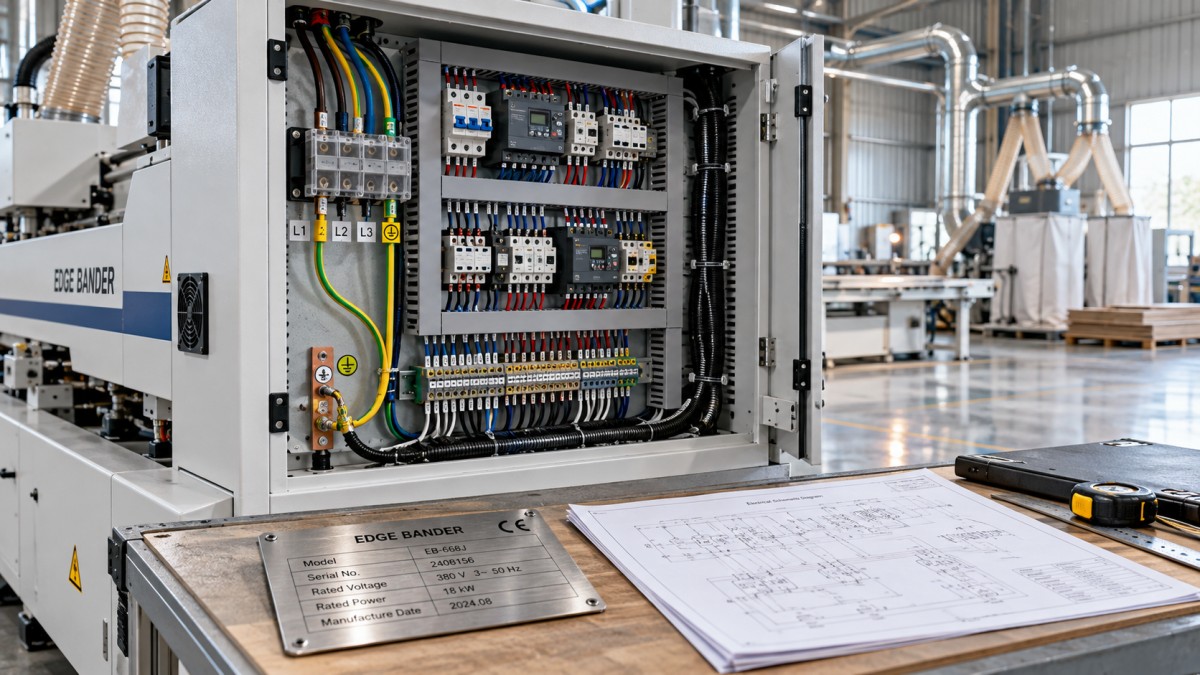
The useful visual comparison is between the machine nameplate, incoming terminals, and schematic supply designation. These should tell the same story. A machine labelled for one voltage but documented for another should remain on hold until the manufacturer resolves the discrepancy.
Frequency changes more than the label
Equipment designed only for 50 Hz should not be assumed suitable for 60 Hz because the voltage appears close. Frequency affects induction motor speed, while voltage-to-frequency relationships affect magnetic loading. Changes in shaft speed can also affect tooling limits, belt drives, fans, and feed behavior.
A variable-frequency drive can address some motor operating requirements, but it is not a whole-machine conversion device. Its input rating, output configuration, motor compatibility, protective measures, and permitted application still need review. It does not automatically correct incompatible heaters or control transformers elsewhere in the machine.
Voltage compatibility and electrical approval are separate gates
Electrical equipment acceptance is governed through provincial or territorial requirements and the responsible authority having jurisdiction. The Canadian Electrical Code, Part I, provides a central installation framework, but applicable editions, amendments, permits, and inspection practices must be checked locally.
A familiar certification logo is not enough by itself. Verify that the mark indicates Canadian coverage, that the issuing organization is recognized for the relevant activity, and that the listing covers the actual machine model and configuration. Organizations such as CSA Group, UL, and Intertek issue different marks; recognition depends on the specific mark and scope, not simply the company name.
Certified components do not automatically make a certified machine. A panel containing approved breakers, contactors, and power supplies still needs an acceptable basis for the assembled equipment. Likewise, a certification label on a control panel should not be assumed to cover every connected part of the woodworking machine.
CE marking alone is not evidence of Canadian electrical approval. Supporting European documentation may help reviewers understand the design, but it does not replace the approval route accepted by the local electrical authority.
Where field evaluation may fit
For equipment without acceptable certification, a field evaluation may be an available route, subject to jurisdictional acceptance and the equipment’s scope. CSA SPE-1000, the Model Code for the Field Evaluation of Electrical Equipment, is commonly relevant to this process. Field evaluation is not the same as product certification and should not be presented as interchangeable with it.
Discuss the proposed machine with an accepted evaluation body before shipment. Provide drawings, ratings, photographs, and the intended installation details. Ask about eligibility, required access, documentation, and likely correction areas. An evaluation arranged only after arrival may reveal changes that are difficult to complete without factory support.
Choose the supply solution before releasing production
When the factory configuration does not match the site, there are several possible responses. None should be selected solely on purchase price.
A transformer changes voltage, not frequency, and does not inherently convert single-phase service into three-phase service. Its rating also cannot be selected reliably from motor horsepower alone. Starting demands, simultaneous loads, and acceptable voltage drop matter.
Short-circuit current rating deserves particular attention. Full-load current describes operating demand; it is not a fault-withstand rating. The machine’s applicable short-circuit rating and upstream protection must be suitable for the installation. A larger breaker is not a remedy for unexplained starting trips.
Build a release file that survives delivery
The purchasing specification should become a controlled electrical record. Retain the agreed supply configuration, final schematics, machine identification, component schedule, installation instructions, and certification or evaluation documentation. Photographs of labels and the completed panel help connect the paperwork to the physical machine.
Set a clear change-control rule: substitutions affecting electrical ratings, protection, or safety functions require review before shipment. A replacement drive or power supply may look equivalent commercially while changing the approval basis or installation requirements.
Qingdao Zhongding Machinery Co., Ltd. manufactures and exports woodworking machinery, drawing on more than 20 years of industry experience. For a Canadian project, the practical use of that manufacturing support is to resolve the electrical configuration before production and preserve the information needed for maintenance afterward. Technical support, spare-parts supply, and responsive after-sales service are most useful when replacement parts can be checked against a controlled machine record.
Ask the supplier who will answer evaluator questions, supply revised drawings, and identify acceptable replacement components. Do not assume that export experience alone establishes Canadian approval for a particular model.
Keep commissioning behind a documented hold point
At receiving inspection, compare the delivered machine with the release file before connection. Check for transport damage, altered components, missing labels, and unresolved discrepancies. Qualified personnel should complete required installation checks, including protective bonding, connection integrity, supply verification, and protective-device settings.
Controlled functional testing should address phase sequence and rotation, emergency stops, guard interlocks, restart behavior, and auxiliary equipment interfaces. Electrical approval does not replace a broader machine-safety assessment. Dust extraction, combustible dust hazards, guarding, and lockout provisions still require their own attention.
Release the machine only when the supply matches the documented configuration, the accepted approval route is complete, and commissioning findings are closed. If any of those conditions remains uncertain, resolve it before production—not after the first electrical fault or inspection visit.
Send Your Inquiry
We welcome your cooperation and we will develop with you.