


News & Exhibitions
Latest Factory Updates, Industry Trends & Global Exhibition Information
Can a 50 Hz Woodworking Machine Run on 60 Hz? Motor and Drive Checks
A 50 Hz woodworking machine can sometimes run on a 60 Hz supply, but matching the voltage alone does not establish compatibility. Direct connection is appropriate only when the motors, mechanical components, controls, and auxiliary equipment are suitable for the resulting operating conditions. A machine that starts and runs without an immediate fault may still exceed a cutter’s speed limit or overload a fan motor.
The central question in woodworking machine frequency conversion is whether the machine must retain its original operating speeds or can safely operate at different speeds. That decision determines whether direct connection, a correctly configured variable frequency drive (VFD), or component replacement is appropriate.
What changes when a 50 Hz motor receives 60 Hz?
For a conventional induction motor, synchronous speed follows supply frequency and the number of motor poles. Raising frequency from 50 Hz to 60 Hz increases synchronous speed by 20%. Actual shaft speed also depends on slip and load, so the measured increase will not necessarily be exactly 20%.
On a belt-driven saw or planer, an unchanged pulley ratio transfers approximately that speed increase to the blade or cutterhead. A feed motor may move material faster, while an extraction fan may require substantially more power. These effects explain why motor compatibility and machine compatibility require separate checks.
Voltage also matters. Below its base operating frequency, an induction motor generally needs an appropriate voltage-to-frequency ratio to maintain magnetic flux. If frequency rises while voltage stays unchanged, flux falls. The motor’s available torque can decrease, particularly where operation enters a field-weakening region.
For example, changing from 50 Hz to 60 Hz at unchanged voltage reduces the voltage-to-frequency ratio to about 83% of its original value. This does not establish a universal torque or power rating; the acceptable load still depends on the motor’s design and operating limits.
Increasing voltage in proportion to frequency may preserve the ratio, but it is permissible only within the equipment’s ratings. A mathematically suitable ratio does not authorize higher voltage on motor insulation, contactor coils, transformers, or electronic controls.
Read the motor nameplate before choosing a conversion method
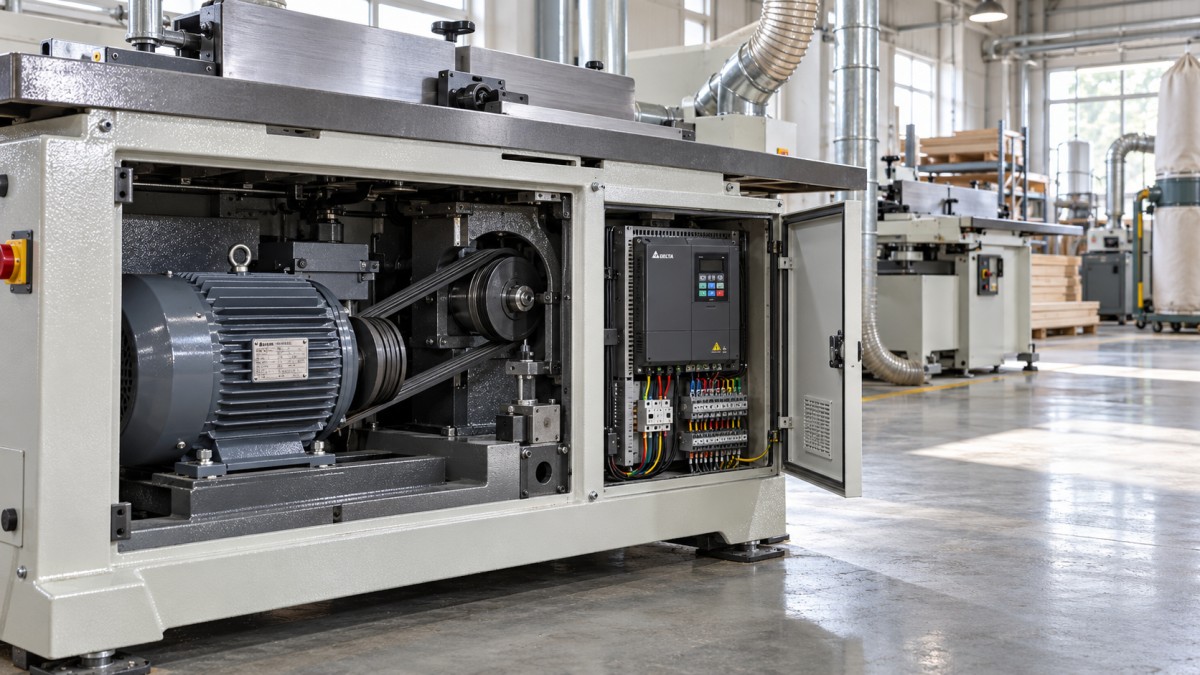
Start with every motor on the machine, including feed drives, scoring units, hydraulic pumps, and separately driven fans. Record the rated voltage, frequency, current, power, speed, phase, duty, and terminal connection. A photograph of the main motor plate alone is insufficient for a machine with several powered functions.
A dual-frequency nameplate is useful because it may specify separate voltage, current, speed, and output ratings for 50 Hz and 60 Hz operation. Read each set together. A 60 Hz rating does not necessarily permit the same output or connection used at 50 Hz.
Distinguish the incoming supply from the voltage at the motor terminals. A transformer, drive, or existing connection arrangement may make these different. Also establish whether the destination supply is single-phase or three-phase; frequency conversion does not automatically resolve phase compatibility.
Mechanical speed limits can rule out direct connection
A motor approved for 60 Hz can still drive a woodworking machine too fast. Trace the power path from motor shaft to pulley, gearbox, spindle, and cutting tool. Calculate the expected speed at each relevant point and compare it with the documented operating limits.
Check both the spindle assembly and the fitted tooling. Saw blades, cutterheads, router tools, sanding drums, bearings, and clamping systems have their own limitations. A tool’s marked maximum speed is a limit, not a recommended production setting. The machine’s permitted operating speed may be lower.
For the same rotating assembly, centrifugal loading increases with the square of rotational speed. A 20% speed increase therefore produces approximately 44% greater centrifugal loading. This makes an apparently modest frequency change significant for rotating tooling and its retention system.
Cutting quality may also change. If spindle speed rises but feed speed remains unchanged, chip load per tooth decreases. That can affect heat, rubbing, and surface finish. If separate motors increase both speeds, the relationship may remain similar, but acceleration, stopping, and material handling still need assessment.
Changing pulley ratios can restore spindle speed in some belt-driven machines. However, it does not resolve motor torque capability, belt loading, braking, guarding, or auxiliary compatibility. Treat a pulley change as an engineered modification with revised speed calculations.
When a VFD provides a practical solution
For a compatible three-phase induction motor, a VFD can accept a suitable 60 Hz supply and provide a controlled 50 Hz output. This can preserve the original motor and spindle operating speeds, avoiding the mechanical consequences of running directly at 60 Hz.
An existing VFD may already provide this separation between supply frequency and motor frequency. If its input specification accepts the destination supply, its motor output can often remain configured for the original operating conditions. Check the drive manual and machine circuit before changing parameters.
Select the drive using motor current, supply voltage, phase arrangement, overload requirements, and load characteristics. Kilowatt or horsepower matching alone can miss important restrictions. A drive supplied from single-phase power must explicitly support that arrangement and may require different sizing.
A conventional VFD does not automatically provide the voltage required by the original motor. Its usable output voltage is generally constrained by its input and design. A motor requiring higher voltage than the supply can support needs an appropriate voltage-conversion arrangement, a permitted winding reconnection, or another compatible motor.
Configure the drive around the motor and machine
Enter the actual motor nameplate values and configure the motor’s rated voltage and base frequency correctly. Setting only the maximum frequency to 50 Hz is insufficient: an incorrect voltage-frequency curve can overflux the motor or leave it short of torque.
The drive configuration should address:
- Maximum output frequency: Keep commanded speed within the machine and tooling limits.
- Acceleration and deceleration: Match the inertia and stopping requirements of the spindle or cutterhead.
- Motor protection: Apply suitable current limits, thermal protection, and overload settings.
- Control integration: Preserve intended start, stop, interlock, and restart behavior.
- Braking: Provide a suitable method for the energy returned during deceleration.
A fast stop can cause a drive overvoltage trip if the braking arrangement cannot absorb the returning energy. Simply extending the stopping ramp may conflict with the machine’s required stopping behavior. The braking system and safety functions must be evaluated together.
Motor insulation suitability, cable length, earthing, electromagnetic compatibility, and cooling also matter when adding a drive. Prolonged operation below the motor’s normal speed can reduce cooling from a shaft-mounted fan while the motor continues to produce heat under load.
Do not connect an entire machine cabinet to an ordinary motor VFD output as a general-purpose frequency converter. Contactors, control transformers, electronics, and multiple independently switched motors require a system designed for that supply arrangement.
Auxiliary components often decide whether conversion is straightforward
Woodworking machines commonly combine several electrical systems with different supply requirements. Even when the main spindle uses a VFD, equipment connected directly to the incoming supply still receives the destination voltage and frequency.
Extraction fans deserve particular attention. For a geometrically unchanged centrifugal fan under comparable conditions, power demand rises approximately with the cube of speed. A 20% increase can therefore raise required fan power by roughly 73%. Actual operation depends on the fan and duct system, but the relationship explains why a fan motor can overload despite an acceptable motor nameplate frequency.
Pumps also need a separate assessment. Faster operation may change flow, pressure, absorbed power, or lubrication behavior, depending on pump type and the connected system. Increased speed is not automatically useful additional capacity.
Check control transformers, contactor and brake coils, cooling fans, lubricators, and electronic power supplies against their own ratings. Some accept both frequencies; others have specific restrictions. Raising the machine’s supply voltage to suit a motor can create problems elsewhere in the cabinet.
Mechanical brakes and electrical braking circuits require attention to both supply and timing. Feed systems, encoders, and PLC sequences may also depend on assumed speeds or stopping times. A machine can turn correctly while its operating sequence becomes unsuitable.
Choose the supply arrangement before commissioning
The appropriate route follows from the equipment findings:
- Direct 60 Hz connection: Suitable when electrical ratings permit it, the load remains within motor capability, and all resulting speeds are acceptable.
- A VFD retaining 50 Hz motor operation: Useful for a compatible motor circuit when original speed must be maintained and voltage requirements can be met.
- A purpose-designed machine supply system: Relevant when several circuits require the original voltage and frequency, including their starting and braking demands.
- Component replacement or mechanical modification: Appropriate when particular motors, auxiliaries, or transmission arrangements prevent a satisfactory conversion.
A transformer changes voltage, not frequency. A soft starter controls starting conditions but normally leaves the motor operating at supply frequency after starting. Neither device alone converts a 60 Hz supply into the original 50 Hz operating condition.
Before energizing a modified machine, have qualified personnel check the wiring, protective bonding, protection settings, and control functions. Commission progressively: establish rotation direction and actual spindle speed, check interlocks and stopping behavior, then introduce representative cutting loads. Observe current, temperature, vibration, feed consistency, and cut quality. A brief unloaded run cannot demonstrate sustained production capability.
For an existing machine, assemble the electrical drawings, all motor nameplates, drive details, pulley ratios, tooling limits, and destination supply specifications before requesting a conversion proposal. When discussing a Qingdao Zhongding Machinery woodworking machine, identify the exact model and electrical configuration so the assessment addresses the complete machine.
Release the machine for production only when its electrical ratings, operating speeds, load capability, and stopping functions agree with the intended supply arrangement. Those documented conditions provide a sound basis for deciding whether direct connection is acceptable or conversion equipment is required.
Send Your Inquiry
We welcome your cooperation and we will develop with you.