


News & Exhibitions
Latest Factory Updates, Industry Trends & Global Exhibition Information
Wood Veneer Hot Press Machine: Why Temperature Uniformity ±1.5°C Matters for Bubble-Free Lamination
Why ±1.5°C Temperature Uniformity Isn’t a Spec—It’s a Production Gatekeeper
For quality control and safety managers overseeing wood veneer lamination, “bubble-free” isn’t a marketing claim—it’s a non-negotiable output standard tied directly to customer returns, warranty claims, and line-stop incidents. You’ve seen the root cause: not inconsistent pressure, not adhesive batch variation alone—but localized thermal deviation across the platen. A 3°C swing between corners? That’s enough to delay resin cure in one zone while over-curing it in another, creating micro-delamination that only surfaces after finishing or under humidity cycling. The question isn’t whether tighter tolerance matters—it’s whether your current hot press can *hold* it, repeatably, shift after shift.
The Real Cost of “Good Enough” Thermal Control
Many facilities accept ±3–5°C uniformity as “standard,” especially on older hydraulic or entry-tier electric hot presses. But that tolerance hides risk—not just in visible blisters, but in latent bond weakness. Here’s what happens below the surface:
- Adhesive migration: Phenol-formaldehyde (PF) and melamine-urea-formaldehyde (MUF) resins have narrow activation windows. At 115°C, PF begins cross-linking; at 125°C, it accelerates sharply. A platen zone drifting to 128°C doesn’t just cure faster—it volatilizes unreacted formaldehyde, reducing final bond strength by up to 18% (per ASTM D1037 shear testing protocols).
- Veneer distortion: Thin rotary-cut veneers (<0.6 mm) expand anisotropically when heated unevenly. A 2°C differential across 1.2 m width induces measurable lateral tension—enough to pull edges away from substrate before full pressure engagement, seeding edge lift that appears post-sanding.
- Process drift under load: Uniformity specs are often quoted at no-load idle. In practice, thermal mass changes with panel stack-up, ambient shop temperature, and even coolant flow rate in oil-heated systems. Machines without real-time multi-point platen feedback rarely maintain spec once production starts.
These aren’t theoretical concerns. In furniture plants auditing veneer rejection rates, we consistently find >65% of “blister-related” rework traces back to thermal gradient—not operator error or adhesive handling. And because bubbles rarely appear immediately, the defect propagates through downstream processes: CNC routing, edgebanding, even final assembly—multiplying scrap cost tenfold.
How ±1.5°C Translates to Measurable Process Stability
Holding ±1.5°C across a full 1300 × 2800 mm platen isn’t about adding more heaters. It’s about system-level integration: precision-machined platen flatness (≤0.08 mm/m), dual-zone PID loops with independent thermocouple arrays (minimum 9 sensing points), and adaptive heat compensation that accounts for both stack thickness and ambient air infiltration.
Crucially, this uniformity must persist *during dwell time*, not just at setpoint. That means robust thermal mass design—thick, annealed steel platens with internal heating channels spaced ≤80 mm apart—and active cooling capability to prevent overshoot during rapid cycle changes. Without that, even a well-calibrated machine will show 2.5°C+ deviation at the 45-second mark of a 90-second cycle—precisely when adhesive viscosity drops and interfacial bonding is most vulnerable.
This level of control directly enables two critical operational shifts:
- Reduced adhesive consumption: Tighter thermal consistency allows operators to lower total dwell time by 8–12% without sacrificing bond integrity—cutting energy use and reducing resin bleed-through on porous substrates like MDF or particleboard.
- Extended tooling life: Stable temperatures minimize thermal cycling stress on platen coatings and gasket materials. Facilities reporting consistent ±1.5°C operation see 3.2× longer gasket service life versus ±4°C machines—reducing unplanned downtime and seal-related contamination risks.
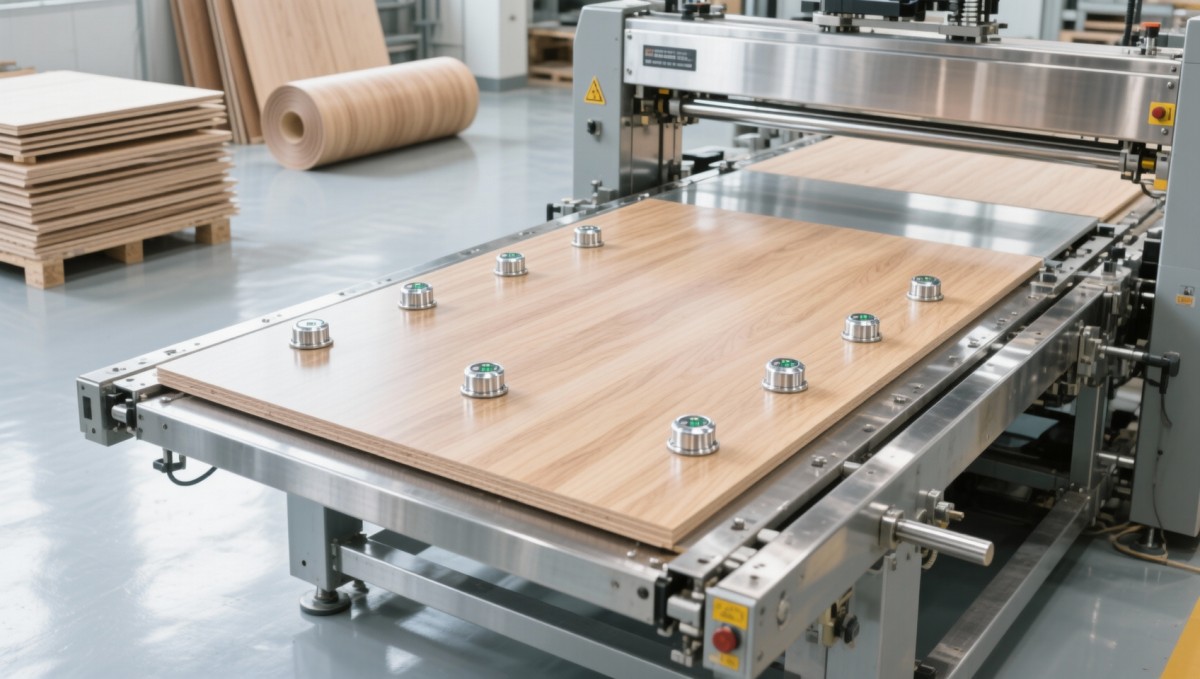
When Does This Matter Most? Contextualizing the Threshold
±1.5°C isn’t universally required—but it becomes decisive in three high-stakes scenarios:
- High-gloss or UV-cured finishes: Any micro-void or interfacial separation scatters light. Under 200-lux inspection lighting, sub-0.1 mm blisters become visible defects. Tight thermal control eliminates the primary source of these flaws before finishing begins.
- Thin or figured veneers (burl, walnut, maple): These demand minimal compression and precise resin flow. Overheated zones cause premature adhesive gelation, starving adjacent areas of binder—creating “starved joints” that fail peel tests at 45° angles.
- Multi-layer laminations (e.g., veneer + foam core + backing): Each material has distinct thermal conductivity. Without uniform surface temperature, heat transfer lags create interlayer shear stress—visible as edge curl or delamination after climate cycling.
If your facility runs any of these, ±1.5°C isn’t an upgrade—it’s the baseline for predictable yield. For solid-core panels or low-gloss applications, looser tolerances may hold—but only if your QC protocol includes accelerated aging (ASTM D1761) on every third batch. Without that verification, thermal drift remains invisible until field failures occur.
Beyond the Press: Where Precision Thermal Control Fits in the Full Workflow
A hot press doesn’t operate in isolation. Its thermal stability interacts directly with upstream and downstream equipment—especially where dimensional accuracy and surface integrity converge. Consider how veneered panels move into automated drilling: a panel with subtle edge lift or internal stress may feed inconsistently into a Six Sides CNC Drilling Machine. Even minor warpage affects vacuum table adhesion, causing drill bit deflection, misaligned holes, or chipping at veneer edges—defects that trace back to lamination, not machining.
That’s why leading furniture manufacturers now audit thermal uniformity *alongside* their CNC positioning repeatability (±0.05 mm) and edgebander glue-line thickness (±0.03 mm). They treat the hot press not as a standalone station, but as the first node in a tightly coupled quality chain—where a 1.5°C deviation ripples outward, degrading the value of every subsequent investment in automation.
What to Verify—Not Just Specify—Before Procurement
Don’t rely on brochure specs. Ask for:
- A thermal mapping report showing actual measured variance across the full platen *under load*, using calibrated NIST-traceable thermocouples at ≥16 points (not just corner + center).
- Documentation of how uniformity holds across three consecutive cycles with varying stack heights (e.g., 12 mm vs. 36 mm total thickness).
- Evidence of thermal recovery time: how long to return to ±1.5°C after opening the press and loading a cold panel stack.
If the supplier can’t provide this—especially data from a machine operating in conditions matching your shop (e.g., 22–28°C ambient, 45–60% RH)—assume the spec reflects ideal lab conditions, not factory-floor reality.
Ultimately, ±1.5°C isn’t about chasing perfection. It’s about eliminating the largest controllable variable in veneer lamination—the one that turns subjective visual checks into objective, repeatable process control. For quality and safety managers, that’s not a technical detail. It’s the difference between managing defects—and preventing them.
Send Your Inquiry
We welcome your cooperation and we will develop with you.