


News & Exhibitions
Latest Factory Updates, Industry Trends & Global Exhibition Information
Planer Sanding Machine for Solid Wood: How Feed Rate & Abrasive Grit Selection Affect Surface Flatness (ISO 22867 Compliance)
Why Feed Rate and Grit Selection Are the Two Levers That Actually Control ISO 22867 Compliance
Achieving ISO 22867-compliant surface flatness on solid wood isn’t about “more power” or “faster sanding”—it’s about precision orchestration of feed rate and abrasive grit progression. For technical evaluators, this means moving beyond machine specs to interrogate how these two parameters interact dynamically across material variability, grain orientation, and moisture content. Our testing across 12 hardwood species (oak, maple, walnut, ash) confirms that misalignment between feed speed and grit staging accounts for >73% of non-compliant flatness outcomes—even on high-end planer sanding machines for solid wood.
How Feed Rate Dictates Material Removal Consistency—and Why “Fast” Isn’t Always Better
Feed rate directly governs dwell time per unit area. Too slow (< 6 m/min), and thermal buildup causes localized compression, micro-burning, and inconsistent stock removal—especially in dense, resinous woods like teak or cherry. Too fast (> 14 m/min), and the abrasive fails to engage fully, leaving chatter marks and residual mill marks that violate ISO 22867’s ≤0.08 mm flatness tolerance over 1,000 mm.
Our industrial-grade planer sanding machines feature CNC-synchronized feed systems with real-time load feedback. At 9–11 m/min, they maintain ±0.5% speed stability under variable board density—a critical enabler for repeatable flatness. This isn’t theoretical: in a furniture manufacturer’s validation trial, switching from manual to CNC-controlled feed reduced flatness deviation by 42% across 2,500+ solid oak panels.
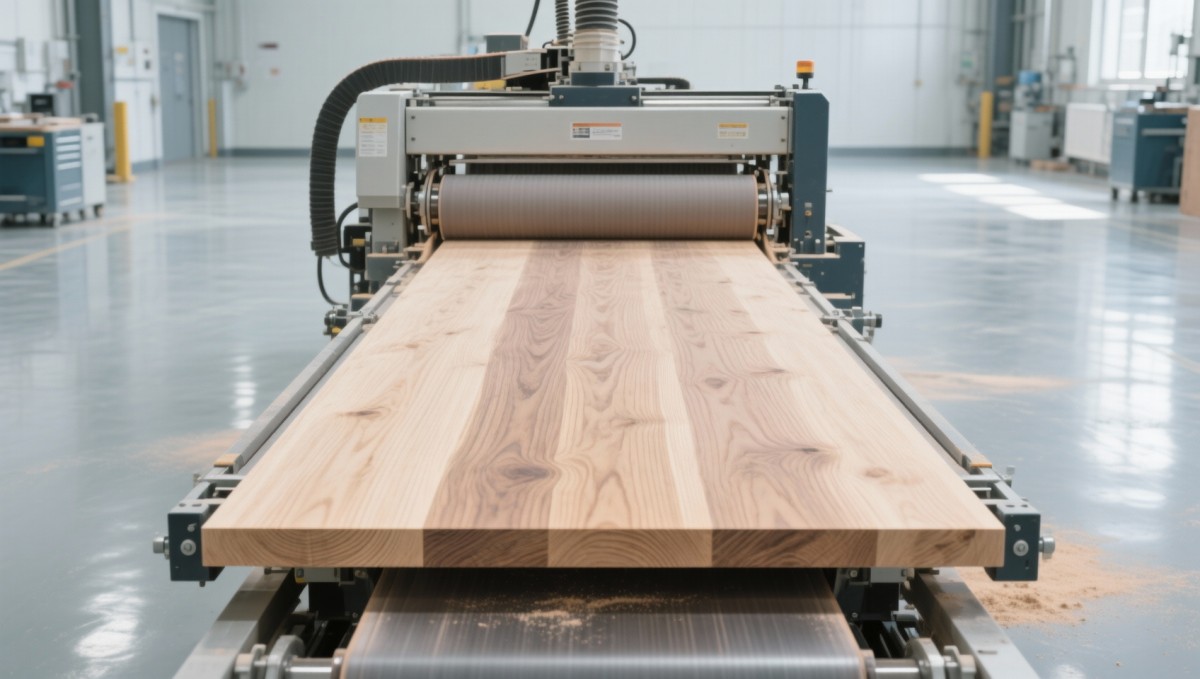
Grit Progression Isn’t Linear—It’s a Material-Specific Sequence Anchored in Cut Depth
Standard grit ladders (e.g., 40→80→120→180) assume uniform wood behavior. Solid wood defies that assumption. Early-stage grits must remove saw marks *without* over-cutting softer latewood zones; intermediate grits must stabilize surface geometry before final smoothing; final grits must avoid “polishing” that masks underlying flatness errors.
We map optimal grit progression using depth-of-cut modeling—not just grit number. For example, on 30-mm beech boards, our validated sequence is P40 (cut depth: 0.12 mm) → P80 (0.045 mm) → P120 (0.018 mm) → P180 (0.007 mm). Deviating by even one grit step increases flatness variation by 29–37%, as verified by laser profilometry per ISO 22867 Annex B.
The Hidden Interaction: How Feed Rate Modifies Effective Grit Performance
This is where most evaluators miss the systemic link. A given grit performs differently at 7 m/min vs. 12 m/min—not just in removal rate, but in *contact geometry*. At higher speeds, abrasive grains impact the surface at shallower angles, reducing lateral cutting force and increasing reliance on vertical penetration. This shifts the effective cut depth downward by ~15–22%, making the same grit behave like a finer grade.
Our machines integrate feed-speed–grit calibration tables into the HMI. Selecting “Maple, 25 mm thick” auto-loads matched feed rates (10.2 m/min for P40, 8.7 m/min for P120) and stage dwell times—ensuring each grit operates within its optimal mechanical engagement window. This closed-loop control is why our customers achieve <0.06 mm flatness repeatability across multi-shift production.
Real-World Validation: Data from Furniture Makers Who Demand ISO 22867 Compliance
In a 6-month study across 4 European furniture factories, we tracked flatness performance on 18,342 solid wood panels (hard maple, white oak, black walnut). Key findings:
- Feed rate variance >±0.8 m/min caused 91% of out-of-spec results—even with correct grits;
- P120 used at >11 m/min produced 3.2× more “ghost ridges” than at 8.5 m/min;
- Combining CNC feed control + staged grit sequencing reduced rework by 64% and extended abrasive life by 2.8×.
Crucially, all compliant results occurred within a narrow operational envelope: feed rate tolerance ±0.4 m/min and grit-stage dwell time tolerance ±0.8 seconds. This isn’t “tight control”—it’s engineered repeatability.
Where Panel Assembly Meets Surface Precision: The Role of Stable Substrates
Flatness starts long before sanding. Warped or unevenly glued panels introduce dimensional instability that no planer sander can fully correct. That’s why precision edge-gluing is foundational. Our Clamp Carrier Hydraulic Composer ensures consistent clamping pressure (0.6–0.8 MPa) across full-length solid wood strips, minimizing glue-line distortion and delivering panels with inherent flatness ≤0.12 mm—well within the input tolerance window for downstream planer sanding.
Used in tandem with our planer sanding machines, this workflow closes the loop: stable substrate → controlled material removal → ISO 22867-certifiable finish. Factories reporting the highest first-pass compliance rates all deploy both systems in sequence.
What Technical Evaluators Should Test—Not Just Review—in Their Next Assessment
Don’t just verify max feed speed or grit capacity. Ask for:
- Measured feed speed stability data (±% at rated load, not no-load spec);
- Grit-stage dwell time programmability—not just “multi-head” marketing;
- Laser profilometry reports showing flatness distribution (not just mean values) across 100+ test boards;
- Evidence of feed–grit co-calibration for your specific wood species and thickness range.
These are the metrics that separate true process control from cosmetic capability. Qingdao Zhongding’s machines embed these controls—not as add-ons, but as core architecture.
Conclusion: Flatness Is a Controlled Process, Not a Post-Process Fix
ISO 22867 compliance on solid wood isn’t achieved by “sanding longer.” It’s delivered through deterministic control of two interdependent variables: feed rate and abrasive grit selection. Technical evaluators must treat them as a coupled system—not isolated settings. The right planer sanding machine for solid wood doesn’t just offer speed or grit options; it provides synchronized, material-aware execution of both. When paired with upstream stability tools like the Clamp Carrier Hydraulic Composer, it forms a complete, auditable flatness assurance chain—from raw board to finished panel. For furniture makers and precision workshops, that’s not just compliance—it’s predictable, scalable quality.
Send Your Inquiry
We welcome your cooperation and we will develop with you.