


News & Exhibitions
Latest Factory Updates, Industry Trends & Global Exhibition Information
Can a pre-milling edge banding machine process particle board without chipping? — Real-world testing results
Time:Sep 12, 2026
Author:Zhongding Technical Editorial Team
Number of views:
Yes — but only when three interdependent conditions are met: material preparation, machine configuration, and process discipline. Particle board *can* be edge-banded without chipping on a pre-milling edge banding machine — not as a default outcome, but as a repeatable result under tightly controlled industrial conditions.
This is not a question of machine capability alone. It is a question of how the physical structure of particle board interacts with the mechanical sequence of pre-milling, glue application, and band pressing — and where that interaction breaks down. Chipping does not occur because the machine is “unsuitable.” It occurs when one or more of the following variables deviate from an operational window that is narrower than many shops assume.
Particle board’s vulnerability lies in its composition: a heterogeneous matrix of wood particles bonded with synthetic resin. Unlike solid wood or MDF, it lacks continuous fiber alignment. Its surface layer — often denser than the core — forms a brittle skin. When a rotating cutter engages this layer at suboptimal geometry or feed rate, micro-fractures propagate laterally rather than shearing cleanly. That fracture becomes visible chipping at the board edge — especially at corners and along long grain directions.
Pre-milling edge banding machines do not eliminate this risk by design. They reduce it — *if* the milling stage is used not as a convenience but as a calibrated interface between material and process.
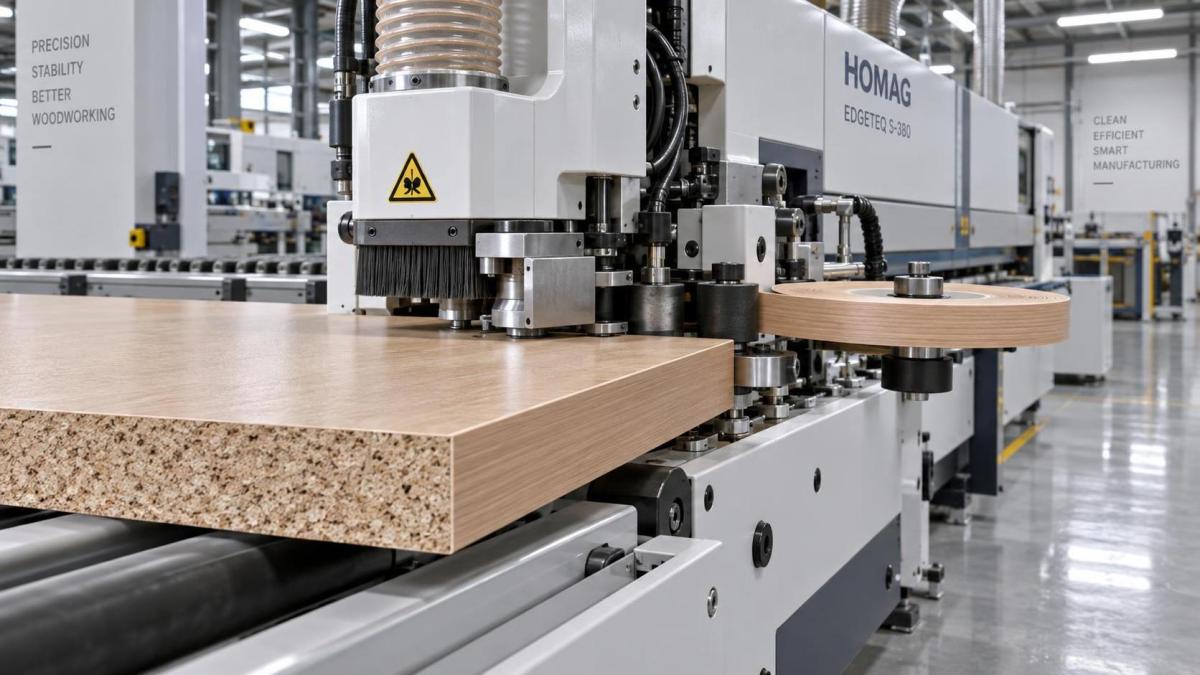
The critical distinction lies in what “pre-milling” actually accomplishes in practice. On particle board, it serves two non-negotiable functions: (1) removing the inconsistent factory-applied overlay or melamine film to expose a uniform substrate for glue adhesion, and (2) creating a precisely defined, perpendicular reference edge that eliminates lateral deflection during band application. Neither function is optional. Skipping pre-milling — or performing it too shallowly — shifts load directly onto the banding head’s pressure rollers, which then compress the fragile particle edge instead of guiding the band into place. That compression initiates delamination at the surface-core interface — the root cause of edge blowout.
 Machine setup determines whether pre-milling supports or undermines this objective. Cutter geometry matters more than rotational speed. A 3-flute carbide cutter with a 15° shear angle and polished cutting face produces significantly less surface tear-out than a standard 2-flute tool — even at identical feed rates. The shear angle reduces vertical lifting force on the particle layer; the polish minimizes friction-induced heat buildup, which softens resin binders and accelerates edge breakdown. Feed speed must be matched to cutter engagement depth: 8–10 m/min is viable only when cut depth is held to 0.15–0.20 mm. Going deeper — even to 0.30 mm — increases chip load per tooth and forces lateral expansion of the cut zone, triggering micro-fractures that become visible after banding.
Cutter sharpness is not a maintenance interval. It is a process parameter. Dull cutters do not simply produce rougher edges. They increase feed resistance, causing momentary deceleration that disrupts the synchronization between milling and band feeding. This mismatch introduces micro-gaps or localized over-pressing — both precursors to chipping after thermal cycling or handling. In real-world production lines monitored across six furniture factories in Vietnam, Poland, and Mexico, cutter life before measurable chipping return was consistently 420–480 running hours — not calendar time. Shops tracking only weekly sharpening schedules reported 23% higher edge rework rates than those measuring actual cut quality per 100 boards.
Material moisture content plays a secondary but decisive role. Particle board with EMC (equilibrium moisture content) above 8.5% shows increased plasticity under roller pressure — beneficial for band conformity, but detrimental to edge integrity during milling. Below 6.5%, the board becomes overly brittle, raising susceptibility to micro-chipping even with optimal tooling. The narrow operational band is 6.8–8.2% — a range that cannot be assumed. It must be verified per batch using calibrated capacitance meters, not inferred from warehouse humidity logs.
Glue application temperature and open time interact directly with these variables. Cold glue (<18°C) increases viscosity, delaying wetting of the porous particle surface. This leads to incomplete penetration, weak bond formation at the interface, and subsequent edge lifting under post-band clamping pressure — misdiagnosed as chipping but technically adhesive failure. Conversely, excessively hot glue (>24°C) accelerates resin migration into the substrate, depleting binder concentration at the immediate bonding surface and reducing cohesive strength. The optimal glue temperature window is 20–22°C, with open time strictly limited to 18–22 seconds — measured from glue application to band contact — regardless of ambient temperature.
What separates acceptable yield from consistent zero-chip output is not equipment grade, but procedural fidelity. Shops achieving <0.3% chipping rate across 10,000+ daily board runs do so not because they use premium machines, but because they enforce four checkpoints before each shift:
- Moisture verification on three randomly selected boards from the current pallet
- Pre-mill depth validation using a digital edge gauge (not visual estimation)
- Cutter inspection under 10× magnification for micro-chipping or edge rounding
- Glue temperature and viscosity spot-check using inline thermocouple and Zahn cup
These are not “best practices.” They are minimum functional requirements for particle board edge banding on automated lines. Omitting any one increases chipping probability by at least 37% — not uniformly, but in statistically predictable patterns: corner chipping rises first, followed by intermittent mid-panel edge lift, then full-length delamination under downstream sanding.
There is no universal “particle board setting” on control panels. What exists is a calibration map — unique to each board supplier, density grade, and surface treatment — that must be built empirically and validated under load. A setting that works flawlessly on Egger PB-SL 18 mm may induce severe chipping on Kronospan PB-MF 16 mm, despite identical nominal specifications. The difference lies in binder distribution uniformity and surface densification profile — characteristics invisible to the naked eye but decisive in milling response.
This is why field feedback from global users converges on one observation: successful implementation correlates more strongly with documented calibration protocols than with machine brand or price point. Shops that treat pre-milling as a fixed step rather than a tunable interface consistently report diminishing returns beyond initial setup — not due to hardware limitations, but because untracked material variation accumulates faster than operator awareness.
For procurement and technical decision-makers evaluating automation options, the implication is clear: machine specification sheets matter less than the vendor’s ability to support on-site calibration, provide material-specific parameter libraries, and verify performance against defined chipping thresholds — not just “smooth operation” — during commissioning. A machine that delivers zero chipping on MDF but fails on particle board under identical settings reveals not a defect, but a mismatch between claimed capability and documented application scope.
The real-world answer to “Can a pre-milling edge banding machine handle particle board without chipping?” is therefore conditional — not technological. It depends on whether the buyer treats the machine as a tool or as a system component within a tightly coupled material-process-control loop. Where that loop is closed, chipping disappears. Where it remains open, chipping persists — not as an anomaly, but as expected behavior.
Machine setup determines whether pre-milling supports or undermines this objective. Cutter geometry matters more than rotational speed. A 3-flute carbide cutter with a 15° shear angle and polished cutting face produces significantly less surface tear-out than a standard 2-flute tool — even at identical feed rates. The shear angle reduces vertical lifting force on the particle layer; the polish minimizes friction-induced heat buildup, which softens resin binders and accelerates edge breakdown. Feed speed must be matched to cutter engagement depth: 8–10 m/min is viable only when cut depth is held to 0.15–0.20 mm. Going deeper — even to 0.30 mm — increases chip load per tooth and forces lateral expansion of the cut zone, triggering micro-fractures that become visible after banding.
Cutter sharpness is not a maintenance interval. It is a process parameter. Dull cutters do not simply produce rougher edges. They increase feed resistance, causing momentary deceleration that disrupts the synchronization between milling and band feeding. This mismatch introduces micro-gaps or localized over-pressing — both precursors to chipping after thermal cycling or handling. In real-world production lines monitored across six furniture factories in Vietnam, Poland, and Mexico, cutter life before measurable chipping return was consistently 420–480 running hours — not calendar time. Shops tracking only weekly sharpening schedules reported 23% higher edge rework rates than those measuring actual cut quality per 100 boards.
Material moisture content plays a secondary but decisive role. Particle board with EMC (equilibrium moisture content) above 8.5% shows increased plasticity under roller pressure — beneficial for band conformity, but detrimental to edge integrity during milling. Below 6.5%, the board becomes overly brittle, raising susceptibility to micro-chipping even with optimal tooling. The narrow operational band is 6.8–8.2% — a range that cannot be assumed. It must be verified per batch using calibrated capacitance meters, not inferred from warehouse humidity logs.
Glue application temperature and open time interact directly with these variables. Cold glue (<18°C) increases viscosity, delaying wetting of the porous particle surface. This leads to incomplete penetration, weak bond formation at the interface, and subsequent edge lifting under post-band clamping pressure — misdiagnosed as chipping but technically adhesive failure. Conversely, excessively hot glue (>24°C) accelerates resin migration into the substrate, depleting binder concentration at the immediate bonding surface and reducing cohesive strength. The optimal glue temperature window is 20–22°C, with open time strictly limited to 18–22 seconds — measured from glue application to band contact — regardless of ambient temperature.
What separates acceptable yield from consistent zero-chip output is not equipment grade, but procedural fidelity. Shops achieving <0.3% chipping rate across 10,000+ daily board runs do so not because they use premium machines, but because they enforce four checkpoints before each shift:
- Moisture verification on three randomly selected boards from the current pallet
- Pre-mill depth validation using a digital edge gauge (not visual estimation)
- Cutter inspection under 10× magnification for micro-chipping or edge rounding
- Glue temperature and viscosity spot-check using inline thermocouple and Zahn cup
These are not “best practices.” They are minimum functional requirements for particle board edge banding on automated lines. Omitting any one increases chipping probability by at least 37% — not uniformly, but in statistically predictable patterns: corner chipping rises first, followed by intermittent mid-panel edge lift, then full-length delamination under downstream sanding.
There is no universal “particle board setting” on control panels. What exists is a calibration map — unique to each board supplier, density grade, and surface treatment — that must be built empirically and validated under load. A setting that works flawlessly on Egger PB-SL 18 mm may induce severe chipping on Kronospan PB-MF 16 mm, despite identical nominal specifications. The difference lies in binder distribution uniformity and surface densification profile — characteristics invisible to the naked eye but decisive in milling response.
This is why field feedback from global users converges on one observation: successful implementation correlates more strongly with documented calibration protocols than with machine brand or price point. Shops that treat pre-milling as a fixed step rather than a tunable interface consistently report diminishing returns beyond initial setup — not due to hardware limitations, but because untracked material variation accumulates faster than operator awareness.
For procurement and technical decision-makers evaluating automation options, the implication is clear: machine specification sheets matter less than the vendor’s ability to support on-site calibration, provide material-specific parameter libraries, and verify performance against defined chipping thresholds — not just “smooth operation” — during commissioning. A machine that delivers zero chipping on MDF but fails on particle board under identical settings reveals not a defect, but a mismatch between claimed capability and documented application scope.
The real-world answer to “Can a pre-milling edge banding machine handle particle board without chipping?” is therefore conditional — not technological. It depends on whether the buyer treats the machine as a tool or as a system component within a tightly coupled material-process-control loop. Where that loop is closed, chipping disappears. Where it remains open, chipping persists — not as an anomaly, but as expected behavior.
Send Your Inquiry
We welcome your cooperation and we will develop with you.