


News & Exhibitions
Latest Factory Updates, Industry Trends & Global Exhibition Information
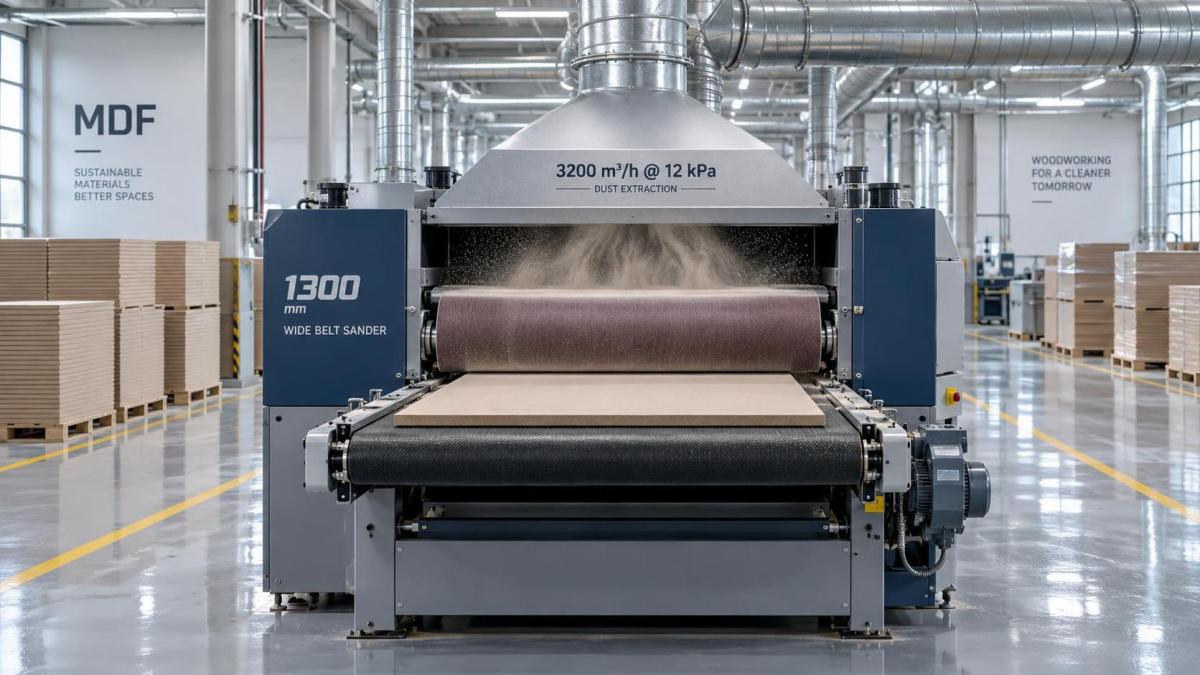
1300mm Wide Belt Sander for MDF: Critical Dust Extraction Requirements (≥3200 m³/h @ 12 kPa) to Avoid Surface Burn and Resin Blooming
Selecting the right 1300mm wide belt sander for MDF is not merely a matter of matching nominal width or motor rating—it hinges on a single, non-negotiable system parameter: dust extraction capacity under real operating resistance. When sanding medium-density fiberboard at production speeds, airborne wood dust, fine resin particles, and thermally degraded binder compounds accumulate rapidly at the contact zone between belt and surface. Without sufficient airflow volume *and* static pressure to evacuate this mixture continuously, heat builds locally—often exceeding 95°C at the abrasive interface. That thermal spike triggers two simultaneous, interdependent failures: localized surface burn (visible as amber discoloration or micro-charring) and resin blooming (a hazy, tacky film formed when molten phenol-formaldehyde or urea-formaldehyde resins migrate to the surface before re-solidifying).
These are not cosmetic defects. Surface burn compromises dimensional stability during subsequent lamination or veneering; resin bloom prevents uniform adhesion of coatings and creates inconsistent absorption in spray-finishing lines. Both lead directly to batch rejection during incoming inspection or final QA sign-off—especially where ISO 9001 Clause 8.6 or automotive OEM paint shop specifications mandate zero visible substrate anomalies. More critically, incomplete dust capture elevates respirable particle concentration (PM₁₀ and PM₂.₅) in the operator breathing zone above OSHA PEL (5 mg/m³ for wood dust) and EU limit values (3 mg/m³), increasing long-term risk of respiratory sensitization and chronic bronchitis.
Why 3200 m³/h @ 12 kPa Is the Functional Threshold
This specification is not arbitrary. It reflects the combined resistance of three dynamic elements: the sander’s internal duct geometry (including plenum design, transition radii, and filter housing configuration), the length and diameter of the connected ductwork (typically ≥12 m in industrial layouts), and the loading state of the filtration system (e.g., baghouse or cartridge filters operating at 60–75% capacity). At lower airflow rates—even if measured at the fan inlet—the velocity through the sanding head’s extraction ports drops below 22 m/s. That shortfall allows dust-laden air to recirculate across the belt surface, reheating the workpiece with each pass. Static pressure below 12 kPa indicates insufficient energy to overcome backpressure from accumulated fines on filter media, resulting in progressive airflow decay over a single shift.
Crucially, volumetric flow alone is misleading. A unit rated at 3800 m³/h *at zero pressure* may deliver only 2400 m³/h when connected to a standard 150 mm duct run with two 90° elbows and a 30 m² cartridge filter. Real-world performance must be verified at the *extraction hood inlet*, using a calibrated anemometer and manometer, while the machine runs at full load with MDF panels moving at 12–18 m/min—a condition rarely simulated during factory commissioning.
Material-Specific Dynamics of MDF Sanding
MDF behaves fundamentally differently than solid wood or plywood during abrasion. Its homogenous density (680–720 kg/m³) and high resin content (8–12% by weight) generate finer, more cohesive dust with higher specific heat retention. Unlike hardwoods that release moisture vapor during sanding, MDF releases no evaporative cooling effect—making thermal management entirely dependent on mechanical heat removal via airflow. Furthermore, the absence of grain direction means no natural “escape path” for trapped air beneath the belt; instead, air compresses into micro-cavities between abrasive grains, further insulating the interface.
This explains why sanders validated on pine or birch often fail catastrophically on MDF without recalibration. Belt tension, contact pressure, and feed rate interact nonlinearly with extraction performance: increasing feed speed by 20% raises heat generation by ~35%, but reduces dwell time—potentially lowering peak temperature *if* extraction keeps pace. However, most fixed-speed systems lack proportional airflow control, so increased throughput simply deepens the extraction deficit.
Three Common Extraction Failures—and How to Diagnose Them
- Intermittent resin bloom on consecutive panels: Indicates cyclic filter loading. When cartridge differential pressure exceeds 1.2 kPa, airflow fluctuates ±15% with each cleaning pulse—enough to allow transient overheating. Requires real-time pressure monitoring at both inlet and outlet of the filtration unit, not just visual inspection of filter condition.
- Burn marks concentrated at panel edges (especially leading edge): Points to inadequate hood coverage or misaligned extraction lips. The leading edge experiences highest shear force and generates the densest dust cloud; extraction ports must extend ≥50 mm beyond the panel width and maintain ≤12 mm gap to the workpiece surface.
- Consistent discoloration across full width, worsening toward the discharge end: Suggests duct undersizing downstream of the sander. Velocity drops below 18 m/s in horizontal runs longer than 8 m, causing dust dropout and gradual restriction. Measured static pressure loss should not exceed 250 Pa per linear meter of straight 150 mm duct at design flow.
None of these issues appear in isolation. Resin bloom increases belt drag, raising motor amperage and further heating the system—a feedback loop that accelerates failure within hours. Preventing it requires integrated design: the sander’s extraction manifold must be engineered for laminar flow distribution across the full 1300 mm width, not retrofitted with generic duct adapters. Internal plenum volume should exceed 0.8 m³ to dampen pulsations from rotary blowers, and all transitions must use ≥R150 radii to minimize turbulence-induced pressure loss.
Verification Protocol for Operational Readiness
Before approving a 1300mm wide belt sander for MDF production, perform this field validation—not just during commissioning, but quarterly during routine maintenance:
- Run three consecutive 18 mm thick MDF panels at rated feed speed (e.g., 15 m/min) with 120-grit ceramic belts.
- Measure surface temperature at five points (center, quarter-width positions, leading and trailing edges) using a non-contact IR thermometer calibrated to ±0.5°C, immediately after discharge.
- Record extraction airflow at the main hood inlet with a vane anemometer (minimum 10 readings over 60 seconds) and static pressure upstream of the primary filter bank.
- Inspect finished surfaces under 6500K LED lighting at 45° angle; resin bloom appears as diffuse opalescence, distinct from mechanical scratches or glue bleed.
Sustained surface temperatures above 65°C—or any measurable bloom—confirm insufficient extraction. Adjustments must address root cause: upgrading filter media to low-delta-P nanofiber cartridges, shortening duct runs, or installing a dedicated high-static-pressure centrifugal blower with variable frequency drive. Simply increasing fan speed without verifying duct integrity often worsens resonance and noise without improving net airflow.
When engineered correctly, a 1300mm wide belt sander for MDF delivers repeatable finish quality across thousands of panels—without thermal degradation, without hidden inhalation exposure, and without compromising the structural integrity of the substrate. That consistency begins not at the abrasive surface, but at the extraction inlet: where airflow volume and pressure converge to define process viability.
Send Your Inquiry
We welcome your cooperation and we will develop with you.