


News & Exhibitions
Latest Factory Updates, Industry Trends & Global Exhibition Information
What machinery is needed for consistent door panel production?
What Machinery Is Needed for Consistent Door Panel Production?
Door panel production looks straightforward until a project reaches volume. A workshop may be able to make a few attractive doors with general-purpose equipment, but repeatable output is a different challenge. Panels must be cut square, routed consistently, edged cleanly, drilled in the right positions, and finished without creating bottlenecks between processes. If any one operation drifts, the problem often appears later at assembly or installation, when correction is expensive and schedules are already tight.
For project managers, the question is not simply which machine can process a board. It is which combination of wood product manufacturing machinery for doors can maintain panel dimensions, surface quality, and throughput across the actual door mix: flat slab doors, shaker-style components, routed decorative panels, cabinet doors, wardrobe fronts, or shaped furniture panels. The right answer depends on material, panel geometry, order variation, expected production rhythm, and the reliability of support after installation.
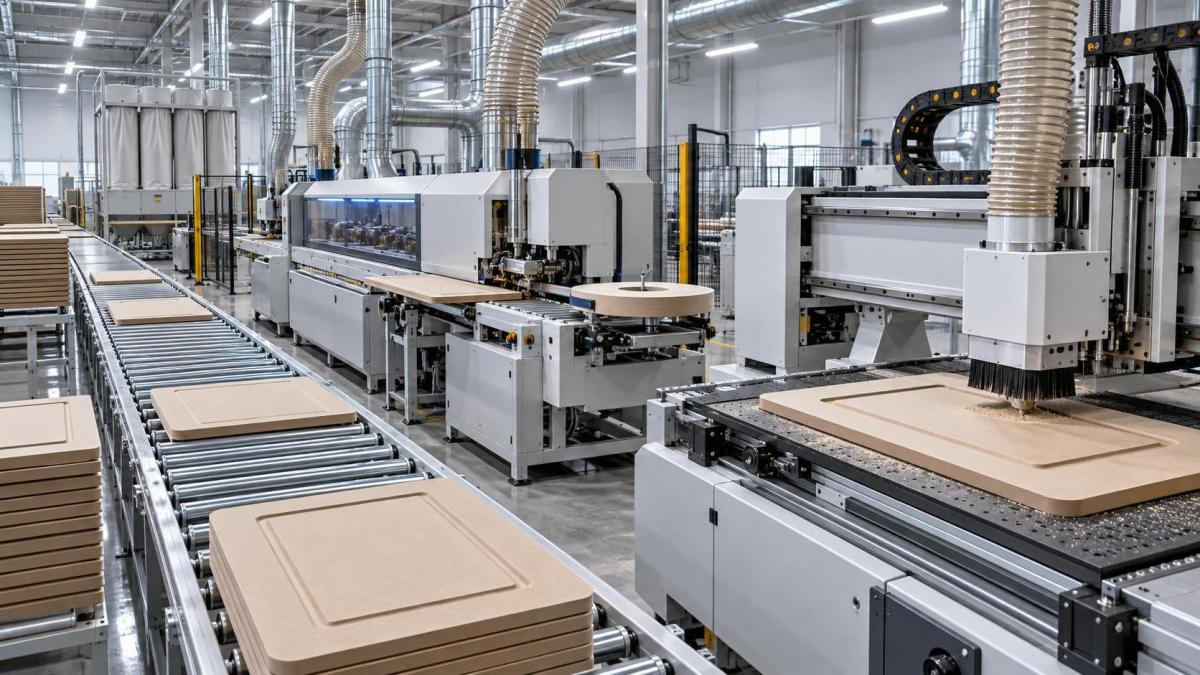
A practical machinery plan usually starts with the production route rather than a machine catalogue. Map the panel from raw board to packed product, then identify where variation enters the process. In most door factories, the critical points are panel cutting, edge preparation, profile machining, drilling, edge banding or veneer application, sanding, finishing, and handling between stations.
Start with the Door Construction, Not the Machine List
The first decision is whether the plant is producing solid wood doors, MDF or particleboard cabinet doors, plywood panels, veneered doors, or composite engineered-door components. These materials behave differently. Solid timber brings grain direction, moisture movement, and occasional defects into the process. MDF offers a stable substrate for profiling and paint-grade doors, but its exposed edges need careful sealing and finishing. Melamine-faced board requires accurate cutting and clean edge banding because chipped edges or glue-line defects are highly visible.
Door style matters just as much. A rectangular slab door can run efficiently through a panel saw, straight-line edgebander, drilling unit, and sanding or finishing line. A door with shaped edges, curved corners, bevels, or soft-formed profiles needs more capable edge processing. A five-piece shaker door adds frame-and-panel machining, tenoning or dowel/joint preparation, clamping, and assembly control. Trying to force all these formats through one “universal” route often creates excessive setup time and inconsistent quality.
Before selecting equipment, define the minimum and maximum panel sizes, thicknesses, edge profile types, surface material, hole patterns, daily shift pattern, and acceptable changeover time. This work is sometimes skipped because it feels administrative. In reality, it prevents the common mistake of buying a fast machine that cannot accept a key door size or profile required by the project.
The Core Machinery Route for Panel Doors
A consistent panel-door line does not need to be fully automated from day one, but it does need compatible process capability. The essential machinery categories are usually as follows.
Panel sizing and precision cutting
Cutting is the reference point for almost everything downstream. Beam saws are often selected for high-volume cutting of sheet materials because they can process stacks and support repeatable batch production. Sliding table saws remain useful for lower volumes, mixed work, oversized materials, and secondary cuts, provided the operator setup is controlled. For flexible production with frequent design changes, a CNC nesting router may combine cutting, grooving, and drilling in one program-driven step.
The important issue is not only dimensional accuracy on the saw. It is whether cut parts arrive at the next station with clean, chip-free edges and a logical identification system. If parts are stacked without labels or sequence control, even accurate cutting can lead to mismatched drilling programs, wrong edging materials, and avoidable rework.
CNC routing, profiling, and machining centers
A CNC router or door machining center becomes valuable when the door design includes grooves, raised or recessed patterns, handle recesses, lock preparation, ventilation cut-outs, shaped outlines, or repeated hinge and hardware locations. The main advantage is not merely complexity. It is repeatability. A stored program can reduce dependence on manual marking, especially when a project includes many similar panels with small dimensional variations.
However, CNC equipment should be matched to the feed strategy and fixturing method. Vacuum pods or spoilboard systems need enough holding performance for the board material and machining load. Thin panels, narrow rails, and heavily machined components may require extra attention to workholding. A fast spindle cannot compensate for poor clamping; shifting during machining can ruin a panel and create a safety concern.
Drilling, hinge boring, and hardware preparation
Hardware errors are among the most disruptive door-production defects because they are often discovered at installation. A dedicated multi-spindle drilling machine can be effective for stable, repetitive hinge patterns. A CNC drilling center offers more flexibility where hole positions vary by door height, handle style, drawer configuration, or regional hardware specification.
The machinery decision should be tied to the installation system. Confirm the actual hinge cup diameter, setback, screw pattern, lock body dimensions, and any concealed fixing requirements before finalizing drill blocks or programs. It is surprisingly easy to standardize production around one hardware family and later find that the project specification calls for another.
Edge Processing Is Often Where Door Quality Becomes Visible
For MDF, particleboard, plywood, and laminated panel doors, the edge is not a minor detail. It is the line users touch every day, and it is usually where moisture resistance, visual consistency, and durability are judged. A basic straight-line edge bander may be enough for square cabinet doors, assuming pre-milling, glue application, end trimming, scraping, and polishing are appropriately configured. But it will not solve every door design.
When a project includes rounded, oblique, wrapped, or shaped edges, the plant needs edge equipment designed for those profiles. Curved door fronts and soft-formed components should not be treated as exceptions handled entirely by hand. Manual work may be acceptable for prototypes or very low quantities, but it becomes difficult to control when panels must match across a hotel room package, residential development, or large furniture program.
For operations processing shaped furniture and door-related panels, the Soft forming edge banding machine ZD980S is intended for curved and shaped panel edge processing with automatic control, trimming, and polishing functions. Its stated panel-edge capacity covers straight edges from 14 to 50 mm and oblique edges from 18 to 25 mm. These limits should be reviewed against the actual door drawings rather than assumed to fit every profile. The machine also requires panels at least 100 mm wide and 250 mm long, so small decorative pieces or narrow rails may need a separate processing route.
This is a useful example of how to assess a machine properly. The ZD980S has a total power rating of 70.5 kW, operates at a stated working pressure of 0.6 to 0.8 MPa, and has an overall size of 10800 × 1150 × 1850 mm with a listed weight of 7000 kg. Those figures are not just catalogue details. They affect compressor sizing, electrical planning, floor loading, access for installation, maintenance clearance, and the physical sequence of the line. A machine may fit the process technically while still creating a poor plant layout if material cannot enter and exit without crossing traffic routes.
Sanding and Finishing Must Match the Material and Finish Standard
Sanding is frequently underestimated because it is viewed as preparation rather than production. Yet uneven sanding can telegraph through paint, expose inconsistent veneer thickness, round a crisp profile, or leave edge zones that absorb finish differently. Wide-belt sanders are suitable for calibrating panels and creating a controlled surface before coating. Profile sanders, brush sanding units, or manual finishing stations may still be needed for routed doors, recessed details, and shaped edges.
The finishing equipment depends on whether the doors are wrapped, painted, lacquered, stained, laminated, or supplied unfinished. A finishing line may include spray booths, drying equipment, conveyor systems, dust extraction, and inspection lighting. But installing a sophisticated coating line before stabilizing substrate preparation can be a costly mistake. If panel thickness varies or edges are poorly sealed, the finish department ends up compensating for upstream defects rather than producing a consistent final surface.
Do Not Treat Material Handling as an Afterthought
In door-panel production, machines are only productive when parts reach them in the correct order and condition. Roller conveyors, belt conveyors, return systems, vacuum lifters, stackers, and transfer tables can reduce handling damage and keep operators from becoming the pace-setting constraint. They also help protect finished faces, particularly on high-gloss laminated panels or prefinished boards.
The right level of automation depends on volume and product mix. A high-volume line with repetitive dimensions may justify automatic loading, return conveyors, and linked workstations. A contract workshop producing many custom sizes may benefit more from flexible handling cells and clear staging areas. The goal is not to automate every movement; it is to remove the movements that cause waiting, panel damage, mix-ups, or unsafe lifting.
Dust extraction belongs in the same planning discussion. Routing, sawing, drilling, and sanding produce different chip sizes and dust loads. Extraction capacity, duct routing, filter maintenance, and collection arrangements must be designed around the actual machine mix. Weak extraction affects surface finish, tool life, operator visibility, and cleanup time. It also makes a well-specified production line feel unreliable in daily use.
Choosing a Line Around Throughput Rather Than Nameplate Speed
A project plan should identify the slowest dependable operation, not the fastest advertised one. If cutting can supply parts rapidly but edge processing requires frequent profile changes, the edge bander may become the real constraint. If routing is quick but panels wait for manual loading and unloading, the CNC cell may be underutilized. If finishing needs extended drying time, adding another saw will not improve delivery performance.
For this reason, capacity planning should include setup time, part handling, tool changes, inspection, rejects, maintenance access, and material movement. It is better to plan a line around realistic flow than around theoretical machine speed. Pilot runs with representative door sizes, edge materials, and hardware patterns are especially useful before a major project is committed.
There is also a practical trade-off between specialized equipment and flexibility. Dedicated machines can make sense where dimensions and profiles are stable. CNC-based equipment gives broader capability where projects change frequently, although it requires disciplined programming, tool management, and trained operators. Many successful factories use both: dedicated machinery for repetitive work and flexible CNC cells for non-standard panels, samples, and short runs.
Support, Tooling, and Maintenance Determine Long-Term Consistency
Machinery selection should include what happens after commissioning. Door production relies on saw blades, router cutters, drill bits, pressure rollers, glue systems, sanding belts, sensors, and pneumatic components. A production line can lose far more time from an unavailable spare part or poorly maintained tool than from an occasional major repair.
Qingdao Zhongding Machinery Co., Ltd. has developed from a small workshop into a woodworking machinery manufacturer and exporter with more than 20 years of industry experience. For buyers building or upgrading a door-panel operation, the relevant point is not the company history alone; it is whether equipment supply is accompanied by technical guidance, spare-parts availability, installation support, and responsive service. These are the factors that help a machine remain part of a stable production system rather than becoming an isolated asset on the factory floor.
The most reliable door production setup is rarely the one with the greatest number of machines. It is the one where cutting accuracy, profile capability, edge quality, drilling precision, finishing requirements, and internal logistics have been planned as one connected route. Review the actual door drawings, material schedule, and installation hardware before placing equipment orders. That early discipline usually avoids the expensive workaround that appears later: trying to make the wrong machine produce a door it was never designed to handle.
Send Your Inquiry
We welcome your cooperation and we will develop with you.