


News & Exhibitions
Latest Factory Updates, Industry Trends & Global Exhibition Information
How Multi-Zone Heating Controls Temperature Uniformity in Hot Wood Pressing
How Multi-Zone Heating Controls Temperature Uniformity in Hot Wood Pressing
In hot wood pressing, a platen can look uniform while behaving very differently from one area to another. The center may reach the target temperature quickly, while the perimeter loses heat to the surrounding air, the press frame, or a cold panel edge. A wide veneer layup may draw heat unevenly across the platen. A small workpiece placed off-center can create another pattern entirely. These differences are not always obvious on the finished panel until bonding defects, inconsistent gloss, thickness variation, or edge lifting begin to appear.
For technical evaluators, this is why platen temperature should not be judged only by the controller display. The displayed value is usually one measurement point or one control reference. It does not automatically confirm that the full pressing surface is operating within the required tolerance for a particular adhesive system, veneer species, laminate, or panel format.
A hot wood press with multi zone heating addresses this practical limitation by dividing the heating platen into separately controlled areas. Rather than applying the same heating response across the entire surface, the system can regulate different zones according to their own temperature feedback. The principle is straightforward; the engineering details are not. Good results depend on zone layout, sensor placement, heating medium, insulation, controller logic, platen construction, and the way the press is actually loaded during production.
Why a Single Heating Circuit Can Produce Uneven Results
Conventional platen heating often relies on one heating circuit or a limited number of shared circuits. This approach can be adequate for stable work involving similar panel dimensions, repetitive loading patterns, and moderate process demands. But it becomes less forgiving when production includes several board sizes, thin decorative surfaces, moisture-sensitive substrates, or adhesives with a narrow processing window.
Heat naturally moves away from the platen surface. At the edges, losses are commonly higher because those areas are more exposed. In some press designs, heat can also be conducted into supporting structures or affected by differences in internal oil flow, electrical heating distribution, or thermal mass. When a large panel is loaded, the board itself becomes a heat sink. When a smaller panel is loaded in the center, the uncovered perimeter behaves differently again. One global temperature setting cannot fully respond to all of these local conditions.
The impact depends on the application. In veneering, an underheated section may delay adhesive cure and weaken bond consistency. In laminating, localized thermal variation can influence resin flow, surface appearance, or post-press stability. For thick engineered wood components, temperature differences may affect the time needed for the panel core to receive sufficient heat. None of these outcomes should be blamed on heating alone—pressure, adhesive spread, material moisture, and loading discipline matter too—but platen uniformity is often the variable that is hardest to see and easiest to underestimate.
What Multi-Zone Heating Changes in Practice
A multi-zone system divides the platen into independent or semi-independent thermal areas. These may be arranged as edge and center sections, longitudinal strips, transverse bands, or a grid pattern. The best arrangement is not automatically the one with the largest number of zones. It is the one that matches the press size, heater arrangement, expected workpiece formats, and the thermal behavior of the intended process.
Each zone receives temperature feedback from one or more sensors and is controlled through its own heating output or valve response. If an edge zone cools faster than the center, the controller can add heat there without unnecessarily pushing the central region above its setpoint. If one section recovers more slowly after a panel is loaded, the control system can respond locally rather than treating the entire platen as one thermal mass.
This does not mean every zone should run at a different setpoint during normal operation. In many production programs, all zones are assigned the same target temperature, but they reach and maintain that target through separate control loops. Independent setpoints are more useful when a process deliberately needs a thermal profile, such as compensating for persistent edge loss, accommodating unusual panel geometry, or running specialized products under validated process conditions.
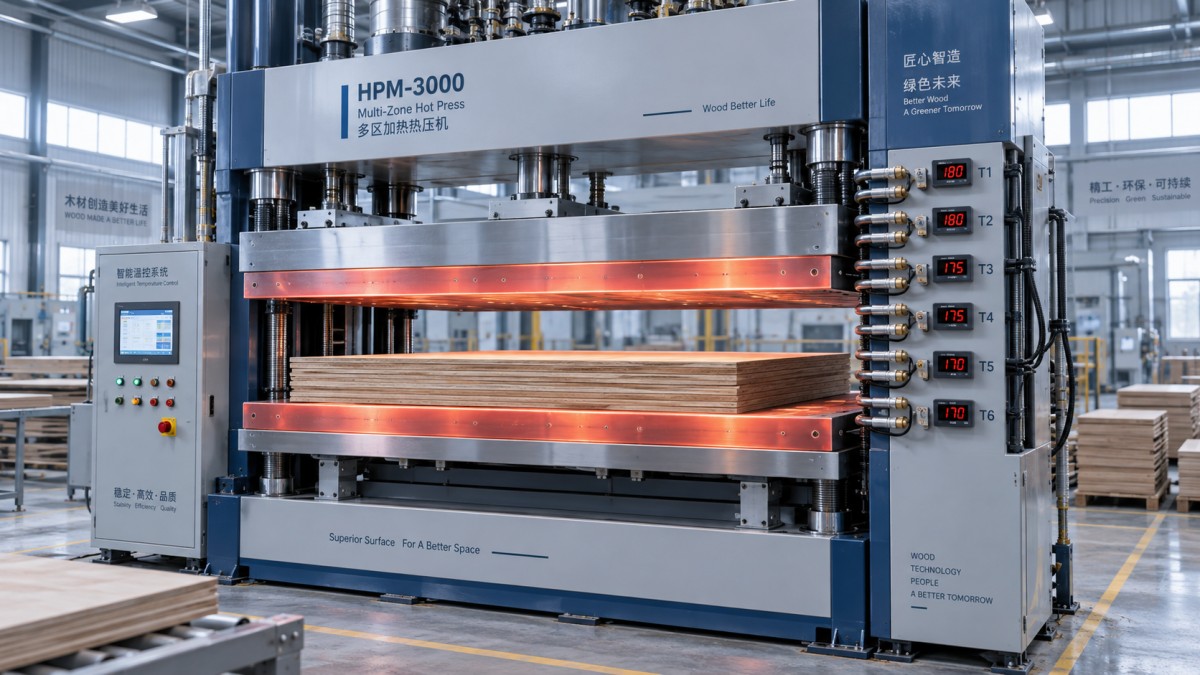
The distinction matters during evaluation. A machine advertised as “multi-zone” should be assessed for actual independent control capability, not merely for having several heaters installed inside one platen. Separate heating elements without separate sensing and control do not provide the same correction ability. Likewise, multiple display values are not enough if they do not correspond to meaningful platen areas and active control outputs.
The Control Loop Is Only as Good as Its Measurement
Temperature sensors are central to the performance of a hot press. Their location should reflect the temperature that matters: the usable platen surface and the heat transferred into the workpiece. A sensor buried too deeply in the platen may react slowly to surface changes. A sensor placed near a heat source may report a stable value while another area of the platen lags behind. Conversely, excessive sensor density does not automatically improve performance if the controller cannot interpret or act on the additional information.
For this reason, technical acceptance should include surface temperature mapping rather than relying solely on installed sensor readings. The mapping method should be agreed before purchase or commissioning. It normally considers the platen at operating temperature, the selected setpoint, the measuring instrument, grid locations, stabilization time, and whether the test is performed empty or under a representative load. Empty-platen uniformity is useful, but it is not identical to loaded production behavior.
There is no universal tolerance that can be responsibly applied to every wood pressing operation without reference to the product and process. An acceptable variation for one thick-core assembly may be unsuitable for a sensitive decorative lamination. The correct question is not “What is the lowest number on a brochure?” It is “Can the press demonstrate repeatable temperature distribution appropriate for our adhesive, substrate, cycle time, and quality requirement?”
Zone Layout Should Follow the Loading Pattern
The way a factory uses a press should influence the heating design. A plant processing full-size furniture panels on every cycle has different needs from a workshop that alternates between cabinet doors, narrow strips, curved components, and short batches. In the first case, edge compensation and stable full-surface recovery may be the main priority. In the second, flexible zoning and program management may have greater value because the uncovered areas change from job to job.
A common mistake is to specify a press based on maximum platen dimensions while ignoring the normal loading footprint. If most production occupies only the central portion of a large platen, the thermal behavior of unused zones becomes relevant. They may need to be controlled differently, held at standby, or managed through recipes to avoid unnecessary energy consumption and uneven edge conditions around the loaded piece. The suitability of such strategies depends on the press design and production rules; they should be discussed with the machine builder rather than assumed.
Zone boundaries also deserve attention. A controller may regulate each zone accurately, yet a visible temperature transition can still occur if the physical heating layout creates a weak area between adjacent circuits. Platen thickness, internal channel spacing, heater placement, and heat-conduction paths determine how smoothly zones blend together. This is one reason experienced manufacturers evaluate platen construction as a whole instead of presenting zoning as a software feature alone.
Heating Medium and Platen Design Still Matter
Multi-zone control can be applied to electrically heated platens, thermal-oil systems, and other heating arrangements used in industrial presses. Each approach has different response characteristics. Electrical systems can offer localized heating control, but the practical result depends on heater design, power distribution, switching method, and maintenance access. Thermal-oil systems can provide stable heat transfer across large platens, yet circuit balance, flow control, insulation, and oil temperature management become critical. The right choice is tied to plant infrastructure, operating temperatures, press size, expected production rhythm, and service capability.
Platen flatness and rigidity should be reviewed alongside thermal specifications. A well-controlled temperature profile cannot compensate for poor pressure distribution caused by platen deformation, worn guiding components, or uneven hydraulic behavior. In wood-based panel work, heat and pressure arrive as a pair. If either one varies excessively across the working surface, the finished result may still be inconsistent.
Insulation is another less visible but meaningful factor. Heat escaping through the back of the platen or into nearby structures increases energy demand and can slow recovery after loading. It may also make edge-to-center balancing more difficult. During a machine review, ask how the platen is insulated, how service access is arranged, and whether insulation materials can be inspected or replaced as part of long-term maintenance.
What to Review During Technical Evaluation
The most useful evaluation discussions move beyond a single “temperature accuracy” statement. Technical teams should request a clear explanation of how the manufacturer defines zones, where sensors are located, and how each zone is regulated. A control diagram is often more informative than a broad performance claim.
- Number, shape, and physical location of heating zones on each platen.
- Whether zones have independent sensing, control outputs, alarms, and setpoint adjustment.
- Heating method, recovery behavior, and how the system responds after a cold panel is loaded.
- Procedure for surface temperature mapping during factory acceptance and site commissioning.
- Controller functions for recipes, trend records, fault diagnosis, and sensor failure detection.
- Availability of heating components, sensors, control modules, and practical after-sales support.
It is also worth asking how the supplier handles a mismatch between an actual production condition and an original specification. A press may pass an empty-plate test but face a more demanding application once large cold panels, high-moisture material, or short cycles enter the process. The supplier’s willingness to review operating data, inspect control behavior, and provide spare parts support can matter as much as the original equipment configuration.
Uniformity Is a Process Issue, Not Just a Machine Feature
Even a well-designed multi-zone press cannot correct every production inconsistency. Operators should avoid loading patterns that are dramatically unbalanced unless the process has been validated for them. Caul plates, protective sheets, and carrier boards can alter heat transfer. Changes in veneer moisture, core density, adhesive type, glue spread, and assembly time may change the result more than expected. When quality becomes unstable, it is sensible to check platen mapping and controller records, but it is equally important to review material preparation and press loading discipline.
This is where machinery suppliers with sustained woodworking experience can provide a more useful contribution than simply supplying a press. Qingdao Zhongding Machinery Co., Ltd., which has worked in woodworking machinery for more than two decades, approaches equipment selection as part of a broader production line question: what panel is being made, how repeatable is the incoming material, what service response is needed, and which machine configuration can be maintained over time? For many buyers, dependable technical communication and spare-parts availability become particularly important once the press is no longer new.
A hot wood press with multi zone heating is most valuable when its zoning strategy is tied to real production conditions and verified through a sensible acceptance method. The goal is not to add complexity for its own sake. It is to reduce avoidable thermal variation, give process engineers better control over difficult areas of the platen, and make bonding quality more predictable across changing workloads. Before finalizing a specification, define the panel range, loading pattern, adhesive process, and temperature verification method. Those four items usually reveal whether multi-zone heating is a useful engineering requirement or an expensive feature that will never be fully used.
Send Your Inquiry
We welcome your cooperation and we will develop with you.