


News & Exhibitions
Latest Factory Updates, Industry Trends & Global Exhibition Information
Safety Light Curtains on Hot Wood Presses: Placement, Validation, and Risk Reduction
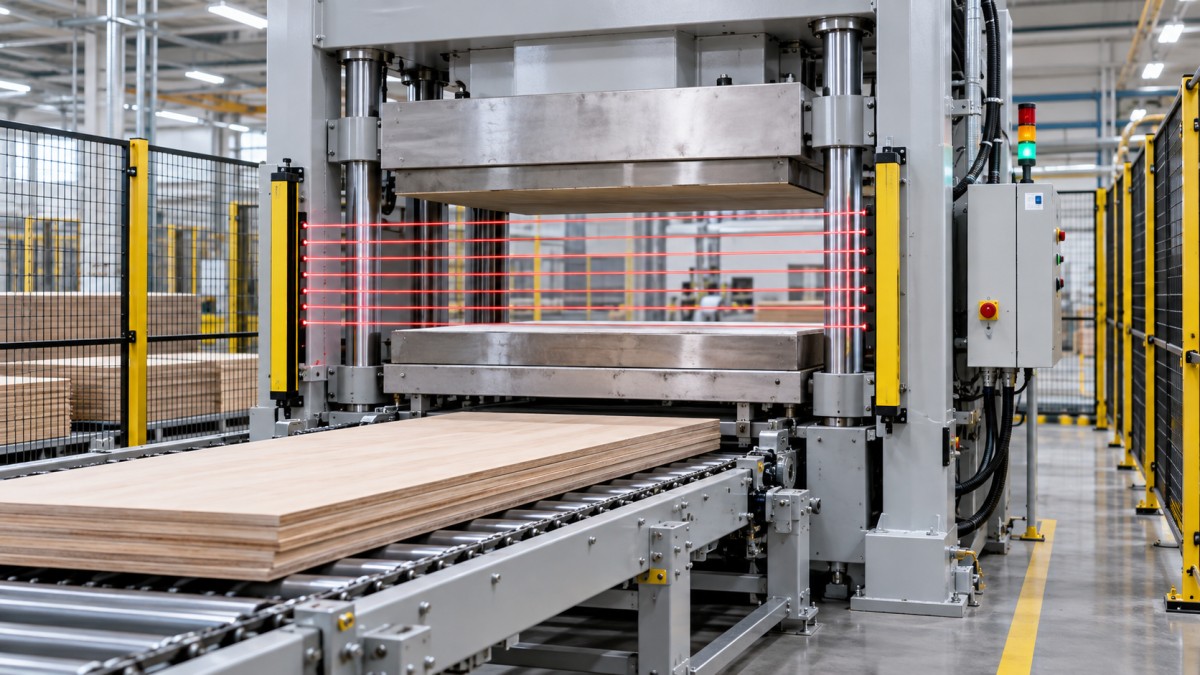
A safety light curtain on a hot wood press must be positioned and validated as part of the press safeguarding system, not treated as an accessory mounted near the danger zone. Its purpose is to prevent a closing cycle, or stop a hazardous closing movement, before a person can reach the platen, loading throat, linkage, or other crushing and burn hazards. A curtain that detects entry but is mounted too close to the moving platen can still leave enough time for contact. A curtain that is correctly spaced but bypassed during production provides only apparent protection.
For a hot wood press with safety light curtain, the central technical question is whether the protective field, stopping performance, control response, and physical layout work together under actual production conditions. The answer changes with press travel, closing speed, platen temperature, loading method, panel size, workpiece overhang, and the way material enters and leaves the press.
Start with the reachable hazard, not the machine outline
Hot presses create more than one hazardous area. The most obvious is the space between upper and lower platens during closing. Yet risk also exists at the front edge where boards are loaded, around moving loading tables or shuttles, at side gaps created by platen guides, and near rear access points used for cleaning or maintenance. A front-mounted light curtain does not automatically protect access from the side or rear.
The sensing field should cover the access route that a hand, arm, or body can use to reach the hazardous movement. This means examining the normal loading position as well as abnormal but foreseeable actions: removing a misaligned veneer stack, recovering a dropped release sheet, clearing adhesive squeeze-out, or reaching around a wide panel. A narrow field that only covers the center of the press opening may leave an unprotected route at the edge of the platen.
Where stock enters from the front, the protected height must match the access risk. A field set only at hand height may not detect entry above or below it. Conversely, extending a field to floor level without considering offcuts, hoses, and accumulated debris can cause frequent interruptions that encourage defeat or bypass behavior. Fixed guards, side barriers, or mechanically controlled loading arrangements often complement the curtain by closing routes that do not need open access during normal work.
Safety distance is a measured system value
The distance between a safety light curtain and the pressing hazard must allow sufficient time for the press to reach a safe condition after the field is interrupted. This distance is affected by the press stopping time, controller reaction time, output switching time, and the response time of valves, relays, brakes, or hydraulic components. It is also affected by the detection capability of the curtain and the permitted approach speed defined by the applicable safety assessment.
A common installation error is to measure from the curtain to the visible platen edge while ignoring the point where harmful pressure can be produced. On a press with a descending upper platen, the relevant boundary may be the nearest point at which trapping begins, including a projecting pressure plate, carrier frame, or moving mechanism. If the press has a slow approach phase followed by a rapid closing or pressure-building stage, validation must consider the hazardous motion profile rather than a single nominal cycle time.
Stopping time should be determined on the installed machine in its production configuration. A result taken with cold hydraulic oil, an empty press, or reduced pressure can be misleading. Temperature, valve condition, system pressure, platen load, and mechanical wear can alter the time from protective-field interruption to a safe state. For a hot press, repeated heat cycles and hydraulic temperature changes deserve attention because the behavior seen at start-up may differ from the behavior seen after sustained production.
The calculated safety distance is not a static drawing dimension. It should include the actual installed response path and any allowances required by the risk assessment. If the curtain is relocated, the press control is modified, the closing speed is changed, or a new loading device is added, the distance needs to be reassessed. Moving the curtain outward to solve nuisance trips can be valid only when the resulting access route remains protected and the layout does not invite reaching around the field.
Placement details that determine whether the field is usable
Mounting brackets must resist vibration, thermal expansion effects, and impact from panel handling. A transmitter and receiver that lose alignment intermittently can stop production, but an installation that is forced back into alignment without investigating the cause may conceal a bent bracket or damaged frame. Rigid supports, protected cable routing, and clear access for lens cleaning reduce avoidable instability.
The optical faces should be protected from direct adhesive spray, steam, dust discharge, and splashing cleaning fluid. Wood dust alone is not always the main problem. Fine dust combined with resin, wax, or moisture can form a film that weakens the received signal. A machine positioned near sanding, trimming, or glue-spreading operations may need more frequent inspection than an identical press in a cleaner cell.
Reflection also requires attention. Highly reflective release plates, stainless guarding, glossy laminated panels, or polished press surfaces can distort the sensing arrangement if the curtain type and mounting geometry are unsuitable. The concern is not simply whether the curtain indicates a clear field during installation. The concern is whether reflected light can create a false-clear condition at a location where access is possible. Protective mounting arrangements and the curtain supplier's installation limits should be followed where reflective surfaces are close to the field.
For presses loading oversized doors, plywood assemblies, or long laminated panels, panel travel deserves separate analysis. The workpiece itself should pass through the intended process without repeatedly blocking the curtain at an unsafe stage. If material must cross the field, the control sequence needs a defined, monitored mode that distinguishes material presence from human access. A simple timer-based mute function is weak where panel dimensions, feed speed, or loading position vary. Muting should be tied to the intended material path and should end promptly when the material clears.
Control integration must produce a safe press response
A light curtain is only one part of the safeguarding chain. Its safety outputs must be evaluated by control components suited to the required risk reduction, and the resulting command must place the press in a safe state. For many presses, that state is prevention of closing or removal of the command that allows hazardous platen movement. The exact architecture depends on the press design, hydraulic circuit, electrical control system, and risk assessment.
Merely connecting a curtain to a general-purpose input that requests a stop is not enough when a single wiring fault, software fault, welded contact, or failed valve could allow closing to continue. The control arrangement needs fault detection, appropriate redundancy where required, and monitoring of final switching elements. Reset behavior also matters. Restoring the protective field should not automatically restart a hazardous cycle. A deliberate reset from a position with visibility of the danger area helps prevent restart while a person remains within an accessible zone.
Presses with two-hand controls, foot controls, automatic loading, or multi-stage cycles need their safeguarding logic reviewed as a combined system. A two-hand initiation device does not compensate for a light curtain installed inside the required safety distance. A curtain does not make an automatic closing sequence safe if material can enter the machine through an unprotected route. Each protective measure has a defined function, and the control logic should not assume one measure covers a different access scenario.
Blanking, muting, and reduced-speed functions
These functions are often applied to solve legitimate process constraints, but they change the protection boundary and require disciplined design. Fixed blanking can be appropriate for a permanent machine member that occupies part of the sensing field. It becomes problematic when used to ignore a variable obstruction or when the blanked area creates a hand-sized opening toward the press throat.
Floating blanking is more sensitive because the allowed blocked beams can move within limits. On a hot press, a configuration intended for a narrow carrier can accidentally permit access around a shifted workpiece if the geometry is not carefully constrained. The acceptance criteria should address the largest allowed opening, the actual material path, and what happens when stock is skewed.
Muting should be triggered by sensors arranged to recognize the intended passage of a workpiece. The sequence must reject implausible timing, a missing panel, or a person entering the field before the material reaches the muting point. Reduced-speed setup functions can also be useful during adjustment, but slower motion is not automatically harmless. The remaining force, distance to trapping points, hold-to-run control arrangement, and visibility of the press area still determine whether the task is adequately controlled.
Validation should test the installed condition, not just the component
Commissioning records should show that the curtain model, protective height, detection capability, mounting location, and control configuration match the approved safeguarding design. The validation process should include the entire sequence from field interruption to safe press response. Testing only the curtain's indicator lights proves optical detection; it does not prove that the press stops or remains prevented from closing.
A useful validation sequence includes:
- Confirming that interruption at several points across the sensing field prevents the hazardous closing command, including locations near the outer edges where alignment errors and access gaps are more likely.
- Measuring or verifying the stopping behavior under representative operating conditions, then confirming that the installed separation distance remains adequate for that result.
- Testing restart prevention after an interruption, power restoration, reset action, and recovery from a detected control fault.
- Checking all accessible approach routes with the press at loading height, during platen travel, and with the largest normal workpiece in position.
- Verifying any muting or blanking function with correctly positioned material, skewed material, missing material, and a blocked or failed auxiliary sensor where the control design permits such testing.
The test object used for field checks should match the detection capability required by the risk assessment. Passing a large object through the field does not demonstrate detection of a smaller body part. Similarly, testing only the centerline of the curtain misses the beam edges, the first and last active beams, and areas affected by mounting tolerances.
Validation evidence is more useful when it records conditions that can later change: hydraulic temperature state, press mode, platen position, safety relay status, safety-distance measurement points, and the version or settings of relevant control logic. This record supports troubleshooting after a component replacement or machine modification. It also helps distinguish a genuine safety performance change from a routine alignment issue.
Routine checks should detect degradation before production adapts around it
Frequent functional verification should be simple enough to perform consistently and specific enough to reveal a dangerous failure. The field should be interrupted at practical access points before the press cycle is initiated, and the expected safe response should be observed. If the press closes with the field blocked, if a reset restores movement without a clear field, or if a status indication is abnormal, the press should not return to normal production until the condition is corrected and the safeguarding function is retested.
Periodic inspection needs a broader scope than a daily functional test. Lens condition, cable strain relief, connector integrity, bracket rigidity, protective housing, reflector hazards, and signs of impact should be examined. The mounting position should be checked against the documented reference dimensions. A curtain can remain electrically functional after a collision while having shifted close enough to invalidate its safety distance.
Changes in nuisance-trip frequency deserve investigation. Repeated trips may arise from contamination, vibration, electrical interference, changing ambient light conditions, marginal alignment, or a process change that pushes material into the field. Disabling the curtain, increasing blanking, or extending a mute timer may restore throughput while creating an unreviewed exposure. The better response is to identify whether the interruption is caused by the process, the environment, or degradation of the protective device.
Risk reduction also depends on the surrounding workflow
Light curtains work best when loading and unloading positions are defined so that hands do not need to follow a panel into the press throat. Panel supports, alignment stops, loading tables, and vacuum or mechanical handling aids can reduce the need for corrective reaching at the moment the cycle begins. Uneven stacks, warped veneers, excess adhesive, and slippery release sheets create conditions where a person may instinctively stabilize material near the closing zone. These process defects should be addressed alongside the safeguarding arrangement.
Cleaning and jam removal require separate control measures because these tasks often occur when normal production guards are inconvenient. Isolation of hazardous energy, prevention of platen movement, support against gravity where relevant, and control of residual hydraulic pressure are distinct from a light-curtain function. The curtain remains useful for normal access protection, but it should not be relied upon as the sole protection during maintenance inside the machine envelope.
A reliable installation therefore remains traceable from hazard assessment through mounting, control design, measured performance, and ongoing inspection. When the protective field matches the real access route and the press response is verified under representative conditions, the light curtain becomes a dependable part of a controlled hot-press operation rather than a device that only appears compliant from the front of the machine.
Send Your Inquiry
We welcome your cooperation and we will develop with you.