


News & Exhibitions
Latest Factory Updates, Industry Trends & Global Exhibition Information
How plywood manufacturing machinery handles veneer thickness variation
Veneer thickness variation matters because plywood is built from thin layers whose behavior changes quickly when thickness, moisture, or density shifts. A veneer that is only locally thinner can absorb adhesive differently, dry faster, buckle under pressure, or leave a weak bond line. A thicker section can prevent full press closure, create localized stress, and contribute to uneven panel thickness after sanding. For a technical evaluator, the question is therefore not whether plywood machinery can process imperfect veneer. Most lines can. The more useful question is how well the line detects variation, keeps it from reaching the wrong process stage, and compensates where compensation remains technically sound.
Wood product manufacturing machinery for plywood handles thickness variation through a sequence of controls rather than one machine function. Veneer preparation, grading, moisture conditioning, glue application, lay-up, pre-pressing, hot pressing, trimming, and sanding all influence the final result. A strong production line does not treat thickness variation only as a pressing problem. It manages it early enough that unsuitable sheets are repaired, redirected, or rejected before they consume adhesive, press capacity, and labor.
Thickness variation starts before the press
Rotary-cut veneer naturally contains variation. Knife wear, lathe settings, wood species, log geometry, moisture distribution, and defects such as knots or grain deviation can all affect the peeled sheet. Some variation is gradual across a roll or batch; some appears as thin bands, loose areas, compression marks, or thicker zones around irregular grain. These conditions have different consequences and should not be assessed by a single average thickness value.
For example, a sheet with a stable average thickness but a narrow thin stripe may still create a localized glue-starved bond. A veneer that is uniformly thicker than specification may laminate successfully but alter the finished panel construction, press cycle, and sanding allowance. Machinery selection should therefore distinguish between average-thickness monitoring and profile monitoring. Average values are useful for process control; thickness profiles are more useful for identifying localized defects that can affect panel integrity.
The first control point is normally veneer measurement after peeling and before downstream assembly. Depending on line configuration, this may involve mechanical gauges, contact rollers, non-contact sensors, or scanner-based inspection systems. The objective is not merely to display thickness. The measurement must be connected to an operating decision: adjust lathe settings, change veneer grading, alter glue spread, send sheets to repair, or remove them from a higher-grade product route.
Where the veneer is supplied from outside the mill, incoming inspection becomes especially important. A plywood press cannot reliably correct a mixed shipment containing sheets with inconsistent thickness, moisture, and surface condition. It may still produce panels, but the source of later bonding or flatness problems becomes difficult to isolate. Technical teams should establish an acceptance range by veneer position in the lay-up, since face veneers, crossbands, and core sheets do not carry the same tolerance or visual requirements.
Measurement only helps when the line can act on it
A thickness sensor without a response strategy is mainly a quality-recording tool. It becomes a process-control tool when machinery can use the result to adjust the next operation. In plywood production, the most practical responses usually fall into four categories: peeling correction, veneer sorting, adhesive compensation, and press recipe selection.
- Peeling correction: When variation is linked to a changing lathe condition, operators can review knife position, pressure bar setting, spindle centering, and log conditioning. The correct adjustment depends on the source of the variation; increasing pressure to solve every thin veneer problem can introduce cracking or compression damage.
- Sorting by usable grade: Veneers outside the preferred thickness range may still be suitable for another core construction, backing layer, packaging grade, or shorter panel format. Routing decisions protect material yield without allowing marginal veneer to enter a demanding product specification.
- Adhesive compensation: Glue spread can be adjusted within a controlled range when veneer porosity or thickness shifts moderately. This is a limited correction, not a substitute for sound veneer quality. Excess adhesive may increase bleed-through, moisture load, press contamination, and cost.
- Press recipe selection: Different constructions may require different loading patterns, closing profiles, pressure stages, or hot-press time. If the line handles multiple panel builds, recipe management helps prevent a thin-core construction and a thick-core construction from receiving identical press treatment.
The control architecture matters as much as the sensor itself. A high-speed line needs traceability between a measured veneer sheet and its later lay-up position. If sheets are measured, stacked, moved, repaired, and manually reintroduced without identification, the original measurement has limited value. Evaluators should ask how the system associates inspection results with a sheet, a stack, a batch, or a production order, and whether operators can understand the resulting reject or diversion instructions without slowing the line.
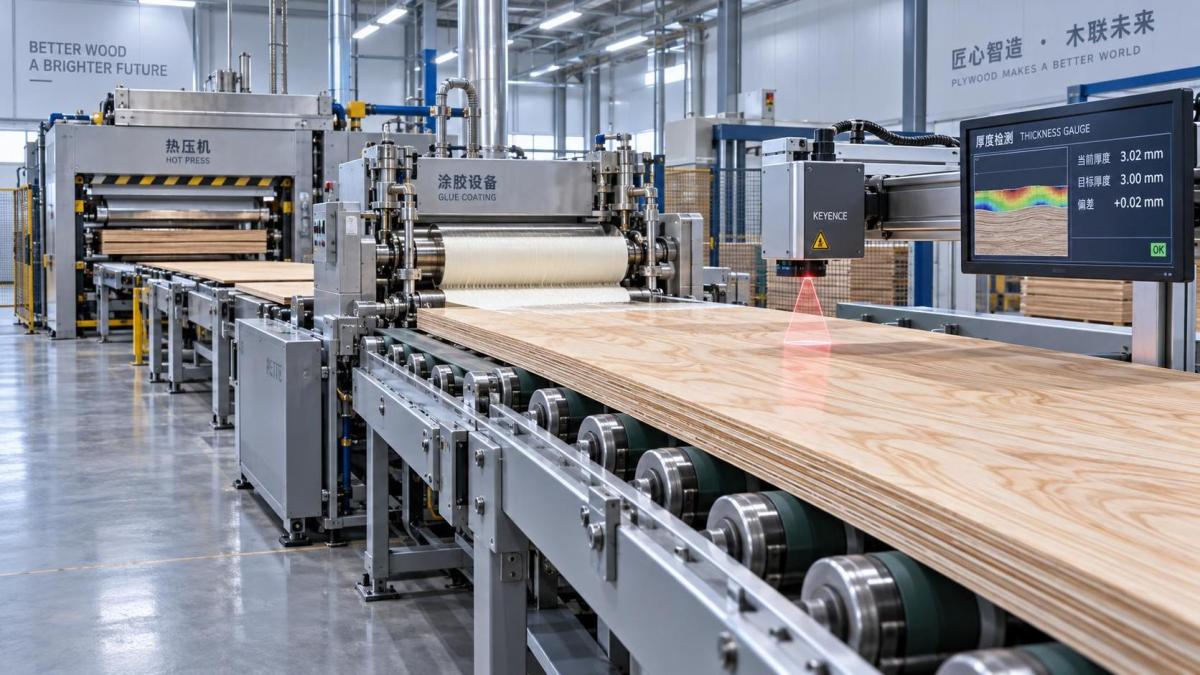
Glue application is where variation becomes a bonding risk
Thickness variation changes the relationship between veneer surface, adhesive film, and press pressure. Thin veneers may be more flexible and may conform readily during pressing, but they can also be more prone to soak-through or surface telegraphing. Thick or uneven veneers may leave gaps at local high points, particularly when core sheets have rough surfaces or overlaps. The adhesive system must bridge normal surface variation without masking defects that should have been screened out earlier.
Roller spreaders, curtain systems, extrusion applicators, and other glue application arrangements should be evaluated for repeatability across changing veneer conditions. A machine may deliver a consistent nominal spread rate, yet the effective bond can vary if the veneer absorbs resin unevenly. Porous zones, lathe checks, dry veneer, and thin spots can pull adhesive into the wood rather than leaving an adequate bond-line film. Conversely, an overly wet or compressed surface can reduce penetration and leave excess adhesive at the interface.
For this reason, thickness data should be considered alongside moisture and surface-quality data. A thin veneer at controlled moisture may behave acceptably. The same veneer with uneven moisture may curl before lay-up, distort at the glue station, and enter the press with poor contact. Technical evaluations that focus only on thickness tolerance can miss the combined effects that produce delamination, blistering, or unstable panel flatness.
Automatic glue spread adjustment is useful when it is constrained by approved operating limits. It should not encourage operators to compensate for every veneer defect by adding adhesive. Once a line relies on excessive spread to maintain bonds, downstream symptoms often include glue squeeze-out, cleaning burden, higher resin consumption, and inconsistent finishing behavior. The better approach is to define which deviations are eligible for compensation and which deviations require sorting or rejection.
Pre-pressing and hot pressing provide controlled consolidation
Pre-pressing is often underestimated in discussions of thickness variation. Its role is to stabilize the assembled mat before hot pressing, improve layer contact, and reduce movement during transfer. When veneers differ in thickness, a pre-press can help distribute contact across the lay-up, but it cannot eliminate severe localized thickness differences. Overloading the pre-press to force a poor lay-up into shape may damage veneer surfaces or lock in uneven stresses.
The hot press then determines whether the panel reaches the required thickness and bond quality without excessive compression. Press platen condition, parallelism, hydraulic pressure stability, loading consistency, temperature control, and closing behavior all affect the outcome. Uneven veneer makes these variables less forgiving. If platen parallelism is poor, a panel with uneven core material will show the problem more severely than a well-balanced construction. Similarly, worn caul plates or contaminated press surfaces can transfer localized thickness variation into the finished panel.
A common misconception is that higher pressure will solve thickness inconsistency. Higher pressure can improve contact in some constructions, but it can also crush low-density core zones, over-compress thin areas, increase density variation, and create springback after pressing. The appropriate press condition depends on wood species, adhesive chemistry, target panel density, veneer moisture, layer count, and intended end use. Machinery should provide repeatable settings and reliable feedback, while the production specification defines the acceptable operating window.
For multi-opening presses or high-throughput lines, consistency between openings also deserves attention. A control system can hold a set pressure and temperature, yet variation in loading sequence, mat position, or platen wear may produce different results across openings. Thickness mapping after pressing is useful because it shows whether the problem originates in incoming veneer, lay-up, or press distribution.
Finishing equipment can correct small deviations, not structural ones
Calibration sanding is the final practical thickness-control stage for many plywood products. Wide-belt sanders can remove modest surface variation and produce a more uniform finished panel. They are valuable for meeting thickness targets and preparing a surface for overlay, coating, or secondary lamination. However, sanding should be treated as a finishing correction. It cannot restore bond integrity, rebalance an uneven core, or remove internal stress created by poor pressing.
Excessive sanding is also expensive. It reduces yield, consumes abrasives, creates dust, and may expose defects in face veneer. If a panel regularly requires substantial sanding to reach specification, the process problem likely sits upstream. A technical assessment should compare the thickness distribution before and after sanding, rather than judging only the final average thickness. A narrow final tolerance achieved through heavy material removal may conceal weak upstream control.
In overlay or wrapped-panel operations, surface uniformity becomes even more visible. Thin face veneer, sanding-through risk, or local panel thickness variation can affect the bonding and appearance of a decorative covering. A lamination unit such as the PUR WRAPING Machine 300 may be relevant for narrower wrapped components, where controlled feed and lamination speed support consistent facing application. Its maximum lamination width of 300 mm and processing height of 80 mm indicate a component-oriented application rather than a substitute for full-sheet plywood press control. The underlying substrate still needs stable thickness and surface preparation before facing is applied.
What to verify when comparing machinery
Technical evaluators should avoid judging a line solely by nominal speed or press tonnage. Veneer variation exposes weaknesses in material handling, measurement, data flow, and maintenance discipline. The following questions usually reveal more than a general claim of “automatic thickness control.”
- Where is veneer thickness measured, and does the method detect localized variation or only provide an average reading?
- Can the system distinguish a correctable process drift from an individual defective sheet?
- What happens automatically after an out-of-range result: alarm, sorting, recipe adjustment, line stop, or operator review?
- How are measured sheets tracked through drying, patching, stacking, lay-up, and pressing?
- Which glue-spread adjustments are permitted, and what prevents excessive compensation for poor veneer?
- How are press parallelism, platen condition, and finished-panel thickness verified during normal production?
- Can production records connect a finished panel issue to veneer batch, lay-up recipe, press cycle, and sanding result?
Maintenance should be included in the same evaluation. Sensor contamination, roller wear, inaccurate calibration, belt tracking problems, hydraulic drift, and damaged press surfaces can all create readings or results that appear to be veneer variation. A useful control system makes these equipment-related causes visible. Otherwise, operators may repeatedly adjust peeling, glue, or pressing parameters while the actual fault is a worn measuring roller or a misaligned sanding head.
The practical objective is stable decision-making, not zero variation. Wood is a variable material, and an economically workable plywood line needs defined limits for what it can absorb, what it can redirect, and what it must reject. Machinery earns its value when those limits are measured consistently and handled predictably across the whole process. That is the difference between producing panels that merely meet a nominal thickness and producing plywood with repeatable bonding, flatness, and downstream finishing performance.
Send Your Inquiry
We welcome your cooperation and we will develop with you.