


News & Exhibitions
Latest Factory Updates, Industry Trends & Global Exhibition Information
When industrial wood product manufacturing machinery fits high-volume production
Industrial wood product manufacturing machinery becomes a strategic question when a factory’s order book begins to outgrow the pace of its existing workflow. A few additional orders may be manageable with overtime, more operators, or longer machine hours. Sustained volume is different. When delivery dates tighten, material variation becomes more visible, and customers expect the same dimensions across every batch, the production system—not just individual machines—must be reconsidered.
For business decision-makers, the issue is rarely “Do we need more machinery?” The more useful question is: Which parts of the process are limiting volume, consistency, and margin? The right industrial wood product manufacturing machinery should make output more predictable while reducing unnecessary handling, repeated setup, avoidable offcuts, and dependence on a small number of highly experienced operators.
In furniture plants, flooring lines, pallet factories, and timber-processing operations, high-volume production is not defined by one impressive daily output figure. It is defined by the ability to keep material moving through each stage without creating a bottleneck downstream. That requires a practical match between product mix, wood condition, labor availability, cutting requirements, maintenance capacity, and future growth plans.
Volume begins to expose the weaknesses of stand-alone production
A workshop can often produce quality wood components with single-purpose, stand-alone equipment. The challenge appears when the same component must be produced repeatedly, in larger quantities, with minimal variation. A manual or semi-manual cutting process may still deliver acceptable results, but it can become difficult to schedule, supervise, and scale.
Common warning signs include operators waiting for material, stacks of semi-finished boards accumulating beside a machine, frequent dimensional adjustments, and a rising proportion of boards rejected or reworked after the cutting stage. These symptoms do not always mean that the current equipment is poor. More often, they show that an earlier production method is no longer suited to the required pace.
High-volume woodworking also amplifies small inconsistencies. A minor deviation in rip width may be tolerable for a custom project, yet it can disrupt assembly, sanding, laminating, or packaging when multiplied across thousands of strips. The same is true of waste. A little excess trim on each board may seem insignificant until it is measured over a full month of production.
That is why industrial wood product manufacturing machinery is usually introduced not simply to “go faster,” but to create a controlled and repeatable production rhythm. The most valuable gains often come from consistency: stable feeding, defined cutting paths, reliable machine settings, and a process that is easier to monitor across shifts.
Where industrial-scale equipment makes the strongest business case
Not every woodworking operation needs a production-line approach. A business built around custom joinery, one-off architectural pieces, or frequently changing designs may benefit more from flexible equipment and skilled manual adjustment. Industrial machinery is most compelling where production has enough repeatability to justify a more disciplined flow.
Decision-makers should look closely at the following conditions:
- Repeated dimensions: The same widths, thicknesses, or component formats are required across regular orders.
- High material throughput: Solid wood, timber, or panels must be processed continuously rather than in occasional batches.
- Delivery pressure: Lead times leave little room for production delays caused by repeated manual cutting or changeover.
- Labor sensitivity: Output depends heavily on individual operators, making absenteeism, turnover, or training gaps a production risk.
- Material-cost pressure: Yield from timber and panels matters enough that unnecessary kerf loss, poor cut planning, and rework affect profitability.
- Downstream coordination: Assembly, edge processing, sanding, finishing, or packing teams need a more reliable supply of correctly sized parts.
The strongest fit is usually found in operations where the cutting department feeds several later stages. If cutting is inconsistent, the entire factory feels it. If cutting becomes steady and predictable, downstream teams can plan labor and capacity with greater confidence.
Rip cutting is often the point where throughput changes
Longitudinal cutting may look like a straightforward operation, but it has a major influence on line capacity. Turning a board into several accurately sized strips using repeated single cuts can consume time, increase handling, and create more opportunities for variation. This is particularly relevant for furniture frames, flooring blanks, pallet components, wooden packaging, and other products that require repeat strip dimensions.
A multi-blade rip saw is designed around a different production logic: rather than cutting one strip at a time, it can process a piece of solid wood, timber, or wood panel into multiple strips in one pass. For factories with stable strip requirements, this reduces the number of cutting cycles and keeps material moving forward more continuously.
Qingdao Zhongding Machinery, a woodworking machinery manufacturer and exporter with more than 20 years of industry experience, works with manufacturers that need to move from isolated machine operations toward more scalable production arrangements. The practical goal is not to install equipment for its own sake. It is to select machinery that fits the material, output target, shop layout, and the realities of daily operation.
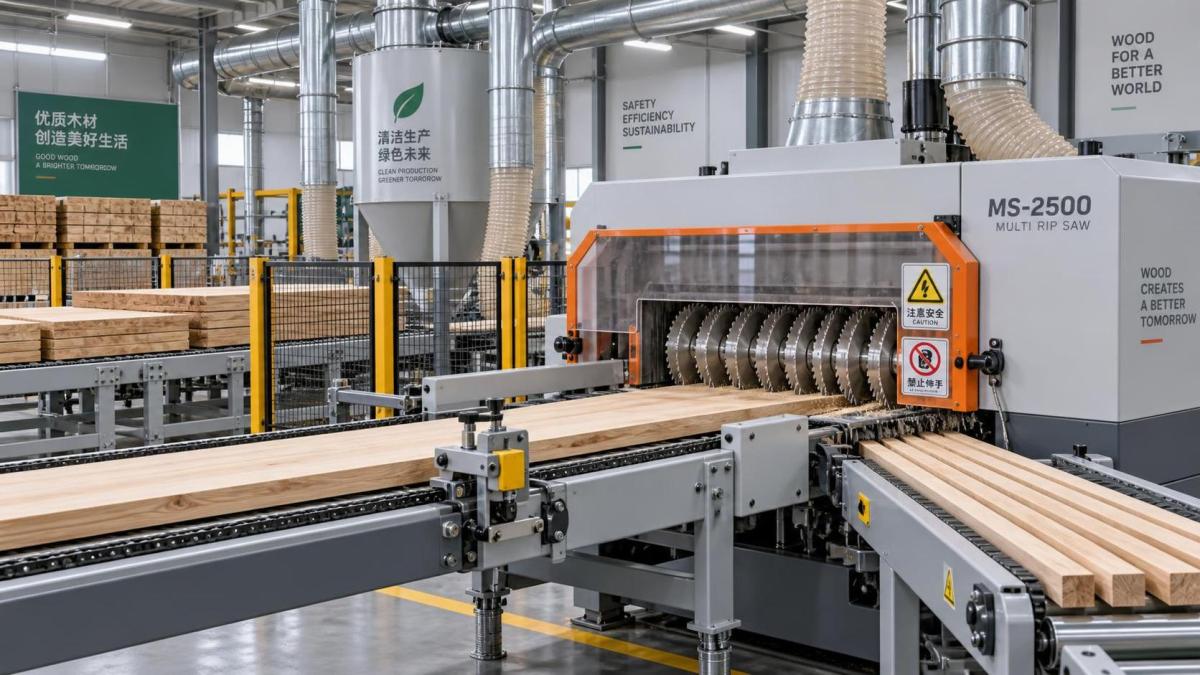
For example, the Multi Blades Rip Saw is intended for continuous longitudinal cutting in furniture manufacturing, flooring production, pallet factories, wooden packaging, and timber-processing industries. The ZDF-120-300 and ZDF-150-300 models accommodate a maximum processing width of 300 mm, while their maximum processing heights are 50–120 mm and 60–150 mm respectively. This distinction matters because machine selection should be based on the actual cross-section of the material being processed, not on an assumed average board size.
Choosing capacity means looking beyond motor power
Specifications are essential, but they should be read in the context of the production process. A higher-capacity machine is not automatically the better investment if the feeding system, material preparation, or downstream handling cannot support it. Conversely, choosing too small a machine can create a new bottleneck immediately after installation.
For rip-saw applications, begin with the boards that represent the most important share of production. Review their widths, thicknesses, moisture condition, species, straightness, and surface condition. A factory processing uniform, prepared timber faces a different cutting environment from one handling variable reclaimed wood or mixed batches of rough lumber.
The ZDF-120-300 uses a 230 mm saw blade diameter and is designed for material heights of up to 120 mm; the ZDF-150-300 uses 255 mm blades and can process material heights up to 150 mm. Both have a 50 mm main shaft diameter and may be configured with a 22 kW or 30 kW main electric motor. These details should be evaluated alongside the desired feed rate, number of blades required, wood density, and expected duty cycle. A decision made only on maximum dimensions can miss the operational demands that determine real output.
Machine footprint also deserves early attention. With approximate machine dimensions of 2250 × 1450 × 1550 mm for the ZDF-120-300 and 2280 × 1450 × 1550 mm for the ZDF-150-300, installation planning must include more than the machine body. Factories need safe infeed and outfeed space, operator access, material staging, dust extraction connections, electrical provision, blade-change access, and room for maintenance. A compact-looking installation can become inefficient if boards cannot be loaded and discharged without interruption.
The material flow around the machine matters as much as the machine itself
One of the most common purchasing mistakes is to assess a wood-processing machine in isolation. In reality, industrial wood product manufacturing machinery performs best when the surrounding process is ready for it.
Consider a typical sequence: raw timber arrives, boards are sorted, unsuitable material is removed, pieces are prepared to the required condition, longitudinal cuts are made, and strips move to the next operation. If sorting is inconsistent, hidden defects may enter the cutting stage. If material is not properly prepared, feeding can become unstable. If finished strips have nowhere to go, the saw may stop even though its mechanical capacity is far from fully used.
Before committing to equipment, map the movement of one representative board from receiving through to its next process. Note every manual lift, waiting point, inspection step, and measurement check. This exercise frequently reveals that the real constraint is not only cutting speed. It may be material staging, slow blade adjustment, inadequate extraction, or a lack of standardized work instructions.
A well-designed solution addresses those surrounding conditions. It may include practical guidance on machine placement, operator workflow, spare-parts planning, blade management, and the sequence in which materials should be introduced. For growing factories, these details can be the difference between a machine that looks productive during a demonstration and one that remains productive through everyday production demands.
What management should verify before approving an investment
The financial case for equipment should be tied to measurable operational changes rather than broad claims about automation. Start with the current baseline: average output per shift, number of handling steps, labor assigned to cutting, material loss, rework, downtime, and delivery delays caused by capacity constraints. The numbers do not need to be perfect; they need to reflect the real operating situation.
Then ask what will change after the new process is in place. Will one pass replace several? Will operators spend less time measuring and repositioning boards? Can the same team support a higher, more stable output? Will downstream processes receive components in a more consistent format? These are the questions that connect a machinery purchase to business performance.
It is equally important to examine support requirements. High-volume production cannot depend on a machine that is difficult to maintain or slow to recover after a stoppage. Availability of wear parts, clarity of technical documentation, operator training, and responsive after-sales communication all influence the value of the investment. Qingdao Zhongding Machinery’s approach combines machinery supply with technical support and spare-parts service, helping customers sustain production after installation rather than treating delivery as the end of the relationship.
A practical fit test for expanding wood manufacturers
Industrial equipment is a good fit when production demand is consistent enough to justify repeatable settings, the cutting stage is restricting the rest of the factory, and management has a clear view of the material formats it needs to process. It is especially relevant when strips of similar dimensions are required in meaningful volume and when manual handling is becoming a hidden cost.
It may be wise to pause, however, if product dimensions change constantly, incoming timber quality is highly uncontrolled, or no one has responsibility for preventive maintenance and blade condition. In those cases, the priority may be process standardization before a capacity upgrade. Machinery can strengthen a sound workflow; it cannot permanently compensate for one that has not been defined.
The best industrial wood product manufacturing machinery decisions are made with both today’s orders and tomorrow’s operating model in view. A machine should fit current material and capacity requirements, while leaving room for a business to serve larger contracts, shorten lead times, and reduce production uncertainty. For manufacturers ready to make that transition, a properly matched rip-cutting solution can turn a pressured cutting department into a steadier foundation for high-volume growth.
Send Your Inquiry
We welcome your cooperation and we will develop with you.