


News & Exhibitions
Latest Factory Updates, Industry Trends & Global Exhibition Information
Vacuum Packaging for Woodworking Machines: What Prevents Rust at Sea?
Vacuum Packaging for Woodworking Machines: What Prevents Rust at Sea?
Ocean freight exposes woodworking machinery to humidity, salt-laden air, and temperature swings that can trigger corrosion before installation. The key question is whether woodworking machine vacuum packaging provides reliable moisture control—not simply a tight seal. Effective protection depends on dry machine surfaces, suitable corrosion inhibitors, correctly sized desiccants, and a low-permeability barrier with verified seals. Removing air alone is not enough.
That distinction matters on a cast-iron table, ground steel guideway, or spindle assembly. Rust on an external bracket may be largely cosmetic; corrosion on a sliding contact surface can affect movement, alignment, and commissioning. A credible packing specification therefore starts with the vulnerable components and the expected journey, not with the appearance of the finished crate.
Why a tightly wrapped machine can still arrive rusty
Consider a machine packed after testing in a humid workshop. Its table looks dry, but moisture remains in recesses, on uncoated fasteners, or in timber placed inside the barrier. The package is sealed, some air is extracted, and everything appears secure. During transport, cooling can bring a metal surface below the dew point of the enclosed air. Condensation then forms inside an apparently intact package.
Temperature changes do not create water. They expose the consequences of moisture already enclosed or entering later. Desiccant can absorb water vapor, but it is not a substitute for removing liquid water or allowing cleaned components to dry before packing.
Salt adds another concern. Chloride contamination can make corrosion more aggressive when moisture is present. It may come from coastal handling, contaminated surfaces, or water ingress; it should not be assumed that every sealed package is continuously exposed to sea spray. Keeping the machine clean before enclosure is as important as blocking moisture afterward.
Define what “vacuum packaging” actually means
In machinery shipping, the term often describes a flexible barrier bag from which some air has been withdrawn before sealing. It does not necessarily mean a controlled, sustained industrial vacuum. Ask the supplier to identify the barrier construction, evacuation method, sealing process, and intended protection period. “Vacuum packed” alone is not a measurable corrosion-protection requirement.
Ordinary polyethylene can provide useful protection against splash and dirt, but it should not automatically be treated as a long-duration moisture barrier. Water vapor can pass through packaging materials without a visible hole. Aluminum-foil laminates are commonly considered where low moisture transmission is needed, although their performance still depends on laminate quality, resistance to handling damage, and seal integrity.
Ask for water-vapor transmission data with the test method, temperature, and humidity conditions stated. ASTM F1249 is one recognized method used to measure water-vapor transmission through plastic film and sheeting. A reported value without test conditions offers little basis for comparison, and a film test does not establish the performance of the complete sealed package.
More suction is not automatically better. A tightly collapsed bag can press against sharp corners, pull on wiring, or bridge over unsupported spaces. Any extraction arrangement also needs a reliable closure. The objective is a dry, protected enclosure—not the most dramatic-looking vacuum.
Build the protection around the machine’s vulnerable surfaces
Woodworking machines combine materials that need different treatment. A cast-iron worktable, painted frame, linear guide, rubber pressure roller, and electrical cabinet should not receive the same preservation compound simply because they share one crate.
Exposed ferrous surfaces may need a removable rust preventive, selected for the surface finish and anticipated storage period. Existing guideway lubrication should remain compatible with any added treatment. Applying an unfamiliar oil over a precision assembly can create a cleaning problem or interfere with the lubricant specified for commissioning.
Volatile corrosion inhibitors, usually called VCI, can provide additional protection when the formulation suits the metals and enclosure. They are not a universal replacement for drying or a sound barrier. Their effectiveness depends on conditions including enclosure integrity, distribution, and access to protected surfaces. Electrical contacts, elastomers, adhesives, and sensitive assemblies require a compatibility check rather than a blanket assumption.
There is also a woodworking-specific trade-off: excessive oily residue on tables or feed components can transfer to timber during initial production. Preservation instructions should therefore name both the protective product and the approved removal procedure. A machine that arrives rust-free but contaminates the first workpieces is not ready for service.
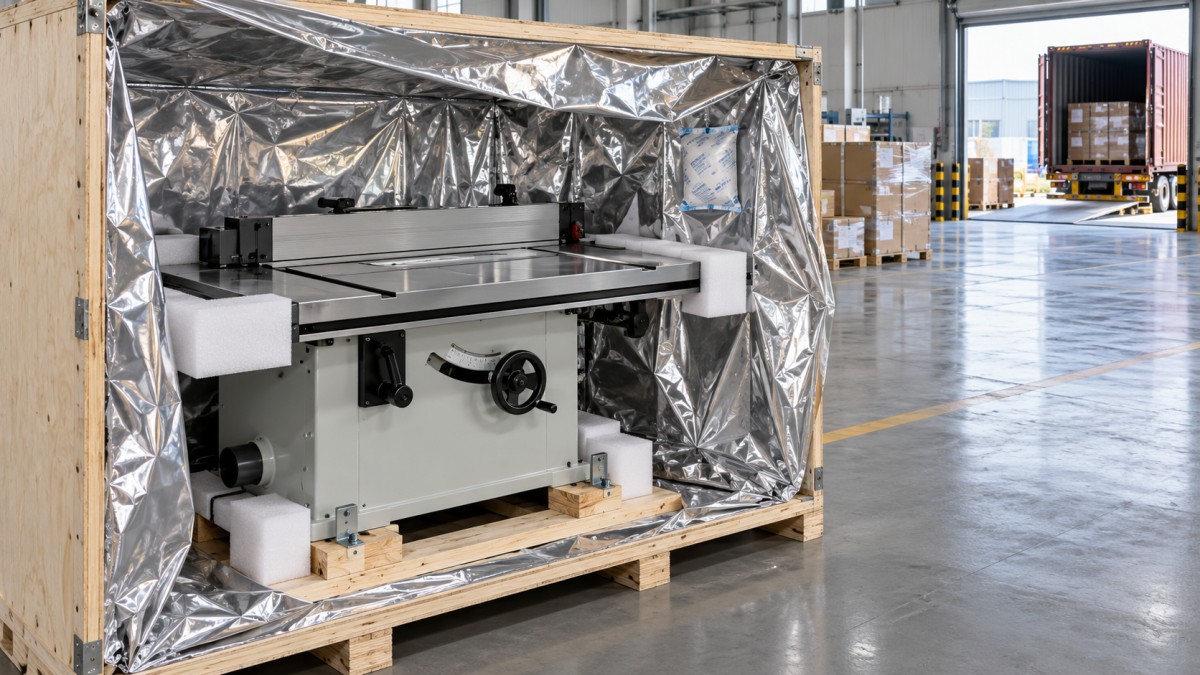
A useful packaging cross-section would show the machine on its transport base, protective padding at sharp edges, desiccants secured inside the moisture barrier, and the outer crate providing impact protection. These are separate functions: the crate restrains and shields the load; the sealed enclosure controls its immediate atmosphere.
Desiccant quantity needs a moisture budget
“Several bags per machine” is not a sizing method. The required quantity depends on initial moisture, moisture released by enclosed materials, vapor transmission through the barrier, the protection period, and the target internal humidity. Desiccant capacity also varies with temperature and humidity; its nominal weight alone does not describe usable performance.
DIN 55474 provides a framework for calculating desiccant requirements for packaging applications. Where a supplier uses this or another documented method, request the assumptions behind the calculation. A result based on a short voyage may be inadequate once inland transport, port delays, customs clearance, and destination storage are included.
Pay particular attention to wood, cardboard, and absorbent cushioning inside the barrier. They can contribute a substantial moisture load. Keep unnecessary hygroscopic material outside the sealed envelope where the package design permits. If timber must remain inside, its condition needs to be considered in the calculation.
Desiccants should be secured, protected from rupture, and positioned so they can exchange moisture with the enclosed air. Do not leave loose sachets where they can enter moving assemblies or spill onto electrical equipment. Large enclosures may need distributed placement rather than one cluster beside the sealing point.
The weak points are usually seams, corners, and penetrations
Even a suitable barrier can fail at a folded, contaminated, or incompletely fused seam. Packing procedures should define how sealing surfaces are kept clean, how the equipment is set for the selected laminate, and how completed seams are checked. Visual inspection is useful, but it cannot prove that every seal is leak-free.
Any seal-strength or leak check should suit the actual package design. Thin barrier material drawn against a heavy machine needs different handling from a small laboratory pouch. Establish an acceptance method with the packaging supplier rather than adopting an arbitrary vacuum-hold requirement.
Hold-down bolts, base interfaces, extraction fittings, and accessory compartments deserve close inspection. A bolt passing through the barrier can defeat otherwise careful sealing. Transport loads should be carried by the machine’s supports and restraints, not by the film. Padding must also stay in place during handling; protection that slips away from a sharp table corner offers little reassurance.
Where solid-wood packaging is used, applicable ISPM 15 requirements should be checked for the destination. This is a separate issue: phytosanitary treatment and marking address pest risks, not the dryness of timber at packing or the corrosion resistance of the enclosed machine.
What to require in the shipment documentation
A useful technical review turns general promises into records that can be checked before dispatch. For woodworking machine vacuum packaging, the following items are more informative than a photograph of a tightly wrapped load:
- Protection scope: components covered, preservation materials used, and any separately packed accessories.
- Design duration: total transport and storage allowance, including foreseeable delays and stated storage conditions.
- Barrier specification: material identification, moisture-transmission evidence, and sealing requirements.
- Moisture-control basis: desiccant type, sizing assumptions, quantity, and placement.
- Inspection evidence: surface condition before closure, seam checks, protected corners, and final restraint arrangement.
- Receiving instructions: inspection sequence, preservative removal, and action if unpacking or commissioning is delayed.
Humidity indicator cards can support receiving inspection when their range and placement suit the package. They should not be treated as a complete history of transit conditions. Where a time record is needed, a suitable humidity and temperature logger is more informative, although its location affects what it measures.
For Qingdao Zhongding Machinery Co., Ltd., a woodworking machinery manufacturer and exporter with more than 20 years of industry experience, packaging discussions belong alongside technical support and commissioning planning. Buyers should request machine-specific preservation details rather than infer a packaging capability from manufacturing experience alone. Clear documentation also gives after-sales teams a better basis for assessing arrival-condition concerns.
Do not lose the protection at the receiving dock
A cold machine opened in warm, humid air can collect condensation immediately. Receiving plans should allow appropriate temperature equalization before opening the barrier, judged against local conditions and the machine’s thermal mass—not a universal waiting period.
Inspect the enclosure before cutting it open and photograph damage, indicator readings, and the initial surface condition. If installation is postponed, an opened bag should not be assumed to retain its original protection. Repacking may require renewed desiccant, fresh preservation, and verified resealing.
The practical acceptance question is straightforward: can the supplier explain how the package stays dry for the full journey, and show how that protection is checked? A convincing answer connects surface preparation, barrier performance, desiccant sizing, mechanical protection, and receiving practice. A tight-looking bag answers only a small part of that question.
Send Your Inquiry
We welcome your cooperation and we will develop with you.