


News & Exhibitions
Latest Factory Updates, Industry Trends & Global Exhibition Information
How much desiccant does woodworking machine moisture-proof packing need?
A woodworking machine does not need a fixed number of desiccant bags per tonne of machine weight. The required quantity depends on the water that must be removed from the sealed package, the moisture entering during transport and storage, and the desiccant’s usable capacity at the specified humidity and temperature. A heavy machine inside a dry, well-sealed barrier can require less desiccant than a smaller machine packed with damp timber.
The defensible approach is a moisture mass balance: estimate the package’s total water load over its protection period, apply a justified allowance for uncertainty, and divide by the desiccant’s working adsorption capacity. That calculation is meaningful only when the moisture barrier, seals, internal packing materials, and protection period are defined.
Define the protected enclosure before calculating the dose
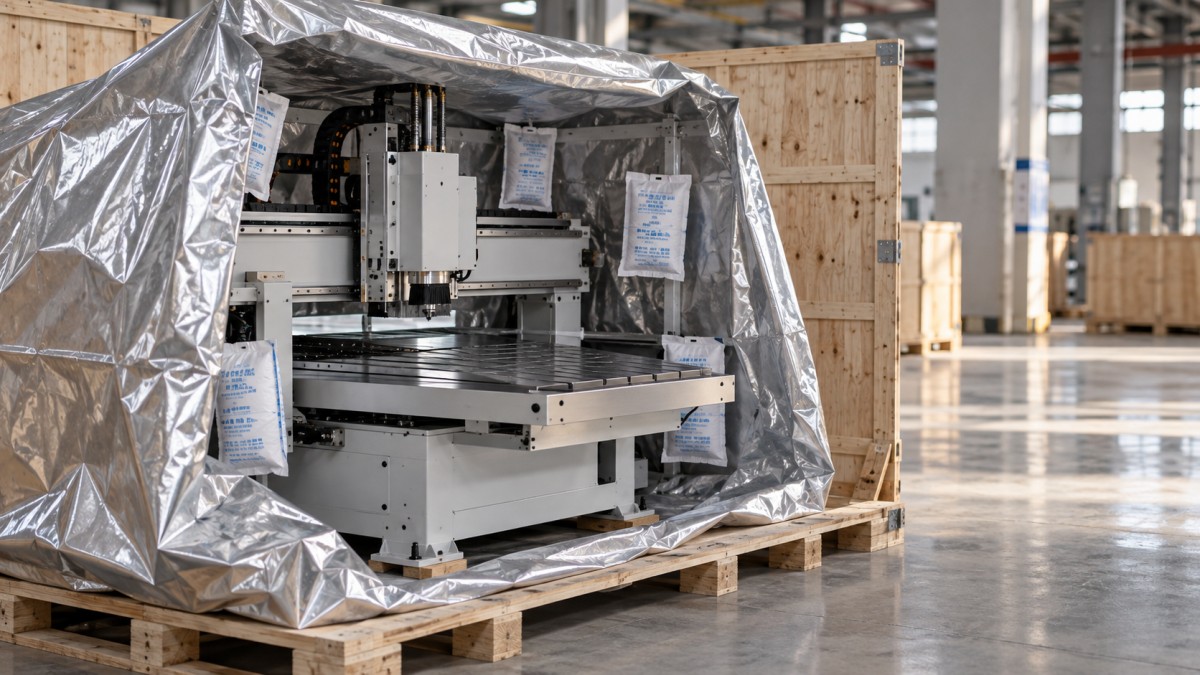
For woodworking machine moisture-proof packaging, the protected enclosure should normally be the sealed barrier surrounding the machine—not the shipping container or the outer wooden crate. Desiccant inside a closed barrier controls a finite moisture load. Desiccant placed in a ventilated crate is exposed to replenished ambient moisture and cannot maintain a reliably low humidity around the machine.
The packaging specification therefore needs to identify:
- The barrier material and its water-vapor transmission performance.
- The enclosed free-air volume and total barrier surface area.
- Which timber, cardboard, foam, cables, and accessories remain inside the barrier.
- The maximum interval from sealing to unpacking, including destination storage.
- The internal humidity limit and the temperature conditions under which it must be maintained.
A crate may provide mechanical protection without providing meaningful vapor resistance. Stretch film and loosely wrapped polyethylene can limit dust or splashes, but their presence alone does not establish a sealed, low-permeability enclosure.
For large panel saws, edge banders, or machining centers, the barrier boundary also determines whether wooden skids contribute to the moisture load. Keeping structural timber outside the sealed envelope, where the mechanical design permits, can reduce the required drying capacity substantially.
Calculate the water load, not the machine weight
A practical engineering balance can be written as:
Required desiccant mass = F × (Wair + Wmaterials + Wpermeation + Wother) ÷ Cworking
Here, each W term is a mass of water, F is a justified design allowance, and Cworking is the usable water uptake per unit mass of desiccant under the specified conditions. All terms must use consistent units. This is a general engineering balance, not a substitute for a calculation procedure required by a contract or packaging standard.
Water in the enclosed air
The initial air load is the difference between the water vapor present at sealing and the water vapor permitted at the design condition:
Wair = free-air volume × (initial absolute humidity − target absolute humidity)
Use absolute humidity, expressed as grams of water per cubic meter, rather than subtracting relative-humidity percentages directly. Relative humidity changes with temperature even when the amount of water vapor remains unchanged.
At approximately 30°C, saturated air contains about 30.4 g/m³ of water vapor. Reducing 8 m³ of enclosed air from 70% to 40% RH at that temperature requires removing approximately 73 g of water. This illustrates why an air-volume-only calculation can underestimate the total requirement: moisture released by packaging materials can exceed the initial air load.
Free-air volume excludes the machine’s solid displacement, but includes accessible cavities within the enclosure. Precision is useful only to the extent that the larger moisture sources are also controlled.
Water released by timber and other materials
Wood, cardboard, paper, and some cushioning materials release moisture as the enclosed air becomes drier. Their contribution depends on initial moisture content, material mass, temperature, equilibrium behavior, and the time available for moisture migration.
For timber, moisture content is commonly expressed relative to oven-dry wood mass. If 20 kg of dry wood releases moisture equivalent to a one-percentage-point reduction on that basis, the water contribution is 200 g. That is not the same as assuming the wood contains only 1% moisture.
The relevant quantity is the moisture expected to be released during the protection period—not all water present in the material. Where this contribution is large or uncertain, measured timber moisture, representative conditioning tests, or removal of the hygroscopic material provides a stronger basis than an arbitrary allowance.
Heat treatment markings on wooden packaging address phytosanitary requirements; they do not establish that timber is sufficiently dry for a sealed moisture-control package.
Water entering through the barrier
For a constant-condition approximation:
Wpermeation = barrier area × effective water-vapor transmission rate × protection duration
If the transmission rate is expressed in g/m²/day, area in m², and duration in days, the result is grams of water.
The word “effective” matters. A supplier’s water-vapor transmission rate, or WVTR, applies to specified test conditions. A value measured under one temperature and humidity gradient cannot automatically represent a different shipping route. For changing conditions, use a justified conservative rate or calculate separate exposure intervals.
Material WVTR also does not account for an open seam, puncture, or poorly sealed cable penetration. Large machines can have excellent barrier film and still admit excessive moisture through closure defects. Such defects should be corrected, not hidden inside a larger desiccant allowance.
A worked example: approximately 5 kg, under stated assumptions
Consider a sealed machine package with the following illustrative design inputs. These values are calculation assumptions, not a recommended dosage for every woodworking machine.
The initial air contributes approximately 73 g. Barrier permeation contributes 30 × 0.05 × 120 = 180 g. Adding timber and other packing materials gives a total estimated water load of 493 g.
Applying the illustrative allowance gives 493 × 1.5 = 739.5 g. At a verified working capacity of 150 g/kg, the required desiccant mass is approximately 4.93 kg. The installed quantity would be rounded upward to available bag sizes.
The result changes sharply if the assumptions change. If effective WVTR rises tenfold to 0.5 g/m²/day, permeation alone becomes 1,800 g, and the same calculation requires approximately 21.1 kg. Increasing barrier performance can therefore be more effective than adding bags to a poorly controlled enclosure.
The 1.5 allowance is not a universal requirement. Its justification depends on input uncertainty and validation evidence. It cannot compensate for wet machinery, standing water, or unsealed packaging.
Use working adsorption capacity—not an advertised maximum
A desiccant’s advertised maximum water uptake may describe high-humidity conditions that are incompatible with the package’s protection target. Sizing against that figure can overstate the available capacity.
The useful value is the additional moisture uptake available from the desiccant’s as-installed condition before the specified internal humidity limit is reached, accounting for the relevant temperature range. Adsorption-isotherm data help establish this limit; kinetic data or package testing establish whether uptake is fast enough.
Silica gel, activated clay, molecular sieve, and calcium-chloride-based products should not be compared by bag weight alone. Their humidity-dependent capacity, temperature response, containment requirements, and suitability near precision equipment differ. Products that form liquid brine require particular attention to leakage and orientation.
Where bags are specified in desiccant units, use the capacity definition in the applicable specification. One unit is not one bag, and it is not a universal mass of material.
DIN 55474 addresses calculation of desiccant quantities for packaging, while DIN 55473 addresses desiccant bags and associated requirements. MIL-D-3464 is another specification encountered for bagged desiccants. A procurement document should identify the applicable edition and required performance rather than merely stating “standard desiccant.” Qualification of a bagged product does not validate the complete machine package.
Humidity control must also address condensation
A humidity target should follow the equipment’s vulnerability and environmental exposure. There is no single RH limit that guarantees protection for every cast-iron table, linear guide, electrical cabinet, and contaminated metal surface.
Condensation occurs when a surface is colder than the surrounding air’s dew point. For example, air at 30°C and 40% RH has a dew point of roughly 15°C. A machine surface below that temperature can collect condensation even though a warm-air measurement appears acceptable.
Heavy castings create a particular challenge because they change temperature more slowly than the surrounding air. The package assessment should therefore consider the coldest vulnerable surface, not just the air temperature near the barrier.
Desiccant capacity is also different from drying speed. A large water load released quickly from damp timber can cause a temporary humidity excursion before the desiccant adsorbs it. Clean, dry machinery and conditioned packing materials reduce this transient risk. Desiccant is not a substitute for removing residual cleaning water or applying compatible corrosion protection where required.
Installation and verification determine whether the calculation holds
Distribute bags so vapor can reach them without obstruction, particularly around enclosed cabinets or partially isolated cavities. A single concentration of bags at the crate floor may leave slower-drying zones elsewhere. Avoid placing bags against lubricated surfaces, sharp edges, hot components, or moving mechanisms.
Do not enclose desiccant in an impermeable accessory bag. Secure it against transport movement, and protect the barrier from brackets, threaded projections, and lifting points. Minimize exposure between opening the desiccant’s supply packaging and sealing the machine enclosure.
A release record should connect the calculated quantity to the actual package: installed desiccant type and amount, barrier identity, seal inspection, internal timber moisture measurements where relevant, sealing date, and protection expiry assumptions.
Humidity indicator cards provide a limited indication at their location; they do not establish the humidity history throughout a large package. For package qualification or sensitive shipments, temperature/RH logging near vulnerable components provides stronger evidence. Representative thermal cycling can reveal local condensation risks and slow-drying zones that a static capacity calculation misses.
Acceptance criteria should state the permitted humidity and temperature conditions, monitoring locations, and how excursions are evaluated. A humidity rise can result from exhausted desiccant, a leak, moisture release, or cooling of the air; the RH trace alone does not identify the cause.
A defensible packing specification therefore states more than “add 5 kg of desiccant.” It links the installed quantity to a defined enclosure, moisture inventory, exposure duration, verified adsorption capacity, and package-integrity controls. Without those links, the bag count is a packing instruction—not evidence of moisture protection.
Send Your Inquiry
We welcome your cooperation and we will develop with you.