


News & Exhibitions
Latest Factory Updates, Industry Trends & Global Exhibition Information
When does seaworthy packing for woodworking machines need ISPM 15?
Woodworking machine seaworthy packing generally needs ISPM 15 treatment and marking when it contains regulated raw wood and enters a country that applies the standard. The deciding factors are the packaging materials and the destination’s requirements—not whether the machine travels by sea. Packaging made entirely from processed wood, such as plywood, is generally exempt; a plywood crate with solid-wood runners may not be.
This distinction matters during final packing inspection. A crate can look suitable for export yet contain untreated timber beneath the machine, inside the base, or as loose container blocking. Those overlooked components can trigger inspection, treatment, removal, or refusal under the importing country’s procedures. At the same time, a compliant ISPM 15 mark does not establish that the package can resist condensation, lifting forces, or movement during transport.
Start with the wood components, not the crate description
ISPM 15 is the international standard addressing phytosanitary risks associated with wood packaging material in international trade. It covers items such as pallets, crates, skids, and dunnage made from regulated raw wood. Its purpose is to reduce the risk of transporting pests through packaging; it is not a structural packaging certification.
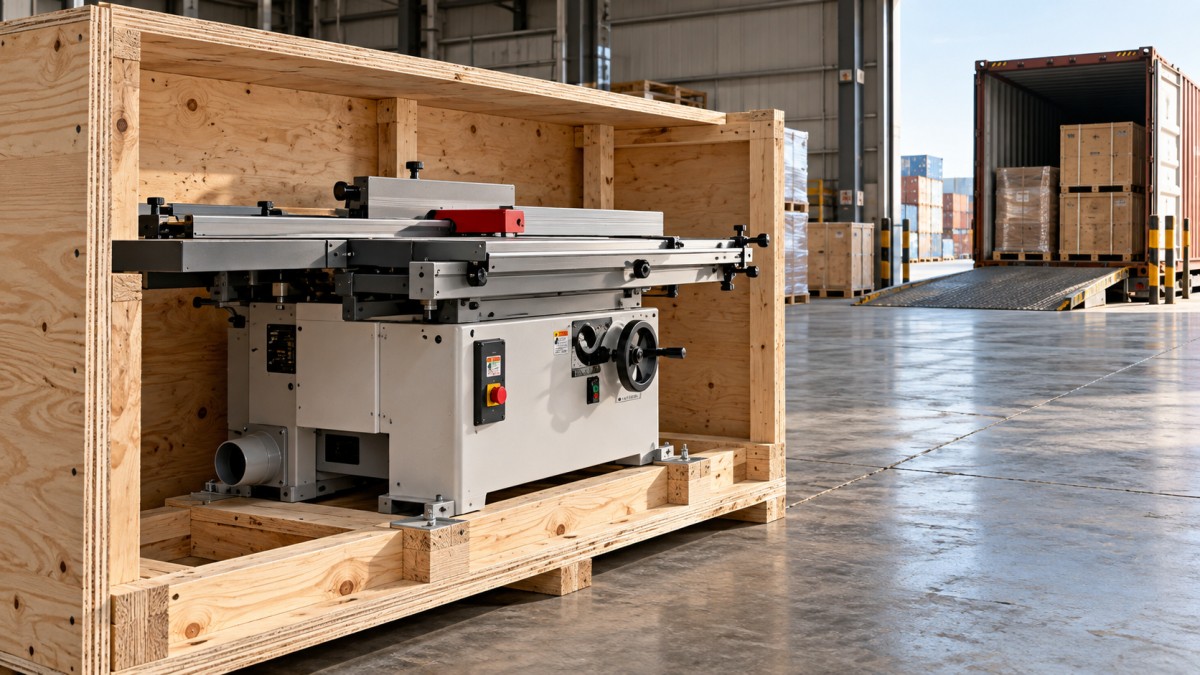
For a woodworking machine shipment, inspect the complete packing assembly. The outer panels may be plywood while the load-bearing base, corner posts, bracing, and wedges are sawn timber. Describing that assembly as a “plywood case” does not make its raw-wood components exempt.
The thin-wood exemption is not a general exemption for small wooden pieces. A short, thick timber wedge can still be regulated. Similarly, painting, kiln drying, preservative application, or a supplier’s statement that wood is “export grade” does not by itself establish ISPM 15 compliance.
Confirm the destination before approving the packing specification
ISPM 15 provides an international framework, but importing countries implement it through their own requirements and inspection systems. Confirm the current rules for the destination and any relevant transit arrangements before ordering the crate. Do not assume that instructions used for a previous shipment apply to a different route.
The importer or customs broker can help identify the applicable requirements, but the destination’s national plant protection organization is the authoritative reference for phytosanitary rules. Clarify whether the shipment will be transshipped, unpacked, stored, or repacked in another country, because additional handling can introduce new wood packaging or affect the applicable controls.
Keep the specification concrete. Instead of requesting only “seaworthy export packing,” state whether raw wood is permitted, which components require treatment and marking, who supplies compliant dunnage, and what evidence must be retained. An instruction to use only processed-wood panels is insufficient if the packing contractor is free to add untreated timber underneath.
What the mark should establish—and what it cannot
A compliant ISPM 15 mark links the packaging to an authorized treatment and marking system. It normally contains the IPPC symbol, a two-letter country code, an assigned producer or treatment-provider identifier, and an approved treatment code. The layout may vary within the standard’s rules; a commercial logo or the words “fumigated wood” are not substitutes.
Inspect the mark on the actual packaging, rather than relying only on a photograph of a supplier’s sample. It must be legible, durable, non-transferable, and visible when the packaging is in use. For a completed packaging unit, placement on at least two opposite sides is preferred. A loose label that can be detached and moved to another crate is not an acceptable substitute for compliant marking.
Heat treatment is not the same as ordinary drying. For conventional heat treatment identified by the HT code, the schedule requires at least 56°C throughout the wood profile, including the core, for at least 30 continuous minutes. Other approved treatment methods have their own conditions and codes. Treatment must be conducted and verified within the relevant authorization system; a workshop cannot simply heat timber and apply its own unofficial stamp.
Regulated wood packaging must also meet the standard’s debarking requirements. A mark does not excuse obvious pest activity or other evidence of noncompliance, and inspectors may examine marked packaging. Fresh-looking exit holes, insect debris, or suspect bark should trigger review before loading, not an assumption that the stamp resolves the concern.
Is a treatment certificate enough?
For wood packaging covered by ISPM 15, a treatment certificate alone generally does not replace the required mark. The standard’s marking system is intended to identify compliant packaging without routine reliance on a phytosanitary certificate for that packaging. Nevertheless, destination rules, contracts, or inspection procedures may call for supporting records.
Retain the packing supplier’s identity, treatment references where available, inspection photographs, and the relationship between each packing unit and the machine shipment. These records help investigate discrepancies, but paperwork cannot make an unmarked or improperly marked regulated wooden skid compliant.
Separate phytosanitary release from seaworthy-packing approval
A treated crate can still arrive with a corroded machine or a collapsed base. For woodworking machine seaworthy packing, use two distinct acceptance decisions: whether the wood meets applicable phytosanitary requirements, and whether the complete package protects the equipment during the intended transport and handling conditions.
Moisture control requires particular attention. ISPM 15 treatment is not a guarantee of low shipping moisture content or protection against subsequent wetting. Timber can absorb moisture after treatment, and damp wood enclosed with machinery can contribute to condensation and corrosion. Check packaging dryness, storage exposure, and the condition of the machine before sealing any protective barrier.
- Protect susceptible surfaces: Select corrosion protection compatible with machined tables, guideways, shafts, and other exposed metal surfaces. Keep protective chemicals away from components they could damage.
- Design the moisture barrier: Where used, barrier film and desiccants must suit the enclosed volume, material moisture, expected journey, and storage conditions. Loose wrapping is not equivalent to a sealed barrier.
- Restrain the machine: Secure it through suitable structural points. Do not rely on thin panels, protective covers, or unsupported machine tables to carry restraint loads.
- Control moving parts: Immobilize slides, fences, and other movable assemblies according to the machine’s transport instructions, and secure accessories separately.
The skid, lifting access, fasteners, and blocking must suit the machine’s mass and center of gravity. Replacing solid timber with an exempt material can simplify phytosanitary compliance, but the replacement still needs adequate strength, stiffness, and fastener performance. A material exemption is not evidence of load capacity.
A release sequence that catches hidden noncompliance
Schedule inspection before the crate is closed and again after container loading. The first inspection exposes internal supports; the second catches timber introduced during blocking and securing. Checking only the finished crate exterior leaves both gaps.
- Review the material list. Identify panels, runners, frames, internal supports, wedges, and loose dunnage. Classify each as regulated raw wood, exempt processed wood, or non-wood material.
- Match the route to current requirements. Record the destination and relevant transit conditions, then resolve any uncertainty before packing starts.
- Verify the packing source. Confirm that regulated wood packaging comes through an authorized treatment and marking arrangement. Request clarification when identification is missing or inconsistent.
- Inspect before closure. Check internal timber, cleanliness, visible pest evidence, moisture concerns, machine restraints, and corrosion protection. Photograph areas that will become inaccessible.
- Check the finished unit. Confirm mark visibility, package identification, lifting provisions, and the integrity of the base and enclosure. Make sure wrapping does not conceal required marks.
- Control loading-stage additions. Require compliant wooden dunnage or suitable non-wood alternatives. Record any repair or replacement that changes the approved packing arrangement.
Agree on hold points with the packing contractor and loading team. Otherwise, an inspector may approve a compliant crate only for untreated blocks to be added later to stop it moving inside the container. Those blocks are part of the shipment’s wood-packaging risk even though they are not attached to the machine.
Repairs, reused crates, and late changes
ISPM 15 treatment does not have a universal calendar expiry date. Properly treated and marked packaging that has not been repaired, remanufactured, or otherwise altered can generally be reused without retreatment, subject to its condition and the importing country’s requirements. Age alone is therefore a poor release criterion.
Repairs need closer control. A damaged runner replaced with untreated timber can break compliance even if the original mark remains visible. Repaired and remanufactured packaging is subject to specific treatment and marking rules; do not transfer old marked boards onto a new assembly or retain conflicting marks without checking the applicable procedure.
When a packing change is proposed after inspection, identify exactly what changed. Replacing a plywood lid is different from adding solid-wood load-bearing members. Refer regulated-wood repairs to the authorized packaging provider, and repeat the relevant structural and phytosanitary checks before release.
If missing marks, questionable treatment identity, or suspect pest evidence are discovered at dispatch, hold the affected packaging and obtain a compliant replacement or authorized corrective action. Do not conceal the issue with paint, an improvised stamp, or a certificate unrelated to the actual packing unit. Resolving the defect before departure preserves access to the machine and avoids leaving corrective handling to the destination inspection process.
Send Your Inquiry
We welcome your cooperation and we will develop with you.