


News & Exhibitions
Latest Factory Updates, Industry Trends & Global Exhibition Information
How to block and brace woodworking machines in an export container
How to block and brace woodworking machines in an export container
A woodworking machine that shifts during ocean transit can turn a planned installation into costly repairs and project delays. Effective woodworking machine container export packing starts with a securing plan based on machine weight, center of gravity, container load limits, and transport forces—not improvised timber supports. Blocking, bracing, and lashing must work together without transferring loads through precision tables, guards, or other vulnerable components.
The practical challenge is not simply making the machine look secure before closing the doors. It is controlling sliding and tipping throughout road transport, terminal handling, and the sea passage, while leaving the receiving team a safe way to unpack and unload it.
Establish the load path before choosing timber or lashings
Blocking prevents movement by placing load-bearing restraints against the machine base or transport skid. Bracing transfers forces from those restraints into suitable supporting structures. Lashings provide additional restraint against sliding or overturning, depending on their arrangement. None works reliably if the force ends at a weak casting, an unsupported floor section, or an unrated container fitting.
Before loading, obtain the machine’s transport configuration rather than relying on its operating dimensions. A CNC router with a moving gantry, a panel saw with a detached sliding table, and an edge bander with projecting conveyors present different securing problems.
- Confirm transport weight, overall dimensions, center of gravity, and base contact points.
- Identify approved lifting points, securing points, and locations where blocking may contact the frame.
- Record the skid or crate weight, attachment details, and bearing footprint.
- Check container payload, floor loading restrictions, lashing-point capacities, and the proposed loading method.
- Define the route and transport modes so the securing calculation uses appropriate acceleration assumptions.
The IMO/ILO/UNECE Code of Practice for Packing of Cargo Transport Units, commonly called the CTU Code, provides a recognized framework for cargo securing. A competent cargo-securing specialist should verify demanding arrangements, especially tall machines, concentrated loads, or mixed cargo. There is no universal timber size or strap count that makes every woodworking machine safe.
Make the machine and its transport base act as one unit
A firmly blocked pallet does little if the machine can slide across it. Check the connection between the machine frame and its transport base before designing restraints around that base.
Where the manufacturer permits it, bolt the machine through designated base holes to an adequately designed skid. Bolt size, bearing plates, timber sections, and edge distances need to suit the loads. Avoid fastening into thin covers or assuming that leveling feet can withstand transport forces. If the machine travels on leveling mounts, confirm whether they must be removed, retracted, or separately supported.
The skid must distribute weight as well as provide attachment points. Narrow runners beneath a heavy machine can overload the container floor locally even when total cargo weight remains below the permitted payload. The load-spreading arrangement should account for runner orientation, contact length, and the container’s structural support—not just the floor area visible from above.
Secure moving assemblies using manufacturer-approved transport locks. Depending on the machine, these may include gantries, saw carriages, tool changers, feed units, or sliding tables. Do not use a strap across a precision assembly as a substitute for its transport lock. Label every temporary restraint so it is removed before commissioning.
Position the load around container limits and unloading access
Inspect the assigned container before loading. Damaged flooring, defective lashing fittings, water ingress, or distorted structural members can invalidate an otherwise sound plan. Verify the actual unit’s ratings and the carrier’s restrictions; do not assume that all containers of the same nominal size have identical capacities.
Arrange the cargo to keep the combined center of gravity suitably low and the weight distribution within applicable limits. A heavy machine placed at one end may create handling or road axle-load problems even when the container is not overloaded. Mixed shipments need a layout that considers every machine, accessory crate, and spare-parts package.
Leave working space for installing and inspecting restraints. A machine packed tightly against a wall may make lashing points inaccessible or conceal poor blocking contact. Confirm that the receiving site has equipment capable of extracting the load in the planned sequence. Loading successfully with a factory crane does not prove that unloading with a destination forklift will be practical.
Install blocking and bracing against structural contact points
Blocks should bear firmly against approved areas of the machine base or skid. Avoid gaps that allow the load to gain momentum before striking the restraint. Use sound material with adequate bearing area, and secure individual pieces so vibration cannot dislodge them.
Plan restraint in both longitudinal directions and both transverse directions. A machine blocked at the front and sides can still move toward the doors. Tall or narrow equipment also requires a separate overturning assessment: preventing movement at floor level does not necessarily prevent the upper mass from tipping.
Braces need a verified load path and protection against buckling, slipping, or splitting at their connections. Loose wedges and long unsupported timber lengths are not dependable substitutes for a designed arrangement. Where several pieces share a load, their contact and connections must allow that sharing to occur.
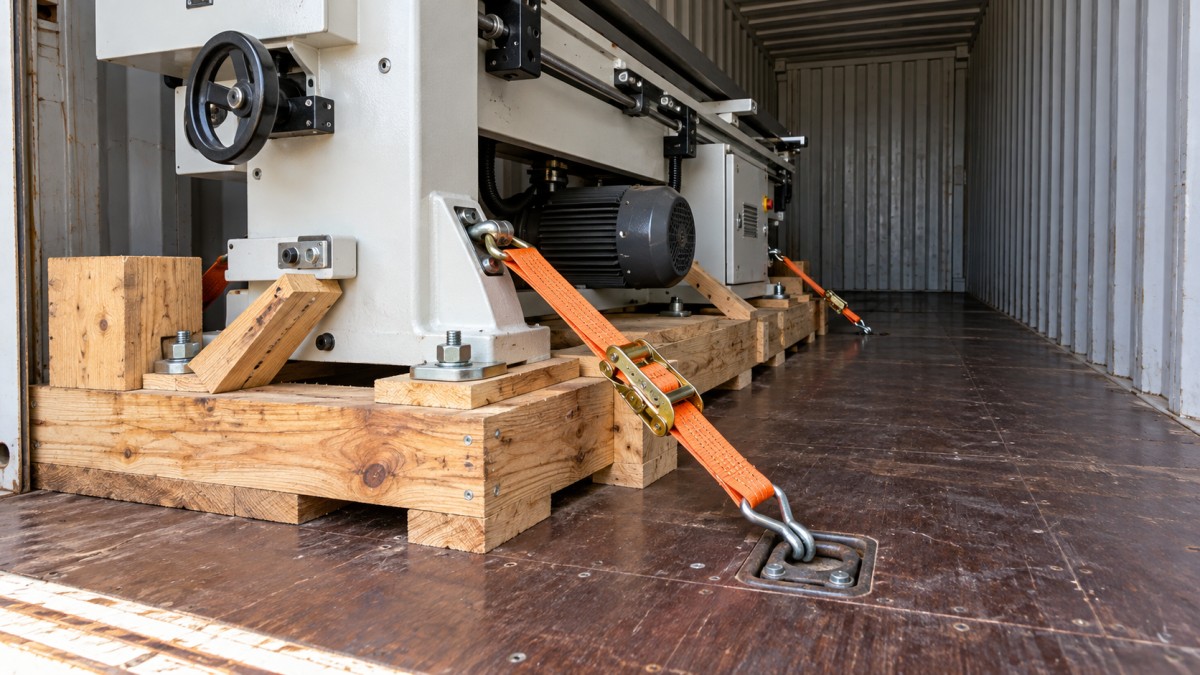
Do not assume the container’s corrugated side panels, end wall, or doors can accept concentrated brace forces. Their suitability depends on the container’s design, condition, load distribution, and applicable limits. Any reaction against container structure needs verification. A wide spreader may reduce local pressure, but it does not automatically make an unsuitable reaction point acceptable.
Do not drill, weld, or nail into a container without the operator’s approval and an accepted method. Floor fasteners, where permitted, require a capacity assessment; their presence alone does not establish restraint strength. For solid-wood packaging and dunnage, verify destination phytosanitary requirements, including applicable ISPM 15 treatment and marking obligations.
Coordinate lashings with the blocking—not around it
Lashings should complement the blocking plan. Direct lashings resist movement through their geometry and tensile capacity. Top-over lashings mainly increase friction by applying downward force. These are different mechanisms, and replacing one with the other without recalculation can leave substantial securing gaps.
Check the entire assembly: machine attachment point, hooks, tensioner, webbing or chain, and container anchorage. The weakest component limits the assembly. Lashing capacity and pretension are also different quantities; a high capacity marking does not mean a tensioner applies that same force to the cargo.
Angles matter. A lashing with little horizontal component offers limited direct resistance in that direction. Check the arrangement in plan and elevation, rather than counting straps in a photograph. Use suitable edge protection and avoid routes across control cabinets, guarding, handrails, or machined surfaces.
Anti-slip material can improve friction when its properties, contact pressure, and surface conditions suit the application. It cannot compensate for oil, loose packing film, unsupported pads, or an unverified friction assumption. Complete tensioning and recheck contact after the machine has settled, following the securing plan and equipment instructions.
Protect precision parts without weakening the restraint
Surface protection and structural securing serve different purposes. Foam, bubble wrap, and ordinary carton board may protect finishes, but they can compress or creep under sustained pressure. Keep soft packaging out of critical load-bearing interfaces unless its behavior has been accounted for.
Remove vulnerable projections where the manufacturer recommends it. Pack detached fences, extraction fittings, screens, tooling, and conveyors in secured, labeled packages. Small accessory crates also need restraint; placing them in spare floor space does not make them safe.
Corrosion protection needs separate attention. Dry the machine and packing materials before wrapping, use compatible protection for exposed metal, and select moisture-control measures for the expected voyage and storage conditions. A barrier bag should not be punctured by unfinished timber or lashing hardware. Any corrosion inhibitor must also be compatible with electrical components and the machine’s commissioning requirements.
Release the container with evidence and an unpacking plan
Before sealing, have the responsible loading lead compare the finished arrangement with the approved drawing. Changes in machine position, timber dimensions, lashing angles, or anchor selection should trigger review—not an assumption that the revised arrangement is equivalent.
- Photograph base attachments, blocking contacts, brace connections, and lashing anchorages before they become hidden.
- Record cargo identification, container number, final packing layout, and seal number.
- Confirm that loose materials and loading tools have been removed and that doors close without contacting cargo.
- Provide an unloading sequence identifying restraints that may retain stored energy or restrain unstable components.
- Include transport-lock locations, lifting instructions, and checks required before machine startup.
Qingdao Zhongding Machinery Co., Ltd. manufactures and exports woodworking machinery, drawing on more than 20 years of industry experience. Its machinery, technical support, spare-parts supply, and after-sales service are relevant to the same handover: the receiving team needs to know not only what was shipped, but how the equipment was prepared and what must be checked before installation.
For the next shipment, request machine transport drawings, approved restraint locations, the proposed container layout, and a documented securing method before confirming loading. Resolve missing information while the machine is still accessible at the factory. Once the doors are sealed, correcting an uncertain load path becomes much harder.
Send Your Inquiry
We welcome your cooperation and we will develop with you.