


News & Exhibitions
Latest Factory Updates, Industry Trends & Global Exhibition Information
How to protect a CNC router's vacuum table during export packing
Protect a CNC router’s vacuum table during export packing by keeping it clean and dry, shielding its working surface, sealing exposed vacuum connections, and directing every transport load into approved structural points. A crate can arrive without visible damage while dust, trapped moisture, or pressure from a packing brace has already affected workholding. The table therefore needs its own protection inside the machine’s shipping package.
Effective CNC router export packaging starts before wrapping. Record the table’s condition and vacuum performance, identify which components will remain installed, and establish where covers and braces can safely bear. Once the barrier bag or crate is closed, those details become difficult to inspect or correct.
Decide what stays on the table
A machined aluminum or phenolic vacuum deck and an MDF spoilboard need different treatment. The deck contains the channels, sealing lands, and ports that distribute vacuum. An MDF spoilboard is a porous working layer that absorbs moisture and can swell unevenly. Leaving it installed does not automatically provide suitable transport protection.
For a long sea journey or a route involving humid storage, removing and packing the MDF separately is often preferable, provided the machine’s instructions allow removal. Mark its orientation and preserve any mounting references. A previously surfaced board may require drying, refitting, and resurfacing after arrival; its pre-shipment condition should not be assumed to survive changes in humidity.
If the spoilboard must remain installed, it needs to be dry before enclosure. Do not cover it immediately after wet cleaning or leave damp material beneath the packaging. Protect its edges from impacts and keep straps, boxes, and loose accessories off its surface. It should not serve as a support for the crate lid or internal bracing.
Inspect removable gasket cord and perimeter seals. Secure sound, correctly seated seals against displacement. Loose sections, spare gasket material, and detachable fittings belong in labeled protective packaging. Avoid crushing a gasket under a temporary cover: prolonged compression can leave it unable to seal properly after unpacking.
Clean the channels without driving debris deeper
Isolate the machine and follow its shutdown procedure before cleaning. Remove chips and fine dust with a suitable industrial vacuum and a soft brush, concentrating on channel intersections, gasket grooves, and port openings. Dust left beneath a protective sheet becomes abrasive when the sheet moves during transport.
Compressed air is a poor first choice around open vacuum passages. It can push particles into manifolds, valves, and hoses, moving contamination beyond reach. Where the machine instructions permit air cleaning, use clean, dry air and control its direction so debris exits the area. Never use the vacuum pump to swallow accumulated machining waste.
For remaining residue, use a cleaner compatible with the table material, gasket compound, and adhesive system. Apply it to a cloth instead of flooding the surface. Strong solvents can damage some plastics and seals, while excess liquid can collect inside blind passages. An MDF spoilboard should not be saturated to make it look clean.
Allow cleaned areas to dry fully, including recesses and accessible connections. A dry-looking upper face does not establish that moisture has left a deep groove or hose. If water has entered the vacuum circuit, address it using the equipment’s maintenance procedure before packing.
Build a cover that cannot transfer loads into the working face
The table cover needs to stop abrasion, resist punctures, and remain clear of sensitive features. A useful arrangement combines a clean, non-abrasive contact layer with a rigid protective panel. The panel’s supports must transfer forces to approved structural locations, with clearance above the vacuum deck, seals, and fittings.
A rigid sheet laid directly on the table is not a load-bearing packing platform. Accessories stacked above it can still transmit weight into the working face. A small chip caught underneath can concentrate that load at one point and mark the surface.
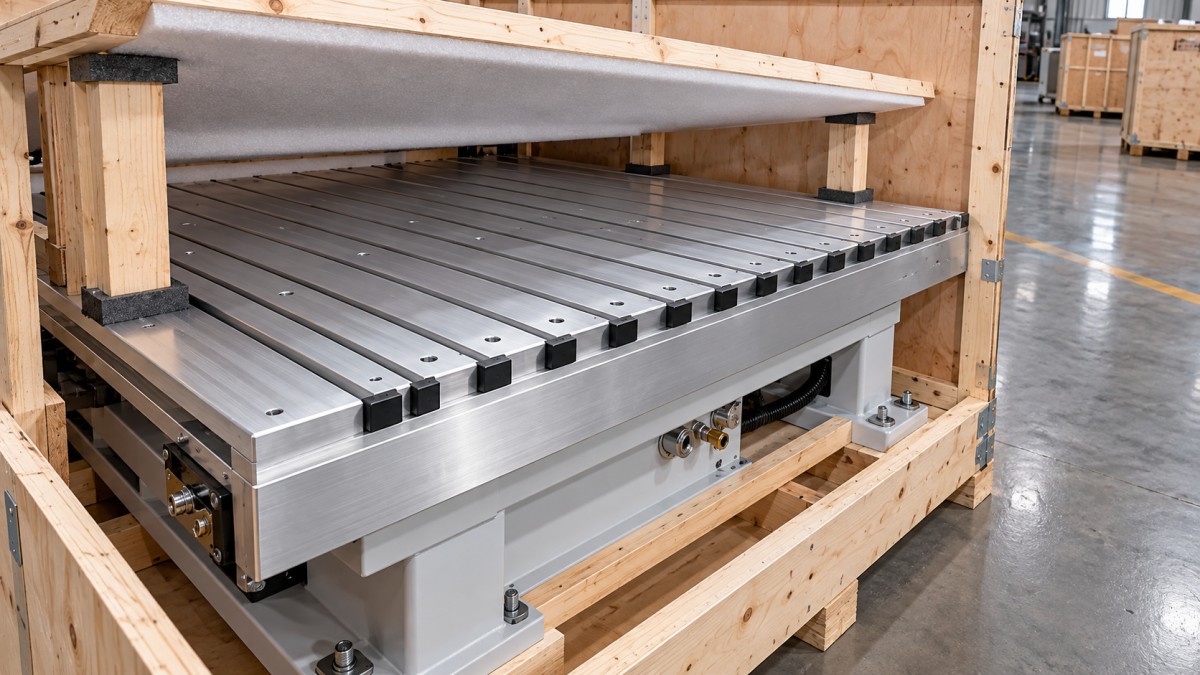
Size the cover to protect exposed edges as well as the central working area. Secure it so vibration cannot make it slide across the deck. Fasteners and brackets must remain outside vacuum channels, sealing surfaces, and machine travel paths. Confirm that the panel cannot sag onto the table under the loads expected during handling.
Keep adhesive tape off machined faces, gasket grooves, and porous spoilboards. Tape residue can interfere with sealing or make cleanup difficult. Fasten wrapping to itself or to designated packing surfaces. Bubble wrap alone offers little resistance to a sharp impact and provides no dependable protection against loads placed above it.
Control moisture inside the package
Moisture protection works only when the enclosed materials are already dry. Sealing a damp spoilboard, wet cleaning cloth, or moisture-laden timber inside a barrier bag traps a source of water beside the table. Temperature changes during transport can then produce condensation within the package.
Choose the moisture barrier for the shipping route, expected storage period, and package size. Place desiccant inside the sealed barrier in secured, breathable holders, away from ports and working surfaces. Its quantity should be calculated for the enclosure and moisture load using the packaging supplier’s method; a few arbitrary sachets do not establish adequate protection.
A humidity indicator positioned for inspection provides evidence about conditions inside the enclosure. Loose desiccant must not be allowed to spill into vacuum grooves. Protect the barrier at corners and fittings so vibration cannot wear holes through it.
Exposed ferrous components may need a compatible corrosion treatment. Keep oils, waxes, and rust preventives away from porous spoilboards and sealing surfaces unless the machine instructions specifically permit them there. Residue that migrates into the workholding area creates additional cleaning and commissioning work. Record any treatment and its removal method with the packing documents.
Close the vacuum circuit and restrain its connections
Open ports admit dust, packing fragments, and moisture. Fit clean, secure caps or plugs suitable for the connection, preferably with visible external retention so they cannot disappear into a passage. A loose rag is unsuitable: fibers remain behind, and the rag can be drawn into the circuit if startup occurs before removal.
Where hoses are disconnected, identify both ends and cap each opening immediately. Photograph the routing and label zone connections clearly. Reversing similar-looking hoses during reassembly can complicate fault finding when one part of the table fails to hold material.
Protect valves, gauges, manifolds, and protruding hose tails from side impacts. A hose hanging from a small fitting repeatedly loads that fitting as the crate vibrates. Support retained hoses without flattening them or forcing bends below their permitted radius. Pack detached hoses so other components cannot crush them.
The vacuum pump requires its own transport preparation. Follow its instructions for orientation, operating fluids, inlet protection, and any transport restraints. These requirements differ between pump designs. Mark all temporary closures and restraints on a removal record that remains accessible when the crate is opened.
Keep transport forces in the machine frame
Anchor the machine through its approved base or frame locations. The vacuum table, gantry, spindle assembly, and projecting pipework are unsuitable substitutes for designated restraint points. Tightening a strap over the table can compress the cover and introduce bending forces even when the surface appears well padded.
Internal crate bracing needs the same separation from the working area. Keep lid battens, diagonal braces, and accessory boxes clear of the table protection. Account for brace deflection and relative movement during handling; a small static gap can disappear when a package is jolted.
Pack tool holders, clamps, spare parts, and detached components in restrained compartments. Heavy accessories placed on the covered table can break free or concentrate their weight during a sudden stop. Secure axes and the gantry using the machine’s specified transport provisions so their movement cannot damage nearby covers or connections.
Before closing the crate, trace each restraint’s load path: from machine frame to mounting hardware, from mounting hardware to base, and from base to the handling structure. No part of that path should rely on the vacuum deck or its protective cover.
Preserve a baseline for unpacking and restart
Record the table condition before the cover goes on. Useful photographs show the clean working face, gasket layout, protected ports, hose labels, cover supports, and completed restraints. Include existing marks so they can be distinguished from transport damage.
Where commissioning facilities permit, record vacuum behavior before shipment using a defined setup: the same zone selection, test panel, uncovered area, and pump configuration intended for the arrival comparison. A gauge reading alone is insufficient. A highly restricted connection can produce substantial vacuum near the pump while providing inadequate airflow at the workpiece.
Place unpacking instructions where they can be reached before the machine is powered. List the cover fasteners, port caps, transport locks, temporary supports, and preservation materials that require removal. Include the hose connection references and the baseline test conditions.
After arrival, allow a cold machine to acclimatize in the installation environment before exposing sensitive surfaces to warm, humid air. Remove packing debris before opening capped connections. Inspect for shifted gaskets, cracked fittings, moisture marks, and evidence that the cover contacted the working face.
If holding performance has deteriorated, reproduce the recorded test conditions before changing pump settings or resurfacing the spoilboard. Poor holding across every zone points toward a shared supply problem, an open connection, or widespread leakage. A problem confined to one zone directs attention to its valve, hose, gasket boundary, or local damage. Complete these checks before machining: resurfacing cannot correct a leaking fitting, and increased vacuum cannot restore a distorted sealing surface.
Send Your Inquiry
We welcome your cooperation and we will develop with you.