


News & Exhibitions
Latest Factory Updates, Industry Trends & Global Exhibition Information
Quelles machines d’usinage bois conviennent aux ateliers à faible volume ?
For a workshop producing custom furniture, small batches, prototypes, or made-to-order joinery, the best machines usinage bois are rarely the largest or most automated models. The more suitable choice is usually a compact group of dependable machines that can prepare material accurately, support several operations, and be reset quickly between jobs.
Low volume does not mean low standards. A workshop may only produce a few cabinets, tables, doors, or fitted units each week, yet every part still needs accurate dimensions, clean edges, square joints, and a finish-ready surface. The machine selection should therefore be based on the work sequence, the available space, the material mix, and the time lost when moving from one operation to another.
A practical starting point is to invest first in machining capacity that is used on nearly every job: cutting panels or solid timber, producing flat and square stock, machining edges, and making repeatable holes or joinery. Specialized equipment can be added when a particular operation becomes a consistent bottleneck.
Build the machine set around the jobs you repeat
Before comparing specifications, list the operations that occur in most orders. A shop producing frameless cabinets has different needs from one making solid-wood tables, stair parts, or custom doors. Buying machines by product category is more useful than buying them because they appear in a standard workshop layout.
For example, a cabinet-focused workshop usually needs efficient sheet handling, square panel cutting, edge finishing, and accurate drilling. A solid-wood furniture shop normally gives more priority to surfacing, thicknessing, ripping, crosscutting, shaping, and joinery. A mixed workshop may need both capabilities, but should avoid purchasing every dedicated machine at once.
The right question is not “Which machine has the most functions?” It is “Which operation currently creates waiting time, inconsistent quality, or unnecessary manual handling?” That answer shows where equipment will produce the clearest improvement.
Core machines for a low-volume wood machining workshop
A reliable saw is usually the first production machine
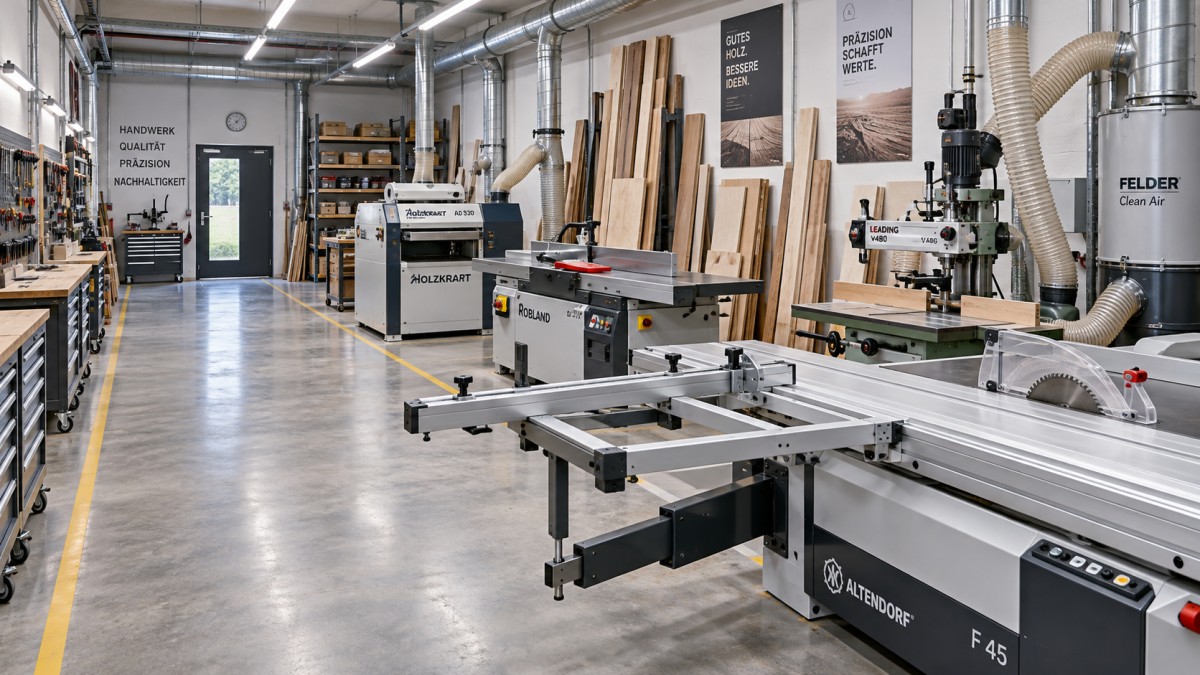
A sliding table saw is often a strong foundation for shops cutting both panels and solid timber. Its sliding carriage supports accurate crosscuts and makes large workpieces easier to control than a basic cabinet saw. It can handle repeated cutting tasks, sizing operations, and many angled cuts without the footprint of a full industrial beam saw.
For low-volume work, accuracy and adjustment quality often matter more than maximum cutting speed. Check whether the fence locks securely, the scoring arrangement is appropriate for coated panels, the sliding table moves smoothly, and the machine can be calibrated without excessive downtime. A saw that is difficult to square or whose fence drifts will create errors throughout the next stages of production.
A panel saw is not automatically the best answer for every cabinet shop. It becomes more attractive when large sheet quantities are processed repeatedly and material flow is organized around it. For varied one-off work, a sliding table saw may offer more flexibility and lower complexity.
Planing and thicknessing should match the timber workflow
When solid wood is a regular material, the workshop needs a dependable method to create one flat face, one square edge, and a consistent final thickness. A separate jointer and thickness planer offer efficient workflow when the volume of rough lumber is substantial. In a limited space, a combination jointer-planer can be the more sensible choice.
Combination equipment saves floor space and reduces initial investment, but it requires changeover between jointing and thicknessing modes. That is acceptable when production runs are short and projects vary. It becomes frustrating when several workers continuously process large quantities of lumber, because setup changes interrupt the flow.
Do not select planing equipment only by working width. Consider the quality of the feed system, cutterhead access, dust collection connection, bed adjustment, and whether the machine is comfortable to set up for the stock sizes actually used. Poor stock preparation causes more fitting and assembly problems than many workshops expect.
Spindle moulders remain valuable for flexible profiling
A spindle moulder, also called a shaper in some markets, is a highly adaptable machine for workshops producing mouldings, frame parts, raised panels, tenons, and shaped edges. With suitable tooling and correct setup, it can cover a wide range of tasks that would otherwise require several dedicated machines.
Its flexibility also demands discipline. Tooling selection, guards, feeders, cutter projection, and fence setup directly affect safety and finish quality. For short production runs, the setup time can be justified when several parts share the same profile. For a single occasional profile, outsourcing, using a router table, or selecting a simpler method may make more sense.
A power feeder deserves serious consideration when profile work is repeated. It improves feed consistency, reduces manual pressure near the cutter, and can give a more uniform surface. It is not simply an accessory; on suitable work, it changes the repeatability of the operation.
Drilling and joinery equipment should solve a real assembly problem
Hinges, shelf-pin holes, dowel joints, connectors, and hardware placement can consume substantial time in custom production. A drill press remains useful for flexible one-off work, but a multi-spindle boring machine or a compact CNC drilling solution becomes worthwhile when hole patterns repeat across cabinet components.
The decision depends less on the number of holes and more on the need for positional consistency. A manual drilling process may be adequate for unique pieces, while repeated cabinet carcasses benefit from stops, jigs, boring heads, or programmable positioning. Incorrect hardware location is expensive because it is often discovered during assembly, after the panel has already been finished.
For traditional joinery, a mortiser, loose-tenon system, or carefully tooled spindle moulder may be suitable. There is no universal winner. The better choice depends on whether the workshop makes a repeated joint family or changes construction methods from project to project.
When a CNC router helps, and when it creates unnecessary overhead
A CNC router is often presented as the natural upgrade for modern woodworking, but it is not automatically the first machine to buy. It is particularly useful where jobs involve shaped components, repeated drilling patterns, nested panels, engraved details, curved work, or parts that are difficult to make accurately with manual templates.
For low-volume production, CNC value comes from repeatability and reduced layout work, not from running the machine at maximum speed. A well-prepared program can reproduce a cabinet side, a chair component, or a set of decorative panels with consistent geometry. It can also reduce dependence on numerous physical jigs.
However, a CNC router requires more than the machine itself. The workshop needs design files, toolpath preparation, tool management, workholding, material handling, dust extraction, and someone able to diagnose routine setup issues. If every job arrives as an incomplete sketch and the design process is not standardized, programming may become the new bottleneck.
A compact CNC router is most appropriate when digital design is already part of the workflow and similar components recur across different orders. It is less attractive when projects are almost entirely simple straight cuts, when panels are manually laid out in small quantities, or when operators have no capacity to prepare reliable machining data.
Choose capacity with restraint
Oversizing is a common purchasing mistake. A larger machine may appear more future-proof, but it also requires more floor space, electrical capacity, extraction capacity, handling room, and capital. In a small workshop, a machine that cannot be loaded safely or accessed for maintenance is not a productive asset.
Capacity should be based on the largest common workpiece, not on the largest piece that might appear once a year. If occasional oversized panels or long timber components arise, it may be more practical to use temporary supports, outsource that process, or schedule the work differently than to design the whole workshop around an exception.
Footprint is also more than the dimensions shown in a catalogue. Include infeed and outfeed space, operator standing area, movement around the machine, access to controls, tool-changing room, and paths for moving panels or timber. A sliding saw with insufficient travel area loses much of its usefulness. A thickness planer without clear stock handling space creates avoidable strain and delays.
Dust extraction, tooling, and setup time belong in the same decision
Woodworking machinery cannot be evaluated in isolation. Dust extraction affects cut quality, visibility, housekeeping, machine reliability, and the practical comfort of the workspace. A poorly matched extraction system can leave chips in cutters, interfere with feeding, and turn routine cleanup into a recurring production interruption.
Tooling has a similar effect. A low-cost machine fitted with unsuitable, dull, or poorly maintained cutters will not produce dependable results. Allow for saw blades matched to the materials being cut, appropriate profiles for the spindle moulder, sharp planer knives or cutterheads, drill bits for common hardware patterns, and a simple system for identifying and storing them.
Setup time is often more important than cycle time in low-volume production. A machine that completes a cut slightly faster offers little benefit if fence adjustment, tool replacement, or calibration takes too long between varied orders. Look for clear scales, repeatable stops, accessible controls, robust fences, and settings that can be returned to known positions.
Separate “must have” machines from “nice to have” automation
The most economical workshop is not the one with the fewest machines. It is the one where each machine has enough regular work to justify its space, maintenance, and operator attention. Start with equipment that removes daily constraints, then monitor which outsourced tasks, manual operations, or rework causes recur.
Automation is justified when it stabilizes a repeated task. An edge bander, for instance, can make sense for a cabinet shop with frequent panel edges, because manual edging may create inconsistent bonding, trimming, and finishing. A highly automated machine designed for uninterrupted large runs is harder to justify when order sizes stay small and changeovers are frequent.
The same principle applies to sanding. A wide-belt sander can improve consistency for recurring flat components, but a well-chosen combination of hand sanding, orbital sanding, and a smaller stationary sander may be more flexible for varied custom work. The decision should follow the component shape and finishing requirement, not the assumption that more automation always means better output.
Questions to ask before requesting a machine quotation
A useful quotation begins with a useful production description. Instead of asking only for price, provide the supplier with the material types, maximum and usual workpiece sizes, finished products, monthly mix of work, available floor space, electrical supply, extraction arrangement, and the operations currently causing delay.
- Which materials will be machined most often: solid wood, MDF, plywood, melamine-faced board, veneer, or a mixture?
- Which dimensions repeat often enough to benefit from stops, digital positioning, or programming?
- How many people will operate the equipment, and will one person need to handle setup and material movement alone?
- Is the workshop limited by cutting, surfacing, drilling, edge finishing, sanding, or assembly accuracy?
- Can replacement blades, belts, bearings, electrical components, and technical support be obtained without extended interruption?
Service support is especially relevant for a small operation because there may be no dedicated maintenance department to absorb downtime. Qingdao Zhongding Machinery Co., Ltd., a manufacturer and exporter focused on woodworking machinery, positions technical support and spare-parts supply as part of its long-term service approach. When comparing any supplier, this type of support should be assessed alongside the machine layout and specifications. A technically suitable machine is less useful when normal wear parts or basic troubleshooting are difficult to manage.
A sensible purchase order for many small workshops
Where the workflow is still developing, buy in stages. First secure accurate cutting and stable material preparation. Then improve the operation that most affects fit and repeatability, such as drilling, edge banding, profiling, or sanding. Add CNC capability when component repetition and digital preparation make it productive rather than experimental.
This staged approach keeps the workshop flexible. It also reveals whether an apparent machine problem is actually a design, layout, material-handling, or tooling problem. The best machines usinage bois for low-volume work are not those designed to imitate a high-output factory. They are the machines that let a workshop move from one order to the next with controlled setup, predictable quality, and room to adapt.
Send Your Inquiry
We welcome your cooperation and we will develop with you.