


News & Exhibitions
Latest Factory Updates, Industry Trends & Global Exhibition Information
Quais máquinas para trabalhar madeira reduzem o retrabalho no corte?
Clean, repeatable cutting begins with a machine that holds the work securely, guides it accurately, and leaves an edge that needs little correction before the next operation. For sheet goods, solid wood, veneered panels, and laminated boards, the best choice is rarely a single “most powerful” saw. Rework falls when the cutting method matches the material, the part size, the required tolerance, and the downstream process.
Among maquinas para trabalhar madeira, panel saws, sliding table saws, beam saws, precision crosscut saws, and CNC nesting routers each reduce rework in different ways. A machine that produces excellent cabinet-side panels may be inefficient for short hardwood rails; a saw suited to rough cutting thick lumber may create too much tear-out for finished veneer. Selecting the right cutting equipment means locating the source of the current correction work: inaccurate dimensions, chipped edges, out-of-square parts, poor repeatability, or parts that are difficult to register during assembly.
Start with the defect, not the machine name
“Cutting rework” often looks like one problem but has several distinct causes. A panel that is oversized at one end may point to fence misalignment, table contamination, or poor pressure control. A panel that is the right size but chips along the cut line usually involves blade selection, scoring, feed direction, or unsupported material. A part that measures correctly yet fails during assembly may have a square-related issue rather than a length-related issue.
Before changing equipment, separate the defect by observing where and when it appears:
- Repeated dimensional drift across a batch usually comes from an inaccurate stop, fence movement, calibration error, or an unstable reference edge.
- Different dimensions on nominally identical parts often indicate inconsistent positioning, material movement during the cut, or a cutting sequence that changes the reference face.
- Chipping on melamine, veneer, or laminate is frequently a blade-and-support issue, although incorrect scoring alignment can produce the same appearance on panel saws.
- Burn marks and a rough sidewall in hardwood can result from a dull or unsuitable blade, insufficient tooth clearance, blade runout, or feed pressure that forces stock against the blade.
- Parts that are square on the machine but not at assembly may have bowed stock, inconsistent edge references, or an incorrect sequence between ripping, crosscutting, and machining.
This distinction matters because replacing a basic saw with a more automated model will not correct a damaged blade flange, an unclean sliding surface, or warped material introduced as a supposedly straight reference. The machine choice should remove the actual variation source.
Panel saws for accurate sheet processing
For cabinet components, furniture panels, shelving, doors, and similar rectangular parts, a panel saw is often the most direct route to lower rework. Its advantage is controlled support across a large sheet and a repeatable cutting reference. The work remains stable while the saw carriage and guide system establish the cut, reducing the tendency for large boards to twist, sag, or wander as they move.
A horizontal beam saw is particularly effective where many identical rectangular pieces must be produced from particleboard, MDF, plywood, melamine-faced board, or laminated panels. The pressure beam holds the stack during the cutting cycle, while programmed dimensions reduce repeated manual measuring. This is useful only when the incoming boards are consistent enough to stack and when the cut plan does not require frequent handling of individual pieces. Thin decorative laminates and high-gloss surfaces still require correct blade condition and scoring setup; automation does not make an unsuitable tooth geometry acceptable.
A vertical panel saw may suit limited floor space or intermittent panel cutting. It can substantially improve control compared with freehand handling on a conventional table saw, especially for large sheets. Its limitations become important when tight batch tolerances, complex cut lists, or high volumes are involved. The support grid, measurement system, and workholding condition should be assessed carefully because accumulated small errors become visible in cabinet assembly.
For panel work, the scoring unit deserves as much attention as the main blade. On coated board, the scorer makes a shallow pre-cut on the exit face so the main blade does not lift the decorative surface. The scoring kerf must align with the main blade kerf. If it is too narrow, chips can remain on one edge; if it is too wide, the score may be visible beyond the main cut. A change in main-blade thickness, kerf, or mounting position can require a corresponding scorer adjustment.
Why a sliding table saw remains valuable for mixed work
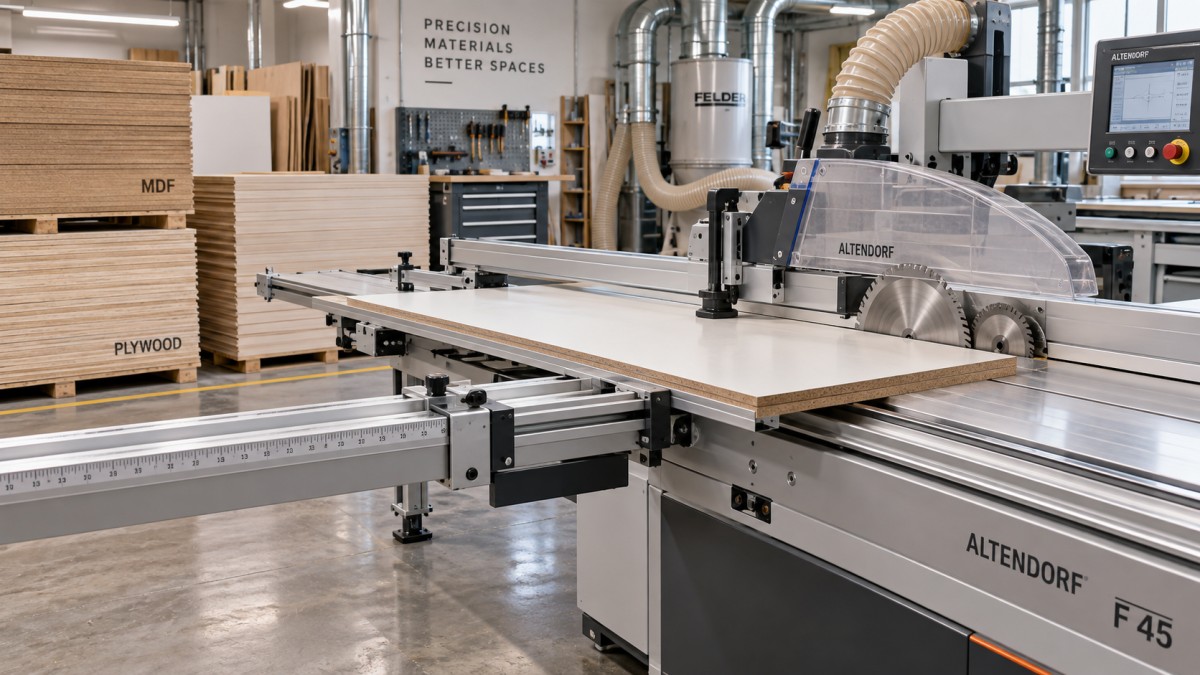
A sliding table saw reduces rework when production includes a changing mix of panels, solid wood components, angled cuts, and short series. Its sliding carriage supports the workpiece through the cut rather than asking the material to move solely along a fixed tabletop. That support is especially useful for wide plywood sheets, long cabinet components, and parts that must remain square to a crosscut fence.
The machine performs well only when the carriage, crosscut fence, and rip fence agree with each other. A crosscut fence set precisely at 90 degrees does not compensate for a carriage that has play or a rip fence that is not parallel to the blade. Before diagnosing a cutting defect as a machine limitation, verify the result with a test board: crosscut a piece, rotate one half against the other, and inspect the joint line. A widening gap reveals a squareness error more clearly than relying on a single tape measurement.
Sliding table saws are often misused as rough-sizing machines for every part. That approach can increase correction work if the first cut is made from a damaged factory edge or a bowed edge. Establish one straight reference edge first, then use it consistently for subsequent cuts. For a narrow solid-wood component, the order is usually straighten one face or edge as required, rip to width with a stable reference, and crosscut to final length from an established square end. Reversing those references can produce parts that appear correct individually but vary when laid together.
Beam saws reduce handling variation, not every type of waste
When the dominant problem is inconsistent panel dimensions across repeated cabinet parts, a beam saw can reduce manual positioning errors. A cut list controls the sequence, clamps stabilize the sheet or stack, and the saw travels on a defined path. The result is especially useful for square or rectangular components that move directly into edge banding, drilling, dowel insertion, or assembly.
Yet beam saw output should be judged beyond nominal length and width. Edge quality matters if the component will receive thin edge banding, exposed finishing, or close-tolerance joining. A chip that seems minor can become visible after edge banding because adhesive and trimming reveal the damaged substrate. Likewise, a narrow strip cut from a large panel can flex after release. The finished piece should be measured after it has settled flat, rather than assuming the clamped condition represents its final shape.
Beam saws are less suitable where the part shapes are irregular, where grain direction must be individually selected, or where a job includes many angled components. Attempting to force non-rectangular work through a rectangular cutting process creates extra handling and secondary trimming. In that situation, a sliding table saw or CNC nesting process may produce fewer total corrections even if the first cut takes longer.
Precision crosscut equipment for length consistency
For rails, stiles, framing members, flooring components, and repeated solid-wood blanks, a dedicated precision crosscut saw can remove a common source of rework: inconsistent finished length. A robust stop system, rigid material support, and a blade designed for cross-grain cutting produce more consistent end faces than manually marked cuts. Pneumatic or automatic feeding may improve repeatability for batches, but the stop must remain free of sawdust and offcuts. A small chip trapped against a stop changes every subsequent part.
Long-stock support is not a convenience item. If material drops or twists at the end of the cut, the blade can deflect slightly, the end may splinter, and the part may appear shorter or longer because it was not seated fully against the stop. Infeed and outfeed tables should support the stock at the same practical height as the machine table. Rollers are helpful for long pieces, but they must not pull stock sideways or allow it to roll away from the fence.
For finished joinery parts, leave an intentional trimming allowance only when a later precision operation actually exists. Adding extra length “just in case” creates a hidden rework loop if every part then needs a second crosscut. When the machine, stop system, material reference, and blade are stable, cutting directly to final length is often the cleaner workflow. When rough lumber contains end checks, twist, or unstable moisture-related movement, a trim allowance remains sensible because the reference must be restored after conditioning or straightening.
CNC nesting routers solve different cutting problems
A CNC nesting router is not a replacement for every saw, but it reduces rework where sheet parts contain curves, internal openings, drilling patterns, pockets, and irregular outlines. Cutting the outside shape and machining locating features in one programmed setup prevents errors that arise when a rectangular blank is transferred between a saw, drill press, template, and router table.
The main source of rework on nested parts is often poor hold-down rather than programming. Vacuum performance changes with sheet porosity, spoilboard condition, gasket layout, small-part size, and the number of open zones. A small component may shift near the end of a contour cut even when the larger panel remains stable. Tabs, onion-skin strategies, bridges, nested sequencing, or supplemental mechanical restraint may be needed, but each method leaves its own cleanup requirement. The best approach is the one that keeps the part stable without leaving a damaged edge that must be sanded heavily.
Tool selection also changes the finished result. Compression cutters are commonly chosen for laminated panels because the opposing flute directions help protect both faces. Their effective cutting zone depends on material thickness and tool engagement. If the compression region is not positioned correctly, one face can still chip. For raw MDF, plywood cores, or solid wood, a different upcut, downcut, or straight-flute geometry may be more appropriate. The desired edge quality, dust extraction, hold-down force, and cutting direction must be considered together.
Blade condition and setup often matter more than rated capacity
Higher motor power helps with thick or dense material, but it does not automatically produce a better cut. Rework frequently begins when a blade is selected by diameter alone. Tooth count, tooth shape, hook angle, kerf, plate stiffness, and sharpening condition influence edge quality and feed behavior. A blade intended for fast ripping may leave a poor cross-grain finish. A fine-cut blade may overheat during heavy ripping if feed and chip clearance are unsuitable.
Material composition changes the decision. MDF creates fine dust and can dull edges differently from solid timber. Particleboard requires clean cutting support because its core fractures easily near a coated face. Plywood may alternate between dense veneer layers and softer core material, making tear-out sensitive to grain direction and blade sharpness. Solid wood brings grain reversal, knots, resin, internal stress, and moisture variation. A setup that produces a clean edge on one material may need adjustment when the board type changes.
Build a cutting sequence that protects references
Even accurate machines create rework when reference surfaces are lost between operations. Mark the face and edge that establish the part orientation, especially where grain appearance, veneer direction, or handed drilling patterns matter. Cut lists should identify finished dimensions, edge treatment, and any face that must remain visible. A panel flipped during cutting may still meet its size requirement while becoming unusable for matched grain or edge-banding orientation.
For cabinet panels, a common stable sequence is to break down oversized sheets, establish accurate rectangular dimensions, then complete edge processing and drilling from known references. For solid wood, flattening and jointing steps must precede final sizing when stock is distorted. Do not use a jointer or planer result as a permanent guarantee of stability; internal stresses can release after material removal. Allow a visibly stressed blank to settle before its final precision cut when the workpiece permits it.
Offcut control also affects accuracy. A trapped offcut can strike the blade, damage an edge, or interfere with the next cut. Arrange supports so the offcut is free to separate without pinching the blade, while the retained part remains supported against the intended reference. This is especially important with long narrow strips and large sheet sections.
Maintenance that prevents recurring corrections
Cutting quality should be checked before a defect becomes a batch problem. Dust buildup under a sliding carriage, resin on a blade, wear in a fence lock, or a damaged throat plate can introduce gradual variation that is easy to miss during a single cut. A short verification routine at the start of a material change or after blade replacement is more useful than waiting for assembly failures.
Keep reference surfaces clean, inspect blade flanges for damage, and ensure the blade is seated correctly before tightening. Confirm that guards, splitters, and hold-down devices are adjusted without interfering with stock movement. Replace or sharpen cutting tools according to their actual edge condition rather than waiting for obvious burning or severe chipping. Once those fundamentals are controlled, the choice among panel saws, sliding table saws, beam saws, crosscut saws, and CNC routers becomes clearer: select the machine that stabilizes the specific part and preserves the references needed by the next operation.
Send Your Inquiry
We welcome your cooperation and we will develop with you.