


News & Exhibitions
Latest Factory Updates, Industry Trends & Global Exhibition Information
Plywood Production Equipment: Sizing a Hot Press for Your Target Output
Plywood Production Equipment: Sizing a Hot Press for Your Target Output
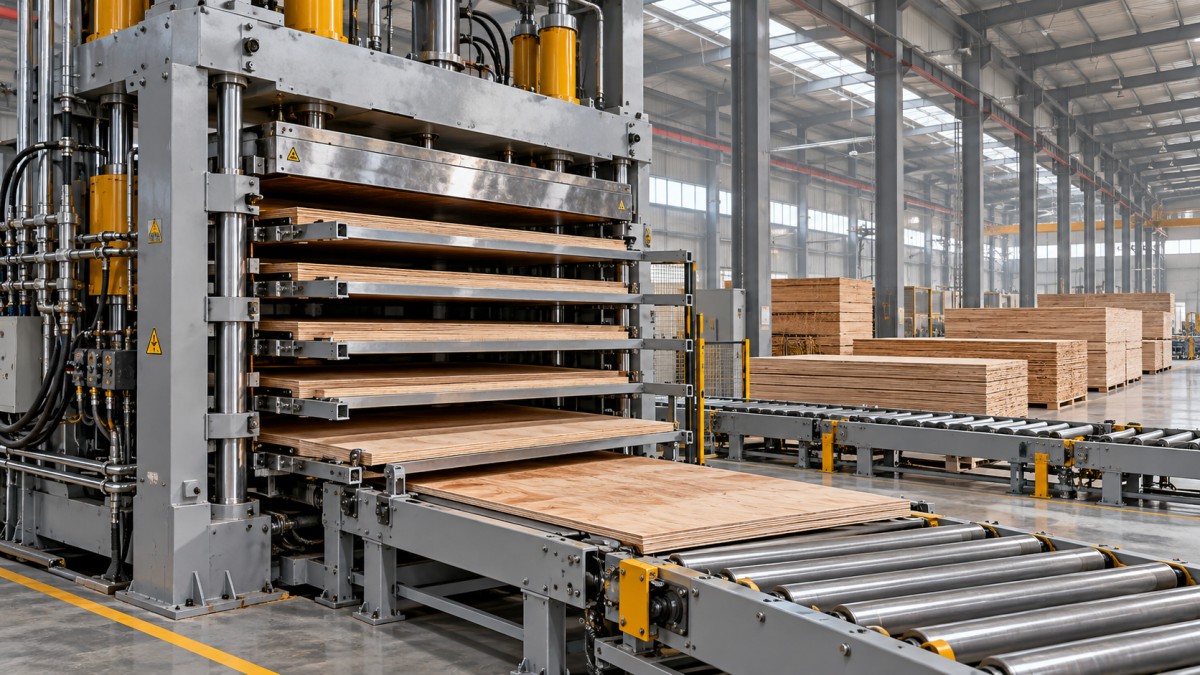
A plywood hot press sized only by platen dimensions can leave your production line short of capacity—or burden it with unnecessary energy and capital costs. For technical evaluators comparing woodworking equipment for plywood, the real task is matching target output to usable press openings, loading efficiency, and a validated pressing cycle for the panel thickness and adhesive system. This guide explains how to translate production targets into practical hot press specifications, check pressure and heating requirements, and identify upstream or downstream bottlenecks before committing to equipment.
Start with saleable output, not the machine’s nominal capacity
“Cubic meters per shift” is not a complete specification. The same volume can require very different numbers of press cycles depending on panel thickness, finished dimensions, product mix, and rejection rates. A press producing thick panels may deliver more cubic meters per cycle, but those panels can also require longer heating and curing times.
Define whether your target refers to gross pressed volume or saleable finished plywood. Trimming, sanding, and rejected panels separate the two. If you calculate output using finished dimensions, account for dimensional losses separately when specifying the rough layup and platen area; do not deduct them twice.
For a mixed production schedule, list each panel family with its required quantity and validated cycle. Calculate the press time each family consumes, then add changeovers. An average panel thickness can conceal a capacity shortage on the product that matters most.
Convert the production target into usable openings
For a batch multi-opening hot press, a useful starting relationship is:
Saleable volume per shift = usable openings × panels per opening × cycles per shift × finished panel volume × saleable yield.
Use one panel per opening unless a different arrangement has been validated. Stacking several layups in one opening changes heat transfer and cannot be treated as free additional capacity. Likewise, an opening that cannot be loaded reliably with your thickest layup is not usable capacity.
Consider an illustrative calculation—not a machine performance claim. A factory needs 80 m³ of saleable plywood per shift, with the following planning assumptions:
- Finished panel size: 1.22 × 2.44 × 0.018 m.
- Net production time after excluded stoppages: 420 minutes.
- Complete press cycle: 8 minutes, including loading and unloading.
- Saleable yield by panel count: 95%.
- One panel per usable opening.
Each finished panel represents approximately 0.05358 m³. The target therefore requires about 1,572 gross panels after allowing for yield. Dividing by 52.5 theoretical cycles gives approximately 30 usable openings. Because a shift cannot finish half a cycle, check the schedule in whole batches: 30 openings over 52 cycles would produce approximately 79.4 m³ at the assumed yield, slightly below target.
That makes 30 openings marginal rather than comfortably sufficient. More openings, a longer operating window, or a shorter validated cycle could close the gap. Do not shorten the assumed cycle simply to make a quotation meet the target.
Keep downtime accounting consistent. If availability losses are already removed from the 420 minutes, applying another general availability factor would double-count them. Conversely, leaving cleaning, changeovers, and routine interruptions out of both the cycle and available time will overstate capacity.
Make the complete cycle visible
A quoted “pressing time” may describe only the period at pressure. Your production calculation needs the interval between equivalent points in successive batches: loading, closing, pressure build-up, curing, controlled pressure release, opening, and unloading. Some operations overlap on automated systems; others do not.
Ask for a timing diagram showing which activities occur inside the critical cycle. An automatic loader may prepare the next batch while the press is closed, but that advantage depends on upstream layup capacity and a clear discharge path.
The curing portion must come from trials or an approved process recipe for the actual veneer species, moisture range, panel construction, adhesive formulation, and thickness. Platen temperature alone does not establish when the innermost glue line has reached suitable curing conditions.
Treat a universal “minutes per millimeter” claim cautiously. It may be useful within a proven product family, but it should not be transferred unquestioned between adhesive systems or panel constructions. Excessively aggressive decompression can also cause defects; pressure-release time is not automatically removable waste.
Check force against loaded area—not the opening count
Required press force follows the specified panel pressure and projected loaded area:
Force = panel pressure × loaded area.
For illustration, applying 1 MPa over a single 1.22 × 2.44 m footprint requires approximately 2.98 MN, or 304 metric tonnes-force. This is an arithmetic example, not a recommended plywood pressing pressure. The process pressure must be established for the actual construction and adhesive.
In a conventional vertically stacked multi-opening press, do not multiply that force by the number of openings. The force passes through the stack. Panels positioned side by side within an opening, however, increase the total projected loaded area and therefore the force requirement.
Hydraulic circuit pressure is not panel pressure. Cylinder area, cylinder arrangement, and machine design determine how one translates into the other. Request the calculation, including the loaded-area assumptions, rather than comparing machines solely by a hydraulic pressure figure.
Also check allowable loading patterns. A large platen used for smaller or offset panels can experience uneven loading. Platen stiffness, parallelism under load, and the manufacturer’s restrictions on partial loading matter as much as nominal tonnage.
Heating capacity and opening clearance can limit the design
More openings increase batch capacity, but they also increase the thermal system’s workload. A heating system that reaches its setpoint when empty may recover too slowly after repeated loads of cooler veneer. Ask for temperature uniformity and recovery behavior under representative production conditions, not only an unloaded maximum temperature.
Compare steam, thermal-oil, or other heating arrangements against the utilities actually available at the site. Confirm operating conditions, circulation requirements, controls, insulation, and heat-source capacity. Installed electrical power alone will not describe total energy demand when heat comes from an external source.
Opening clearance must accommodate the uncompressed layup, any cauls or carriers, and the handling system—not merely the finished panel thickness. Increasing clearance unnecessarily can increase travel and affect loading geometry. The specification should identify both maximum layup thickness and the handling allowance.
Platen dimensions need similar care. Allow for the rough panel footprint and required positioning tolerances, while confirming the effective heated and load-bearing area with the supplier. The largest quoted platen is not necessarily the most economical fit.
Follow the panel beyond the press
A correctly sized press still misses its target if veneer drying, glue spreading, layup, or pre-pressing cannot supply complete batches on time. Check adhesive assembly-time limits alongside buffer capacity: a large queue of glued layups is not always a safe solution to irregular feeding.
Downstream, cooling, trimming, sanding, stacking, and inspection must absorb the press’s batch discharge. Average hourly capacity can hide congestion when many panels arrive together. Map the batch movement and available floor space, including access for maintenance and rejected material.
Where plywood continues into cabinet or furniture production, edge finishing becomes a separate capacity calculation. For example, the Straight Automatic Edge Banding Machine ZD450C combines automatic feeding, gluing, trimming, and polishing, with a specified feeding speed of 12–23 m/min and working thickness of 10–60 mm. Those figures describe downstream processing, not plywood pressing capacity. Actual throughput still depends on part lengths, spacing, edge passes, and compatibility trials for the intended panel and edging material.
This distinction prevents a common planning error: comparing cubic meters per shift at the press with linear meters per minute at a finishing machine without converting both into the same production schedule.
Turn the quotation into a testable specification
When comparing woodworking equipment for plywood, require every supplier to use the same panel recipe, utility conditions, cycle boundaries, and output definition. Otherwise, apparently similar capacity claims may describe different operating assumptions.
The technical agreement should define representative trial material, the sustained test duration, cycle measurement, temperature checks, and agreed bond-quality acceptance methods. Include the thickest or slowest-curing product in the evaluation rather than testing only the easiest panel. Applicable product standards and local machinery requirements need project-specific confirmation.
Qingdao Zhongding Machinery Co., Ltd., a woodworking machinery manufacturer and exporter with more than 20 years of industry experience, also provides technical support, spare parts, and after-sales service. For a hot-press project, make those support provisions concrete: clarify commissioning responsibilities, operator training, critical spares, troubleshooting documentation, and the service response process before approval.
The final selection should meet the required output using a demonstrated recipe and realistic handling times, with an explicitly agreed operating reserve. If it reaches the target only by ignoring changeovers, assuming perfect yield, or counting curing time as the entire cycle, the press is not yet properly sized.
Send Your Inquiry
We welcome your cooperation and we will develop with you.