


News & Exhibitions
Latest Factory Updates, Industry Trends & Global Exhibition Information
Woodworking Machinery Commissioning: A Site Acceptance Checklist
A successful production launch depends on more than installing equipment. Woodworking machinery commissioning must establish that the machine is safe to operate, performs its agreed tasks under representative conditions, and can be supported after the supplier’s team leaves. A machine that runs without an alarm is not necessarily ready for production.
Site acceptance should therefore be based on recorded results against agreed criteria—not on a demonstration alone. The most useful checklist connects each test to a requirement, identifies who will witness it, and specifies what happens if the result is outside tolerance.
Set the acceptance boundary before testing starts
Site acceptance testing (SAT) verifies the installed equipment in its intended environment. It is distinct from a factory acceptance test (FAT), which checks equipment before shipment. FAT results are valuable reference points, but they do not prove that transport, installation, site utilities, extraction, or integration with neighboring equipment are correct.
Before scheduling the test, assemble a controlled set of documents: the purchase contract, technical specification, approved layout, machine manual, electrical and pneumatic connection requirements, risk assessment, FAT records where available, and any agreed changes. Check that the documents describe the equipment actually delivered, including optional devices and control software.
The acceptance protocol should identify:
- Scope: Individual machines, conveyors, extraction connections, software interfaces, and other equipment included in the test.
- Responsibilities: Who supplies utilities, timber or panels, tooling, adhesives, measuring instruments, operators, and test supervision.
- Criteria: Required quality, capacity, safety functions, operating conditions, and the method for measuring each result.
- Test sequence: Prerequisites, individual machine checks, integrated operation, and any required production run.
- Decision rules: Which defects prevent operation or acceptance, which can remain open, and who has authority to approve exceptions.
A statement such as “machine runs correctly” is too broad to settle a dispute. For a panel-processing line, the protocol should instead identify the material, dimensions, target output, inspection method, sample size, and permitted deviation. If a capacity figure depends on automatic loading, full extraction flow, or a particular board size, those conditions belong in the test record.
Confirm the site is ready for energization
Commissioning time is easily lost when the machine is mechanically installed but its supporting systems are incomplete. Record readiness before the supplier’s commissioning personnel begin powered testing.
- Location and mechanical installation: Check the layout, access routes, foundations, anchoring, leveling, transport restraints, and clearance for material handling and maintenance against the approved installation documents.
- Electrical supply: Confirm voltage, frequency, protective devices, earthing, cable connections, and available supply capacity against the machine documentation. Electrical work and verification should be performed by authorized, qualified personnel.
- Compressed air and hydraulics: Verify the required supply conditions, connections, fluid levels, and leak-free installation. Do not assume a hydraulic operating-pressure figure is also the required plant air-supply pressure.
- Dust and chip extraction: Check duct connections, direction of airflow, isolation devices where specified, and the extraction system’s readiness with the machine operating. An installed duct alone does not establish adequate capture.
- Material flow: Confirm infeed and outfeed heights, conveyor interfaces, storage space, and safe access for removing jams and finished workpieces.
- Environmental conditions: Check temperature, humidity, lighting, and floor condition against the equipment and process requirements. Material condition should also be suitable for the planned test.
Any temporary arrangement used during commissioning should be clearly identified. For example, a temporary extraction connection may permit a limited check, but its result cannot establish performance under the permanent production configuration. Define what must be repeated after the permanent system is installed.
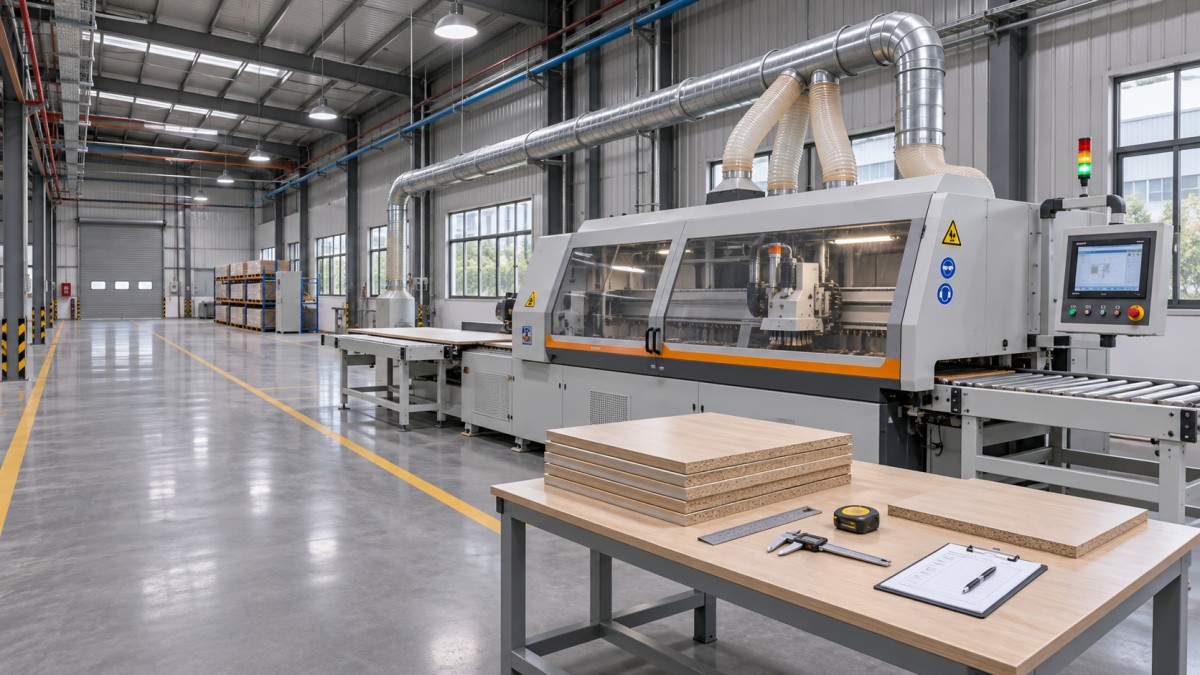
Test safety functions before production trials
Safety checks should be completed under the applicable local requirements, the machine documentation, and the project’s approved risk assessment. The checklist should identify each relevant function and its expected response; a single tick beside “safety OK” is not sufficient.
- Inspect fixed and movable guards for correct installation, secure fastening, and access to hazardous moving parts.
- Test each emergency-stop device and confirm the response of affected equipment, including connected conveyors where the design requires it.
- Verify guard interlocks and any associated restart conditions using the approved test procedure. Never defeat an interlock to make a production test pass.
- Confirm that normal stop, isolation, and prevention of unexpected restart operate as specified. Identify electrical, pneumatic, hydraulic, and stored-energy isolation points.
- Check warning labels, control identification, operating instructions, and visibility of the work area.
- Verify that safe procedures exist for changing blades or cutters, clearing jams, cleaning, and carrying out maintenance.
Tests should establish not only that a safety device responds, but also what stops, whether hazardous motion or stored pressure remains, and what deliberate actions are needed to restart. Where machinery is integrated into a line, include interface tests: an emergency stop on one section may need to affect upstream or downstream equipment according to the documented safety design.
Record the device tested, test method, observed response, and result. If a required safety function fails, stop the affected test and correct the defect before proceeding. Acceptance of a production output target does not compensate for an unresolved safety failure.
Prove operation with representative workpieces
Dry running can reveal abnormal movement, control faults, and interface problems without consuming production material. It should cover start-up, normal stopping, direction of rotation where applicable, travel limits, speed changes, positioning, and communication between connected machines. Check for unusual vibration, noise, leaks, and overheating according to the manufacturer’s instructions.
Move to loaded tests only after the relevant safety and installation checks are complete. Use workpieces that reflect the agreed application, rather than selecting only the easiest material to process. Depending on the machine, record species or board type, dimensions, moisture condition where relevant, tooling, feed speed, adhesive type and application conditions, and operating settings. These details make a failed test diagnosable and a successful test repeatable.
Quality checks should match the process
A saw, edge bander, sander, and panel press do not produce the same acceptance evidence. Choose measurements that relate to the finished operation:
- Cutting and sizing: Measure dimensions, squareness, and edge condition using the agreed method and sampling plan.
- Machining: Check feature position, depth, fit, and surface condition against the approved drawing or sample.
- Sanding: Assess surface consistency and workpiece dimensions with the specified abrasive sequence and material.
- Gluing and pressing: Check panel dimensions, alignment, surface flatness, joint appearance, and any bond evaluation specified for the process. Allow the adhesive the required conditions and time before judging bond performance.
Agree the instruments and reference points before collecting results. Panel flatness, for example, depends on where and how it is measured and on the condition of the timber. An unqualified visual judgment is difficult to use as a contractual acceptance criterion.
For a hydraulic panel-composing application, the Clamp Carrier Hydraulic Composer illustrates why machine capability and test conditions must be separated. The supplied specification lists a maximum processing length of 2,500 mm, maximum width of 1,250 mm, and thickness range of 10–90 mm. The MJ2500-6, MJ2500-8, and MJ2500-20 configurations have different section quantities. The acceptance record should identify the ordered configuration and the panel size actually tested; a successful run at one size does not establish performance across the entire stated range.
For such a test, document strip preparation, adhesive, clamping settings, press time, and the inspection timing. Check the delivered panel against the agreed criteria rather than treating clamp pressure alone as proof of bond quality. Confirm the applicable settings and pressure units against the machine documentation before testing.
Measure throughput at the agreed boundary
Capacity claims need a defined start and end point. Specify whether the clock includes loading, positioning, machining, unloading, handling between machines, and planned checks. Record the number of conforming pieces produced as well as rejects, interruptions, and their causes.
A short demonstration may confirm that a cycle works, but it gives limited evidence about sustained operation. The agreed production run should be long enough to exercise normal loading, unloading, and recurring machine cycles. If the contract requires a longer reliability or availability test, define its duration, downtime classification, and treatment of operator or utility interruptions before it begins.
Do not attribute every shortfall to the machine without examining the boundary. Restricted extraction, inconsistent workpiece dimensions, an incomplete upstream conveyor, or insufficient staffing can affect output. Equally, a line should not be accepted against an individual machine’s cycle time if the contractual requirement concerns finished output from the integrated line.
Turn observations into a controlled punch list
Not every open item has the same consequence. A missing nonessential label, an inaccurate position sensor, and a failed guard interlock should not be managed as equivalent defects. The acceptance protocol should define categories and approval authority in advance, including which issues block energization, production, or final acceptance.
Each punch-list entry should include the equipment identifier, description, location, supporting evidence, operational or safety impact, responsible party, corrective action, target date, and required retest. Keep the original finding visible when an item is closed, and attach the retest result rather than simply changing its status.
Where a nonblocking item remains open, record any operating restriction and who accepts it. A temporary workaround should have an owner and an expiry or review date. If the contractual position is unclear, do not let an informal “conditional acceptance” erase the distinction between equipment made available for limited use and final acceptance under the agreement.
Close the handover with evidence, not just signatures
The handover package should allow the site team to operate, maintain, isolate, and troubleshoot the installed configuration. Check the completeness and version of:
- Operating, maintenance, and safety instructions in the language required by the project and applicable rules.
- Electrical drawings, pneumatic and hydraulic schematics, equipment lists, and relevant software or parameter backups as contractually agreed.
- Inspection and test records, including completed checklists, measured results, deviations, and retest evidence.
- Lubrication requirements, maintenance schedules, recommended spare parts, and identification of wear components.
- Training records covering normal operation, isolation, routine maintenance, fault response, and escalation arrangements.
- The final punch list, assigned responsibilities, warranty terms, and the agreed date or event that starts the warranty period.
Confirm that training has been performed on the delivered equipment and that the designated personnel can locate the instructions and isolation points. Attendance alone does not demonstrate that an operator can recover safely from a stopped cycle or that maintenance personnel can identify a replacement component.
The final acceptance record should state precisely what was tested, what passed, what remains open, and which documents form the handover package. If a test was deferred because a permanent utility or upstream machine was unavailable, list it as an outstanding test with an owner and completion condition. This preserves a clear path to final acceptance without presenting an incomplete production system as fully proven.
Send Your Inquiry
We welcome your cooperation and we will develop with you.