


News & Exhibitions
Latest Factory Updates, Industry Trends & Global Exhibition Information
Essential Woodworking Machines for a Joinery Workshop
Choosing the right woodworking machines is essential for a productive joinery workshop, whether you are setting up a small shop or upgrading existing equipment. From table saws and planers to spindle moulders and CNC machines, each tool plays a different role in producing accurate, consistent joinery. If you are researching machines pour les métiers de la menuiserie, this guide explains the equipment you are likely to encounter, what it does, and how to decide which machines deserve space in your workshop.
A useful starting point is to follow the material rather than the machinery catalogue. A rough board may need to be flattened, thicknessed, cut and shaped before it becomes a door frame. A sheet of plywood might instead move from panel cutting to edge banding and drilling. Understanding those journeys makes it easier to distinguish essential equipment from machines that can wait.
Start with the work you intend to make
Joinery workshops vary considerably. A business making solid-wood doors and stair components has different needs from a cabinet shop working mostly with MDF and laminated panels. Many workshops handle both, but the balance between these materials should guide their first equipment decisions.
- Solid-wood joinery: Prioritise machines for flattening and thicknessing timber, accurate crosscutting, profiling and joint making.
- Cabinet and fitted furniture: Focus on precise panel sizing, clean edges, drilling and efficient handling of sheet materials.
- Mixed or custom work: Look for flexible machines with manageable setup times, because jobs may change from one day to the next.
Production volume matters as much as material. A small workshop producing one-off pieces may value versatility and a compact footprint, while a shop cutting the same cabinet components throughout the day may benefit more from dedicated or automated equipment.
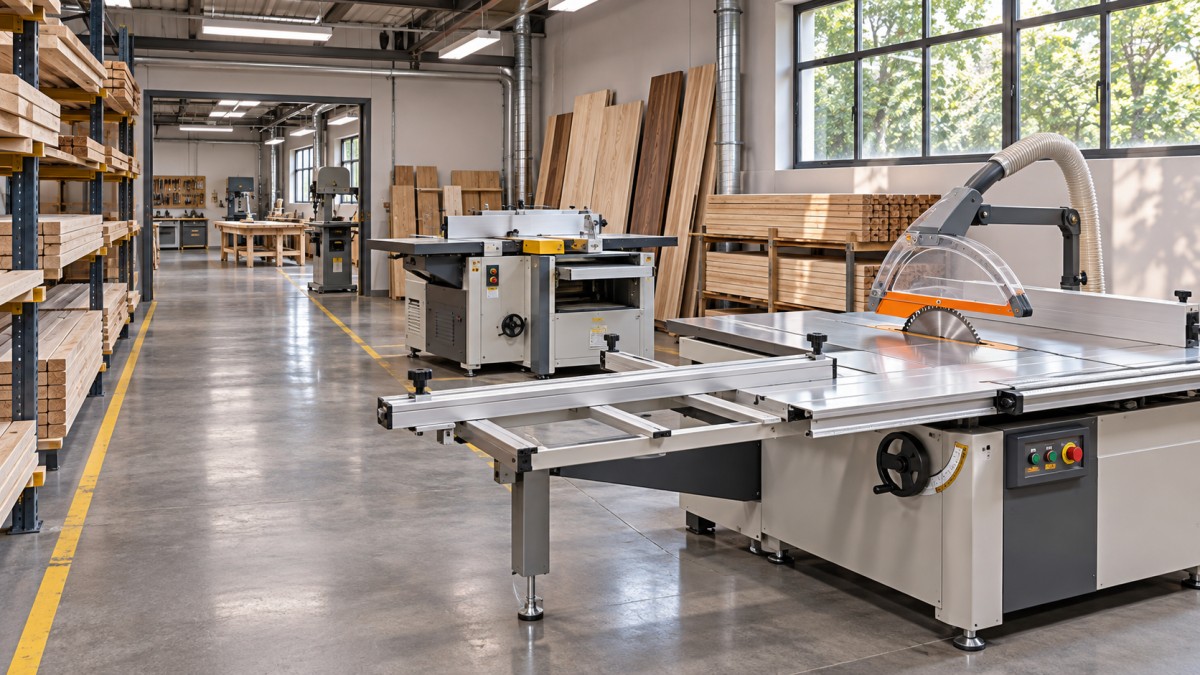
The core machines for preparing and cutting timber
Table saw or sliding table saw
The table saw is a familiar centrepiece of a joinery workshop. It is used for ripping boards along the grain, crosscutting components and sizing panels. A sliding table saw adds support and controlled movement for larger pieces, making it useful when cutting sheet goods or long, awkward workpieces.
When comparing models, look beyond the maximum blade diameter. Table support, fence adjustment, cutting capacity and available space around the machine all affect daily work. For laminated panels, a scoring blade may help reduce chipping on the underside when properly set up.
A table saw is versatile, but it is not automatically the fastest way to process large batches of full-size sheets. Repeated measuring and handling can become demanding as cabinet production grows.
Surface planer and thickness planer
Rough timber rarely arrives perfectly flat or uniform. A surface planer, also called a jointer, establishes a flat face and a straight reference edge. The thickness planer then brings the opposite face parallel to the reference face and reduces the board to the required thickness.
These are complementary jobs, not interchangeable ones. Sending a twisted board straight through a thickness planer does not reliably remove the twist; the board needs an appropriate reference surface first. Some workshops use separate machines, while others choose a combined planer-thicknesser to save floor space. A combined unit can be practical in a small shop, although changing between functions may interrupt the workflow.
Check the working width against the timber you commonly buy, and consider how long boards will be supported on the infeed and outfeed sides. Cutterhead maintenance and the availability of replacement knives or inserts also deserve attention.
Band saw and crosscut saw
A band saw is useful for curved cuts, resawing and preparing irregularly shaped stock. Its relatively narrow blade can follow shapes that would be difficult to produce on a table saw. It is also valuable when breaking down thick timber before further machining, although the finished surface will often need additional work.
For cutting material to length, a mitre saw or dedicated crosscut saw offers a straightforward solution. Accurate stops are particularly helpful when several rails or frame members must match. The best choice depends on the size of the workpieces and whether cuts are occasional or repeated throughout the day.
Machines that turn prepared stock into joinery
Spindle moulder or router table
Once timber is flat and cut to size, a spindle moulder can create profiles, rebates and other shaped edges. It is common in workshops making doors, frames and mouldings. A router table can handle many lighter profiling tasks and may suit smaller components or a workshop with limited space.
The distinction is not simply one of size. Tooling, cutter speed, guarding and the type of feed must match the operation. A power feeder, where appropriate, can provide more consistent movement and help keep the operator’s hands away from the cutter. For either machine, consider the cost and availability of suitable cutters as part of the purchase decision.
Mortising and drilling equipment
Traditional frame joinery often relies on mortise-and-tenon joints. A mortising machine produces the recess, while the matching tenon can be made using suitable saws, spindle tooling or dedicated equipment. For a workshop that makes these joints frequently, a dedicated mortiser can make repeat work easier to set up and control.
A drill press is another useful workshop machine. It gives better control over hole position and depth than freehand drilling, particularly with a fence or jig. Cabinet shops may also consider multi-spindle or line-boring equipment for repeated shelf-pin and hardware holes. The value of specialised drilling machinery rises when the same hole patterns appear across many components.
Sanders
Machining marks become especially noticeable after a finish is applied, so sanding should be part of the equipment plan rather than an afterthought. A wide-belt sander is useful for consistent sanding of panels and flat components; a belt or disc sander may be better suited to edges and smaller pieces. Handheld sanders still have a place for details, assembled parts and custom work.
Choose for the surfaces you actually produce. A large panel sander is not necessarily the best early investment for a workshop making mainly shaped frames, and no sander compensates for poor cutting or excessive tear-out earlier in the process.
Panel processing: when dedicated equipment makes sense
Sheet-based furniture production follows a different rhythm from solid-wood joinery. Large panels must be handled safely, cut accurately and often finished along their exposed edges. As volumes increase, moving and measuring every sheet manually can take more time than the cut itself.
A CNC beam saw is designed for controlled panel sizing and is generally more relevant to furniture manufacturers, cabinet factories and professional production lines than to a small shop making occasional cabinets. For example, the CNC BEAM SAW ZD330F is intended for materials including wood panels, MDF, plywood and laminate boards. It combines CNC control and automatic feeding with an air flotation table to assist panel handling.
Its stated cutting length and width are up to 3,300 mm, with a maximum sawing thickness of 90 mm. The listed sawing accuracy is ±0.1 mm, while servo positioning accuracy is 0.02 mm; these are different specifications and should not be treated as interchangeable guarantees for every finished panel. Material condition, tooling, setup and maintenance remain important to the result.
Capacity must also be considered in physical terms. The machine’s listed dimensions are 6,200 × 5,980 × 1,900 mm, before allowing additional working and handling clearance. A smaller sliding table saw may be a more practical choice when space is limited or production runs are short.
After cutting, an edge bander applies edging to exposed panel edges. This is particularly relevant for cabinets made from particleboard or MDF. Manual methods may be sufficient for occasional work, while a dedicated machine becomes more attractive when panels need consistent edge finishing throughout the day. Check the materials and edge thicknesses the machine can handle, as well as the space needed for feeding long panels.
Where does a CNC router fit?
A CNC router follows programmed toolpaths to cut shapes, drill holes and machine features in panels or suitable solid-wood components. It can be useful for nested cabinet parts, repeated patterns and designs that would require several manual setups. Its appeal is not limited to high volume: repeatability and the ability to reproduce a design later can also matter in custom work.
However, a CNC router is a system rather than a shortcut around planning. The workshop needs suitable design and programming software, workholding or vacuum arrangements, tooling, dust extraction and someone trained to prepare jobs. A router may cut and machine a panel component, but it does not necessarily replace edge banding, sanding or every sawing operation.
Before investing, compare the complete process. If most work consists of straightforward rectangular panels, a panel saw and drilling setup may be sufficient. If parts frequently involve curves, pockets and repeated hole patterns, CNC routing may remove several separate handling and marking steps.
How to choose machines that work together
When comparing machines pour les métiers de la menuiserie, avoid evaluating each machine in isolation. A fast saw has limited value if panels accumulate beside it because there is no room for sorting or edge processing. Likewise, a wide planer is difficult to use efficiently if long timber cannot enter and leave the machine comfortably.
- Map the sequence. List the steps from incoming material to finished component. Identify operations performed on nearly every job before considering occasional tasks.
- Measure workpieces and space. Check capacity against the largest realistic parts, then allow for infeed, outfeed, loading, maintenance and operator movement.
- Match power and extraction. Confirm electrical supply, dust extraction requirements and, where applicable, compressed air before finalising a layout.
- Consider changeovers. A flexible machine can be ideal for varied work, but frequent tooling and fence changes may slow a shop with several simultaneous jobs.
- Plan for ownership. Ask about tooling, wear parts, maintenance access, technical documentation and spare parts rather than comparing purchase specifications alone.
Qingdao Zhongding Machinery Co., Ltd. manufactures and exports woodworking machinery for applications ranging from workshops to industrial production lines. For anyone comparing equipment, its stated support offering—including technical assistance, spare parts supply and after-sales service—is the kind of information worth checking alongside machine specifications. The appropriate level of support will depend on the equipment and the customer’s location.
Safety and maintenance belong in the original plan
Every machine choice affects how people will work around it. Provide suitable guarding and extraction, use push devices or appropriate feeding arrangements where required, and follow the manufacturer’s instructions and applicable local safety rules. Training matters for routine cuts as well as complex setups; familiarity should not replace a safe procedure.
Sharp tooling, clean tables and correctly adjusted fences also contribute to dependable results. Build time into the schedule for inspection, cleaning and maintenance, and leave enough access around equipment to carry out that work. Dust collection is especially important when processing sheet materials and sanding, but it should be designed for the machines and materials in use rather than treated as a single universal accessory.
What should a small joinery workshop buy first?
For many solid-wood workshops, a practical starting group is a table saw, a surface planer, a thickness planer, a way to crosscut accurately and appropriate sanding equipment. A cabinet-focused shop may instead put panel cutting, drilling and edge finishing ahead of a large spindle moulder. In either case, clamps, measuring tools, workbenches and extraction remain necessary even though they are not the largest machines on the floor.
The strongest equipment list is not the longest one. It is the one that fits the material, the work being sold and the space available today, while leaving a sensible path for adding capacity later.
Send Your Inquiry
We welcome your cooperation and we will develop with you.