


News & Exhibitions
Latest Factory Updates, Industry Trends & Global Exhibition Information
Can woodworking workshop layout consultation reduce material handling?
Yes—woodworking workshop layout consultation can reduce material handling when it addresses how materials move through production, how often they are touched, and where they wait. Moving machines closer together may shorten a route, but it will not solve repeated sorting, blocked unloading areas, or parts arriving at assembly in the wrong sequence.
The useful outcome is a workable flow from receiving to dispatch, with enough room for safe operation, temporary storage, and maintenance. Before relocating equipment or purchasing another machine, examine where handling effort is being spent and whether the proposed layout removes its cause.
Find the handling that adds no production value
Material handling includes more than carrying timber between machines. It also includes lifting panels onto a saw, turning components to match the next operation, searching through mixed stacks, moving finished work to reach unfinished work, and transferring parts between unsuitable carts.
Some movement is unavoidable. A board must reach the machine that processes it. The avoidable work usually appears between operations: a stack placed in an aisle because no receiving space exists, or a batch unloaded onto the floor because its transport cart is needed elsewhere.
A useful starting point is to follow a representative order through the workshop. Record each pickup, set-down, transfer, waiting location, and return trip. Include offcuts, rejected components, packaging, and waste; these movements compete for the same space as saleable work.
Look especially for these patterns:
- Backtracking: parts pass a later workstation, travel elsewhere, then return.
- Repeated transfers: components move between pallets, carts, benches, and floors without a processing reason.
- Searching and sorting: operators separate mixed components before the next operation can begin.
- Temporary obstruction: work in progress blocks machine access or forces traffic onto a longer route.
- Unnecessary rotation: large panels or long boards repeatedly change orientation because receiving and discharge positions do not align.
Travel distance alone can hide these problems. A short route involving several manual lifts may consume more effort than a longer route completed on a suitable trolley.
Map the actual production routes before choosing a layout
A furniture workshop processing sheet materials has different requirements from a solid timber operation. Even within one workshop, cabinet components, doors, and custom furniture may follow different routes. Consultation should establish the main product families and their operation sequences before deciding where equipment belongs.
For panel furniture, a common sequence may involve sheet storage, cutting or nesting, edge banding, drilling, assembly, and packing. The exact order depends on the construction method and equipment. Solid timber work may require crosscutting, ripping, planing, further machining, sanding, and assembly, with some components returning for additional processing.
Draw these routes on a measured floor plan. Weight them by the amount of material moved and the frequency of trips. A daily movement of heavy sheet stacks deserves more attention than an occasional transfer of a small jig, even if both appear as similar lines on the drawing.
Also record batch sizes, shift patterns, and shared equipment. A route that works when one operator moves a cart may become congested when several machines discharge work at once. The plan needs to accommodate ordinary busy periods, not just an empty workshop.
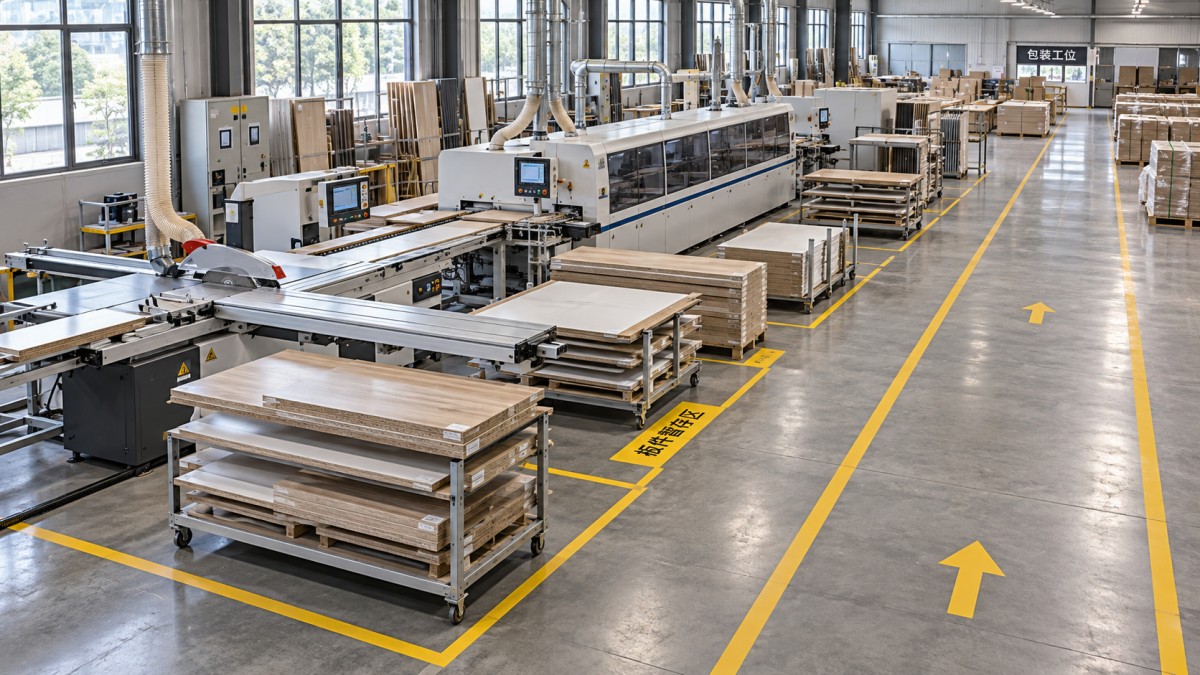
A useful visual comparison shows the existing routes beside the proposed routes, including receiving points, buffers, pedestrian access, and waste collection. This makes crossings and repeated transfers easier to see.
Choose the flow pattern around the work
There is no single best woodworking shop layout. Building access, product variety, material dimensions, and machine sharing all affect the choice.
A mixed arrangement is often practical. High-volume components can follow a defined route, while occasional custom work uses shared stations. Forcing every product through one line can create detours or interfere with repeat production.
Machine orientation matters as much as location. Positioning a saw near the next operation provides little benefit if its unloading side faces away from the transfer route. Check how operators load, discharge, turn, and stack the actual workpiece.
Plan the space around each machine
A machine footprint is only part of its space requirement. The layout must also accommodate the longest intended workpiece, operator movement, loading equipment, service access, extraction connections, and temporary material positions.
This is particularly important with sliding table saws, planers, moulders, and equipment handling long boards. An apparently empty area may be needed during feeding or outfeed. Using it for storage can make the machine difficult to operate even though the floor plan appears compact.
For panel processing, check the full movement of the sheet, lifting device, and transfer cart. Allow room to approach the loading position without repeated repositioning. Where materials move manually between stations, compatible working heights can reduce lifting and awkward transfers, provided guarding and access remain suitable.
Clearances should come from the equipment documentation and a review of the intended task. A generic aisle dimension cannot account for every workpiece, vehicle turning movement, or maintenance requirement.
Keep waiting material in defined locations
Removing all space between machines can make flow less reliable. Different operations rarely finish at exactly the same pace, and some need setup changes, inspections, or batch processing. A controlled buffer allows one operation to continue through a short interruption downstream.
The buffer needs a purpose, an identified location, and a capacity limit. If it regularly overflows, examine the production imbalance or release schedule. Enlarging the storage area may simply allow more unfinished work to accumulate.
For cabinet work, carts that keep components grouped by order can reduce sorting at assembly. With solid timber, storage may need to preserve identification, provide suitable support, and accommodate material condition. In both cases, the next operator should be able to retrieve the required parts without dismantling several stacks.
Check whether handling is caused by capacity or scheduling
Layout consultation cannot solve every material movement problem. If cutting releases parts faster than edge banding or assembly can process them, work in progress will build up even along a short, direct route.
The resulting handling often looks like a space problem: operators move stacks out of the way, relocate them again, and search for urgent components. The underlying cause may be oversized batches, uneven production release, or a constrained downstream operation.
Before approving major relocation, separate the possible remedies:
- Change the route when material crosses the workshop unnecessarily.
- Change the transfer method when repeated lifting or restacking causes delays.
- Change release quantities or timing when downstream areas receive more work than they can absorb.
- Review capacity when a required operation remains consistently overloaded.
These decisions also affect equipment selection. A faster cutting machine may increase congestion if downstream handling and processing remain unchanged. Its value depends partly on whether the rest of the workshop can accept its output.
Include waste, extraction, and finished goods in the plan
Offcuts and waste need planned collection points. If bins occupy transfer routes or require frequent movement through active production areas, the proposed handling improvement may disappear during normal work. Reusable remnants also need identification and accessible storage; an unmanaged offcut pile creates searching and repeated lifting.
Machine relocation can affect dust extraction ducting, electrical supplies, compressed air, and access to isolation points. These connections influence installation cost and practicality. Changes to extraction branches require technical review because duct arrangement and system capacity affect collection performance.
Sanding, finishing, assembly, and packing introduce further constraints. Dust-generating activities should not compromise sensitive finishing work. Finished surfaces need suitable supports and protection during transfer, while packing materials require space that does not obstruct dispatch.
Shortening a route is not useful if it increases surface damage, exposes people to vehicle movements, or removes access needed for servicing. The layout should evaluate these consequences alongside handling time.
What a useful consultation should deliver
A worthwhile woodworking workshop layout consultation should produce more than an attractive arrangement of machine symbols. It should explain which movements will change, what enables those changes, and which operating assumptions the plan depends on.
Provide a measured building plan showing columns, doors, fixed services, and access restrictions. Add equipment drawings, typical material sizes, product routes, production volumes, staffing arrangements, and known congestion points. Include anticipated product changes so the proposal reflects more than the current order book.
The resulting proposal should identify machine orientation, loading and unloading positions, transfer methods, buffer locations, service access, and utility changes. It should also distinguish improvements achievable with existing equipment from those requiring new handling devices or machinery.
Qingdao Zhongding Machinery Co., Ltd. manufactures and exports woodworking machinery and has more than 20 years of industry experience. When discussing equipment requirements with the company, sharing production routes and site constraints alongside capacity needs helps connect machine selection with the workshop’s material flow. Technical support and spare parts arrangements also matter when evaluating the longer-term practicality of an equipment change.
Validate the proposal before committing to relocation
Test the proposed arrangement against representative orders, including a large workpiece, a common repeat product, and a job that uses shared equipment. Trace how each enters, waits, moves through processing, and reaches dispatch. Check what happens when a downstream machine stops or a delivery arrives during production.
Where practical, mark proposed machine boundaries and staging areas on the floor. Move a typical cart or load through the route to expose tight turns and access conflicts that may be difficult to judge from a drawing.
Compare the proposal with the current arrangement using consistent measures: handling time per batch, transfer count, travel distance, work awaiting processing, and handling-related damage. Include relocation downtime, service modifications, and operator training when assessing the investment.
The next step is to document one troublesome production route and identify every avoidable pickup, set-down, and detour. That gives the consultation a concrete problem to solve—and gives the finished layout a result that can be checked once production resumes.
Send Your Inquiry
We welcome your cooperation and we will develop with you.