


News & Exhibitions
Latest Factory Updates, Industry Trends & Global Exhibition Information
How to plan a woodworking factory for future capacity expansion
A woodworking factory can run out of usable capacity before it runs out of floor space. Finished panels wait beside an overloaded edge bander, forklifts cross production routes, and a new machine has nowhere to connect without moving existing equipment. Expansion then becomes a disruptive rebuilding exercise rather than a controlled investment.
Plan for growth by designing the future material flow first, then installing equipment and infrastructure in stages. Effective woodworking factory process planning connects demand forecasts, measured process capacity, reserved expansion zones, and utility requirements. The aim is not to buy tomorrow’s entire factory today, but to make sure today’s decisions do not block the next practical increase in output.
Define the expansion you actually need to accommodate
“More production” is not a sufficient design brief. Increasing output of standard cabinet panels creates different requirements from introducing solid-wood components, painted doors, or highly customized furniture. Before drawing a layout, define the product families the facility must support and the likely route each family will follow.
For panel furniture, that route may include board storage, cutting or nesting, edge banding, drilling, assembly, inspection, and packing. Solid-wood production may require additional preparation, machining, sanding, and finishing stages. Map the actual operations rather than forcing every product through one assumed sequence.
Build a current-demand case and plausible growth cases using your own order history, sales pipeline, and product strategy. For each case, record:
- Required saleable output by product family and planning period.
- Material types, panel dimensions, component sizes, and handling constraints.
- Batch sizes, changeover frequency, and customization requirements.
- Available shifts, staffing assumptions, and delivery expectations.
- Processes performed internally and those dependent on outside suppliers.
Keep uncertain opportunities separate from committed demand. A speculative finishing department might justify preserving suitable building space, but not immediately purchasing equipment or installing a complete finishing system.
Find the constraint before specifying another machine
A machine’s advertised processing speed is not the same as dependable factory output. Loading, programming, tool changes, material defects, maintenance, and downstream congestion all affect what reaches packing. Expansion decisions should therefore use observed production performance wherever existing operations provide useful evidence.
Record output and losses at each major process over representative product mixes. Separate processing time from waiting time: a drilling machine that frequently stops because parts arrive late presents a different problem from one that remains loaded throughout the shift.
A useful starting calculation is:
Required process load = demand by product family × processing time per unit, plus expected setup and rework time.
Compare that load with realistic available productive time. Use consistent units and distinguish finished products from components; one cabinet may require several parts to pass through the same operation. Do not subtract downtime twice if the measured processing rate already includes those losses.
After identifying the current constraint, check where it will move when that constraint is relieved. A faster cutting operation has limited value if edge banding, extraction capacity, or packing space immediately becomes the next restriction.
Reserve a usable expansion zone, not leftover floor area
Prepare two layouts: the initial operating arrangement and the intended expanded arrangement. Overlay them to see which machines, aisles, services, and storage areas would need to move. Major relocations in the second drawing are a warning that the first layout may be too tightly optimized for current demand.
A useful expansion zone sits beside the operation it will extend and connects to a workable material route. An empty corner across a forklift aisle may be unsuitable for a second edge banding line, even if its floor area appears sufficient.
Show receiving, raw-material storage, processing, assembly, packing, and dispatch on the same drawing. Mark pedestrian routes, vehicle crossings, maintenance access, electrical cabinets, structural columns, and building exits. Include the operating envelope around each machine—not just its footprint—including loading, unloading, long-workpiece movement, and service access.
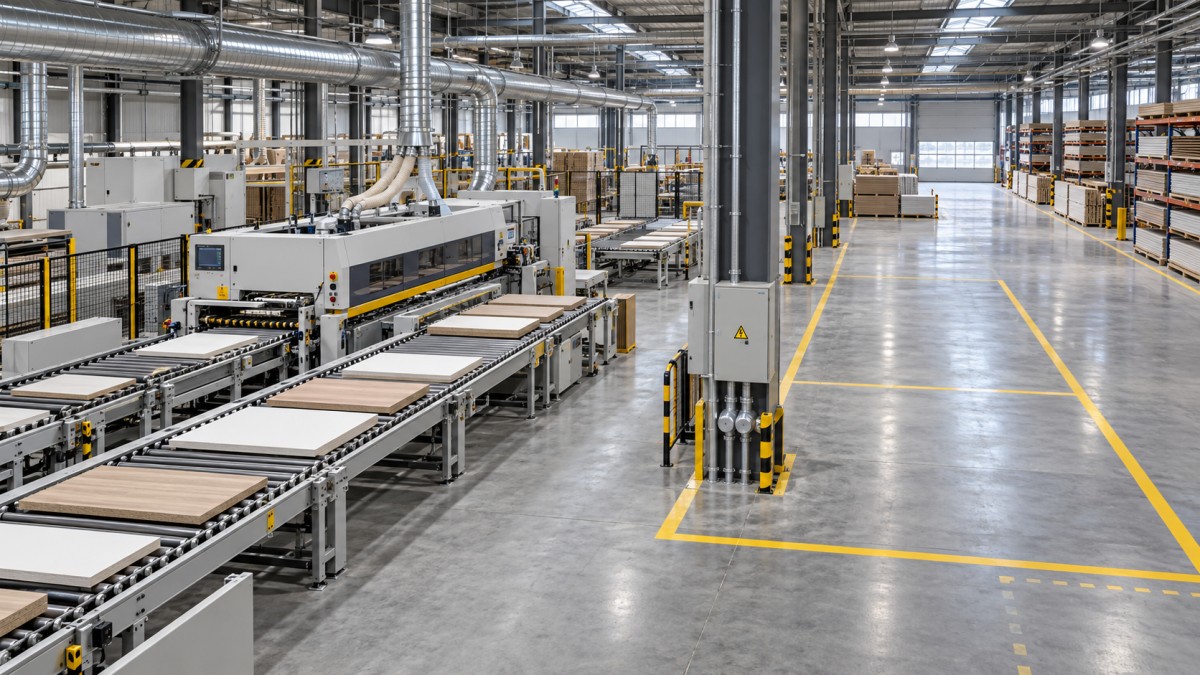
For a predominantly sequential panel process, an expandable production spine can allow additional equipment or parallel lanes to connect along the flow. A mixed-product factory may benefit more from cells with defined transfer points. Neither arrangement is automatically superior: compare travel distance, routing flexibility, supervision, and the ability to expand without interrupting unrelated work.
Protect reserved space through operating rules. Temporary storage has a habit of becoming permanent. Mark expansion areas on controlled layout drawings and identify what must be removed before the next phase begins.
Choose where capacity should be modular
Buying the largest available machine can create an expensive imbalance. A higher-capacity machine may require different handling, stronger utilities, or larger batches to work effectively. Parallel machines can offer scheduling flexibility and maintenance resilience, but they also require space, staffing, and coordinated work allocation.
Compare three routes at the constrained process: improving the existing operation, extending operating hours, and adding equipment. Additional shifts may postpone capital spending, provided staffing, maintenance coverage, and material supply can support them. They do not solve inadequate storage, unsafe traffic patterns, or utilities already operating at their limits.
When equipment is likely to be added in stages, define interfaces early. Relevant details include workpiece dimensions, feed direction, transfer height, labeling, program formats, and loading methods. Machines do not become a coherent production system simply because their nominal capacities match.
Automation should follow a sufficiently stable process. Where product routing or part identification remains inconsistent, preserve the option for future conveyors or robotic handling without fixing the current factory around an unproven automation concept.
Install the difficult-to-change infrastructure first
Some provisions are economical during construction and disruptive later. Underground services, transformer space, structural openings, and main distribution routes deserve early attention. This does not mean oversizing every installed system; distinguish between reserving space, preparing connection points, and purchasing active capacity.
Electrical supply and compressed air
Build an equipment load schedule for each expansion phase. Have qualified designers assess connected loads, expected simultaneous use, starting characteristics, protection, and available supply. Reserve suitable routes and distribution-board space where justified. A spare breaker position alone does not establish that the building can support another production line.
For compressed air, assess demand at operating pressure, air quality, distribution losses, and peak simultaneous use. Leave accessible expansion points and isolation arrangements so future work does not unnecessarily shut down the whole factory.
Dust extraction, finishing, and fire risk
Extraction must be evaluated as a complete system. Adding branches can change airflow throughout the network, and oversized ductwork operated at low flow can create transport problems. Plan the future duct route and collector location, then have a competent specialist verify each installed phase for the machinery, dust characteristics, and applicable safety requirements.
Finishing areas may introduce separate ventilation, material-storage, fire-protection, and environmental constraints. Their location cannot be chosen solely to shorten travel. Confirm the relevant local requirements before committing surrounding space or locating future expansion beside them.
Also verify slab suitability, equipment anchoring, access for machine delivery, and roof or wall penetrations. These checks are particularly important when converting a warehouse that was not designed for the intended manufacturing process.
Size storage and handling around the expanded flow
More machining capacity usually changes inventory movement as well as output. Incoming boards, work in progress, hardware kits, packaging, and finished goods all need explicit locations. Without them, the apparent capacity gain can become congestion between machines.
Estimate intermediate storage from throughput and expected waiting time. Longer queues require more space, but generous buffers can also hide scheduling problems. Set defined buffer limits at important transfer points and decide how production will respond when those limits are reached.
Material handling deserves its own capacity review. Check whether forklifts, carts, lifting devices, and operators can supply the expanded process without unsafe crossings or repeated double handling. Board unloading and finished-goods dispatch should remain workable during busy periods, not only under average conditions.
Preserve traceability as routes multiply. Consistent part identification and production status help prevent an additional machine from creating misplaced components, incomplete assembly kits, or uncertainty about which operation comes next.
Release investment in phases with measurable triggers
A phased master plan should state what gets installed, what remains reserved, and what evidence authorizes the next investment. Avoid triggers based only on one unusually busy month or high utilization at an isolated machine.
- Stabilize the existing flow. Address unreliable supply, avoidable setup losses, maintenance problems, and unclear work instructions before treating them as permanent capacity shortages.
- Prepare expansion interfaces. Complete justified enabling work, protect floor space, and confirm equipment access and utility provisions.
- Add capacity at the verified constraint. Proceed when sustained demand and measured process loading support the investment, with downstream capacity checked.
- Validate the expanded system. Review throughput, work-in-progress levels, quality, delivery performance, and safety under the intended product mix.
The financial comparison should include installation, extraction changes, tooling, handling equipment, software integration, training, commissioning losses, and working capital—not just machine purchase prices. Compare options using the same demand assumptions and include the consequences of a slower-than-expected ramp-up.
Make the changeover plan part of the approval
Expansion is not ready for approval until there is a credible installation sequence. Identify which services can be prepared while production continues, which connections require shutdowns, and how materials will move around the installation area. Schedule equipment access before surrounding storage or machinery makes delivery difficult.
Assign responsibility for operator training, maintenance preparation, spare-parts readiness, and production-data setup. Agree on acceptance criteria using representative materials and products rather than an unloaded machine demonstration. The expanded operation should prove that it can deliver acceptable parts through the full route, including handling and downstream work.
Keep the phased layout, utility schedule, capacity model, and investment triggers under revision control. Before approving any interim machine move or storage change, check it against the next expansion phase. That simple discipline prevents a convenient short-term adjustment from consuming the access, service capacity, or production space the factory will need later.
Send Your Inquiry
We welcome your cooperation and we will develop with you.