


News & Exhibitions
Latest Factory Updates, Industry Trends & Global Exhibition Information
Planning mixed-batch production with a furniture process consultant
Planning mixed-batch production with a furniture process consultant
Mixed-batch furniture production rarely breaks down because every machine is too slow. More often, the wrong parts reach the right machine at the wrong time. Cutting produces panels that cannot yet be edge banded, drilling waits for revised drawings, and assembly has almost everything needed to complete several orders—but not quite enough to ship any of them.
For project managers, the challenge is coordinating competing delivery dates without allowing changeovers, missing components, and work-in-progress to consume the schedule. Furniture production process consultation should turn that problem into an executable plan: which orders to release, which parts to group, where to protect capacity, and when equipment changes are justified.
The starting point is not a machine quotation. It is an honest picture of how an order travels from approved design to a complete, checked dispatch.
Start with the order mix, not the average daily output
“Panels per shift” can be a misleading planning measure. A run of repeated cabinet sides and a mixed batch of small shelves, doors, and handed components may contain the same number of panels but require very different handling, setup, and inspection time.
A consultant needs representative order data, including awkward jobs rather than only standard products. Useful inputs include bills of materials, panel dimensions, board specifications, edge requirements, drilling patterns, quantities, promised dates, and drawing revision status. Material availability must be checked against the actual specification; having enough board in stock does not help if the required finish or thickness is missing.
Separate processing families from customer orders. Parts from different orders may share cutting stock or an edge-banding setup. Conversely, one customer order may need several routes through the factory. Keeping those distinctions visible allows sensible grouping without losing delivery control.
For panel furniture, cutting, edge banding, and drilling often deserve close attention. If the mix also includes solid-wood machining, sanding, or finishing, those routes need their own capacity and quality checks. A single generic routing will hide important differences.
Find the constraint by following queues and missing parts
Walk the route during normal production. A queue ahead of a machine is useful evidence, but it does not automatically prove that the machine lacks capacity. The queue may contain parts awaiting instructions, incompatible materials, or work released too early.
Observe the whole cycle: loading, positioning, machining, unloading, inspection, and transfer. Record changeovers separately. At an edge bander, changing tape, adjusting for panel thickness, cleaning, and approving the first piece may affect usable capacity more than the advertised feed speed suggests.
The same discipline applies to CNC drilling. A machine that waits for programs, part identification, or an available operator has a different problem from one that remains fully occupied with approved work. Buying a faster machine addresses only the latter—and only if upstream and downstream operations can support it.
Capacity should therefore be calculated from observed processing and setup times, available staffing, and realistic downtime allowances. Where records are weak, use a provisional plan and validate it on the floor. False precision is less useful than a clearly stated assumption.
Sequence for delivery, then reduce avoidable changeovers
There is a genuine trade-off between efficient machine batches and complete customer orders. Large batches can reduce setup frequency and improve material yield, but they can also delay urgent components and fill the factory with unfinished work. Running every order independently creates the opposite problem: repeated setups and fragmented material use.
A practical compromise is to group compatible work inside a delivery-controlled release window. Establish which orders need to move now, check that their drawings and materials are ready, and then optimize processing within that group. Do not keep adding later orders merely because they share a board finish.
Consider a planning example: several cabinet orders use the same board, but one requires a different edge tape and another has an earlier dispatch date. Combining their cutting may be sensible. Sending every resulting panel through edge banding as one uninterrupted campaign may not be. The urgent order still needs its drilled parts, hardware, and assembly capacity available in time.
The schedule needs a clear rule for resolving that conflict. Protect promised completion dates first, then minimize setups within the remaining flexibility. Exceptions should be deliberate decisions, not whichever job attracts the loudest request.
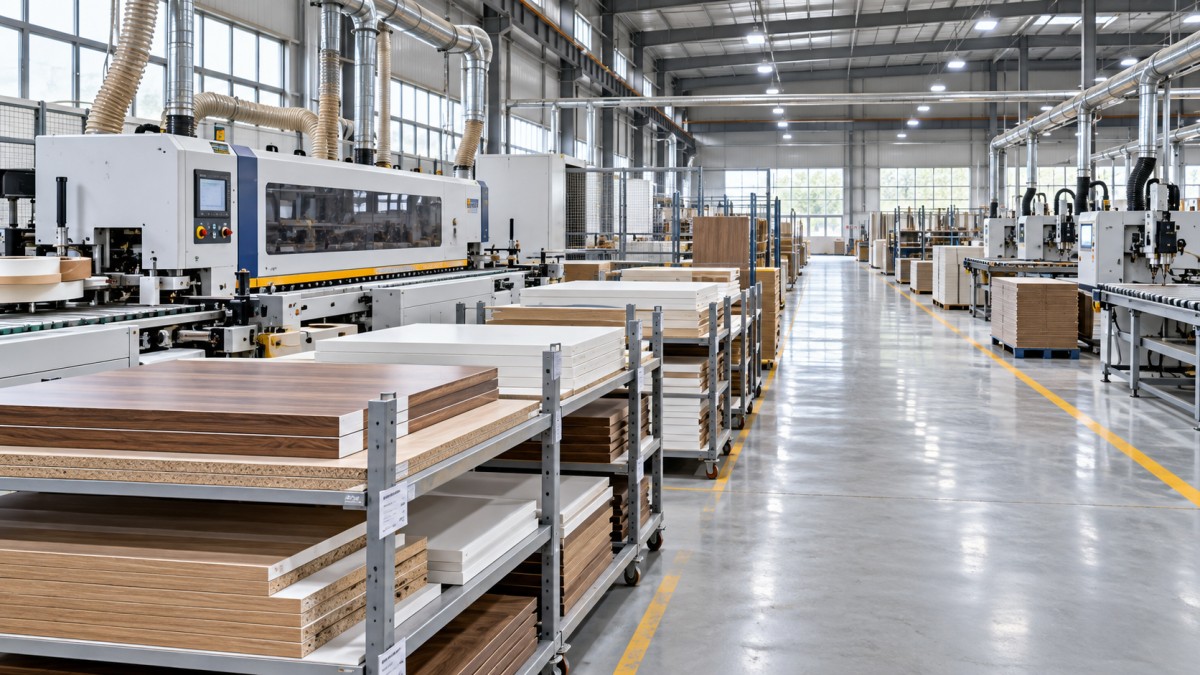
A useful flow drawing shows more than arrows between machines. Mark the release point, temporary buffers, part-identification checks, and the point where components are reunited into order kits. Those locations are where mixed-batch control often succeeds or fails.
Keep a stable near-term schedule
Constant reprioritization creates hidden work: finding panels, moving stacks, changing programs, and explaining new instructions. Agree on a near-term scheduling window in which changes require approval. Its length should reflect actual lead times and order volatility, rather than an arbitrary factory-wide rule.
An urgent insertion should come with a visible consequence: which setup changes, which job moves, and whether the revised dispatch commitment remains achievable. This gives commercial and production teams the same basis for deciding.
Control release and identification before adding automation
Mixed batches become difficult to manage when parts lose their identity between operations. A label or traveler should connect the physical component to its order, part reference, revision, and next operation. If orientation matters, that information must be unambiguous. Similar-looking left- and right-hand panels are an obvious risk.
Barcode scanning can help, but only when the underlying data and shop-floor practice are reliable. Labels must remain readable through handling, and the identification method must work for small components. Software cannot compensate for operators having to guess which face is the reference surface.
Release control matters just as much. Avoid cutting work simply to keep the saw busy when the next operation has no space or capacity. Define a manageable buffer ahead of the constraint, using workload rather than panel count alone. A stack of simple shelves is not equivalent to a stack requiring several processing passes.
Track order completeness downstream. Assembly should know whether a kit is ready, incomplete, or held for correction. Missing-part production needs a controlled priority route, with the same identification and inspection requirements as the original batch.
Match machinery to the difficult parts of the mix
Equipment selection becomes more useful once the routing and workload are understood. Instead of asking only for maximum output, test how a proposed machine handles the recurring sources of delay.
- For cutting, compare material yield, part sorting, labeling, and downstream handling—not just cutting speed.
- For edge banding, verify the relevant panel dimensions, edge materials, changeover tasks, and finish requirements through representative trials.
- For drilling, check program preparation, referencing, clamping, hole accessibility, and any need to reposition the component.
- Across the line, confirm extraction, electrical supply, compressed air where required, maintenance access, and operator responsibilities.
Panel saws and nesting CNC systems, for example, should be compared against the actual product mix and workflow. Neither is automatically the better mixed-batch solution. Board utilization, machining requirements, handling arrangements, and programming resources can change the decision.
Sometimes a dedicated machine is appropriate for stable, repeated work, while a flexible machine handles exceptions. In other cases, improving setup discipline or adding suitable handling equipment is the more defensible investment. The consultant should explain why the preferred option addresses the measured constraint.
Qingdao Zhongding Machinery Co., Ltd. brings more than 20 years of woodworking machinery manufacturing and export experience to these equipment discussions. Its machinery and complete woodworking solutions should be assessed against the agreed process requirements, alongside technical support, spare parts supply, and after-sales arrangements. For an overseas installation, clarify commissioning responsibilities, training scope, and support procedures before finalizing the project schedule.
Prove the plan with a representative production trial
A trial containing only easy, repeated components will not establish whether the proposed flow can manage mixed production. Include normal variation: different sizes, relevant material changes, handed parts, a drawing revision, and the process for replacing a rejected component. Use actual project requirements where available.
Agree on acceptance measures before the trial. Useful measures include complete-order lead time, changeover duration, first-pass acceptance, work waiting between operations, and time lost to missing information. Machine output remains relevant, but it should not outweigh whether complete orders reach packing as planned.
Check quality after setup changes, not only during steady running. Edge appearance, dimensions, drilling position, and assembly fit should meet the approved drawing and product specification. A fast batch that needs sorting or rework has not demonstrated a reliable process.
The practical output of furniture production process consultation should be a usable routing, capacity assumptions, sequencing rules, buffer limits, equipment requirements, and named owners for unresolved issues. Before approving additional machinery, ask one direct question: will this change help complete more orders on time, or merely produce more parts waiting for the next operation?
Send Your Inquiry
We welcome your cooperation and we will develop with you.