


News & Exhibitions
Latest Factory Updates, Industry Trends & Global Exhibition Information
Can an ATC CNC router for door production machine lock mortises?
Yes—an ATC CNC router for door production can machine lock mortises when its spindle arrangement, tooling, and workholding provide access to the door edge. Automatic tool changing alone does not establish that capability. A machine may cut door panels, decorative profiles, and handle holes efficiently while still lacking the configuration needed for a deep lock pocket.
The practical question is whether the proposed machine can produce the complete lock preparation on your door design: the lock-body pocket, faceplate recess, handle or spindle holes, and any cylinder openings. These features require different cutting directions, and their alignment determines whether the hardware fits and operates correctly.
Start with the lock drawing and the direction of each cut
A mortise lock usually requires a pocket extending inward from the narrow edge of the door. A shallow recess around its entrance allows the faceplate to sit flush. Openings through the door face accommodate the handle spindle, cylinder, or other hardware specified by the lock manufacturer.
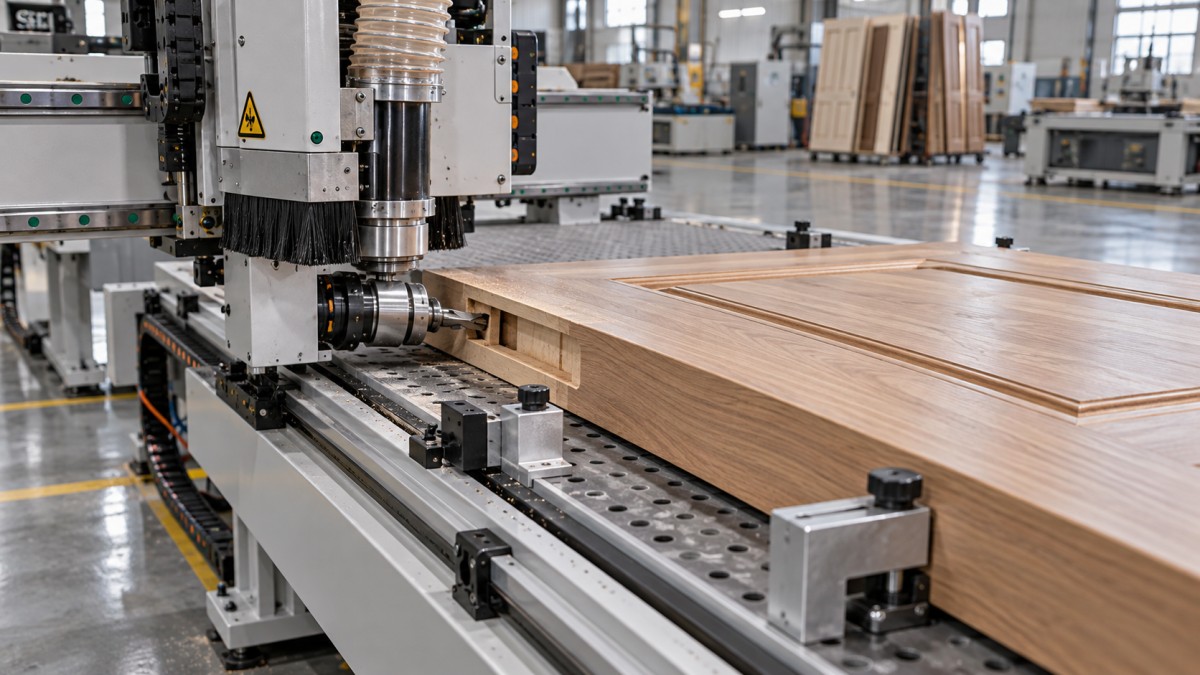
These operations should be assessed separately. When a door lies flat on a router table, a conventional vertical spindle approaches its broad face. That arrangement suits face machining, but an edge pocket requires a tool approaching horizontally. Changing cutters does not change the spindle’s direction.
The lock drawing also distinguishes dimensions that are easily confused. Backset locates the handle or cylinder axis relative to the door edge; it does not directly specify the required pocket depth. Pocket length, width, depth, faceplate dimensions, and hole positions must each come from the hardware preparation drawing.
Before comparing machines, assemble the lock drawings alongside the door construction details. Include the finished door thickness, edge profile, handing, and the material surrounding the lock pocket. A machine configuration should be evaluated against that complete preparation.
Which router configurations can reach the door edge?
Several arrangements can perform CNC lock mortising, but they impose different requirements on the machine and production process.
A horizontal unit is often a direct solution for repeated edge work. However, “horizontal drilling” in a specification does not automatically mean the unit can mill a deep lock pocket. Its bearings, drive, toolholding, and permitted cutting movements must support the intended operation.
A right-angle aggregate can expand a suitable router’s capability, but it is not a universal accessory. The machine needs the correct mounting and torque-reaction arrangement, plus suitable programming support. If the aggregate will enter the automatic tool magazine, its dimensions, weight, and orientation must also suit the changer. Some arrangements require manual fitting.
A multi-axis machine offers more approach options, yet its axis count alone proves little. The spindle housing, toolholder, table, and clamps still need enough space around the edge. Evaluate the usable envelope with the intended cutter and fixture installed.
Standing the door on edge can allow a vertical spindle to reach the lock area. This may work for occasional jobs with an engineered fixture and adequate clearance. For large or heavy doors, the additional handling and support requirements can make this approach less attractive for routine production.
Deep pockets expose the limits of tooling and reach
A shallow faceplate recess is generally less demanding than a deep, narrow lock-body pocket. As the cutter extends farther from its holder, it becomes more susceptible to deflection and vibration. Possible results include tapered walls, rough surfaces, dimensional variation, or tool failure.
Tool length, cutting length, and usable reach are different measurements. A cutter may be long enough overall while having insufficient flute length for the planned cut. Conversely, a suitable cutter may still be unusable because the aggregate housing or toolholder contacts the door before it reaches full depth.
Assess the complete tool assembly against the pocket geometry. This includes cutter diameter, flute length, projection from the holder, holder size, and clearance at the pocket entrance. A small cutter can produce tighter internal radii, but it may require a more conservative cutting strategy than a larger, stiffer tool.
The pocket’s corners also deserve attention. Rotary milling naturally leaves radiused internal corners. The resulting shape must provide clearance for the lock body while preserving sufficient material around the pocket. If the hardware drawing requires a shape the cutter cannot produce, an approved machining allowance or a secondary operation is needed.
Deep cutting also makes chip removal more difficult. Packed chips can be recut, increasing heat and affecting surface quality. Toolpaths should provide an effective way to clear the pocket, supported by suitable extraction and any approved air assistance. Feed, speed, and cutting depth should follow the cutter guidance and the behavior of the actual door material.
The fixture must resist edge-cutting forces
A door that stays secure during face routing may move during horizontal mortising. Edge cutting introduces lateral forces, and a long door can vibrate if the lock area has insufficient support. Small movement can spoil the relationship between the pocket and the face holes even when each feature appears acceptable on its own.
Vacuum holding can be effective on suitable surfaces, but its performance depends on the available sealing area, surface condition, leakage, and machining forces. Grooves, porous materials, and irregular door faces can reduce holding reliability. Some applications benefit from mechanical stops or clamps that resist lateral movement.
Those supports must leave room for the cutting assembly. A clamp may clear the cutter tip while obstructing the aggregate body or spindle housing. Check the entire approach, cutting path, and withdrawal movement, including any travel between features.
Consistent referencing matters as much as clamping strength. Door faces may be profiled or slightly uneven, and opposite edges may differ after finishing. Establish which surfaces locate the door and how the program accounts for thickness, handing, and edge shape. Repeated setups should reproduce the relationship between the lock pocket and the face openings.
Door construction changes what counts as a successful cut
A clean pocket does not necessarily mean the door is suitable for the lock. Hollow-core doors need an appropriately positioned lock block or other reinforcement. If the machining extends beyond that material, the hardware may lack adequate support even though the router follows its program accurately.
Solid timber presents different concerns. Grain direction and local defects can affect cutting behavior, particularly around the thin material remaining beside a deep mortise. Engineered cores, laminated stiles, and veneered surfaces may require different tooling or cutting sequences to control breakout and surface damage.
For finished doors, entry and exit quality become especially important. A good process must protect the visible edge and face as well as produce the internal cavity. Where through-holes are required, machining from both faces or using suitable backing can help control breakout, provided the setup maintains alignment.
Fire-rated or other performance-rated door assemblies introduce an additional constraint: hardware preparation must stay within the permitted details for that assembly. The router’s ability to remove material does not determine whether a particular modification is acceptable.
Plan the pocket and face holes as one operation sequence
The lock body, faceplate, spindle, and cylinder must align after machining. If the door is repositioned between operations, each setup introduces another opportunity for error. A process that maintains a common reference can simplify alignment, provided the machine can access all required features.
A typical sequence may involve a larger cutter for bulk pocket removal, another tool for finishing or faceplate work, and suitable tools for face openings. The exact order depends on access, surface protection, workholding, and material support. Removing material too early can weaken an area needed for a later cut or reduce the effectiveness of the fixture.
This is where automatic tool changing adds practical value. It allows different cutters to perform their respective tasks without repeated manual changes. The benefit depends on having the necessary tools, offsets, programs, and access available within the proposed setup.
Programming deserves the same attention as the hardware. CAM software and the machine’s postprocessor must support the actual horizontal unit or aggregate arrangement, including tool orientation and safe movements. A drawing that looks correct on screen is insufficient if the generated program handles the attachment incorrectly.
Evaluate a complete door preparation during the trial
A representative machining trial should use the proposed machine configuration, tooling, fixture, door construction, and lock preparation. A shallow demonstration pocket in an easy-to-machine sample does not establish suitability for your deepest mortise or most demanding finished surface.
Build the acceptance check around the assembled hardware:
- Pocket geometry: Check depth, width, wall consistency, and clearance throughout the lock-body envelope.
- Faceplate seating: Confirm that the plate sits correctly without forcing it into position or hiding uneven support.
- Feature alignment: Fit the lock, spindle, and cylinder to check that the openings align without corrective filing.
- Surface condition: Inspect the visible edge, pocket entrance, and hole exits for breakout or finish damage.
- Repeatability: Reload doors and repeat the preparation to reveal locating or clamping variation.
- Production time: Include loading, referencing, tool changes, repositioning, unloading, and any manual cleanup.
Trial the relevant variations too: different door thicknesses, opposite handing, alternative lock patterns, and the deepest required pocket. These changes can reveal clearance or programming limitations that a single demonstration leaves hidden.
Choose the process around your production mix
An ATC router with suitable edge-machining capability can make sense when doors also need varied face machining, decorative work, and multiple hardware patterns. Its flexibility is useful when programs change frequently and the machine can complete related features with consistent references.
A dedicated lock-mortising machine may be a better fit when edge preparation is repetitive and occupies too much time on a router needed elsewhere. Separating the operations adds handling, but it can improve overall workflow when each station has a clear role. Compare the complete production sequence, including staffing and work queues.
When discussing an ATC CNC router for door production with Qingdao Zhongding Machinery Co., Ltd. or another supplier, provide the lock drawings, door sections, material details, and expected production mix. Request a proposal identifying the machining unit, tooling, fixture, programming method, and operations requiring repositioning.
The purchasing decision should rest on a demonstrated, repeatable lock preparation. Confirm that the proposed machine reaches every required feature, holds the door securely, and produces a preparation in which the specified hardware fits and operates correctly.
Send Your Inquiry
We welcome your cooperation and we will develop with you.